
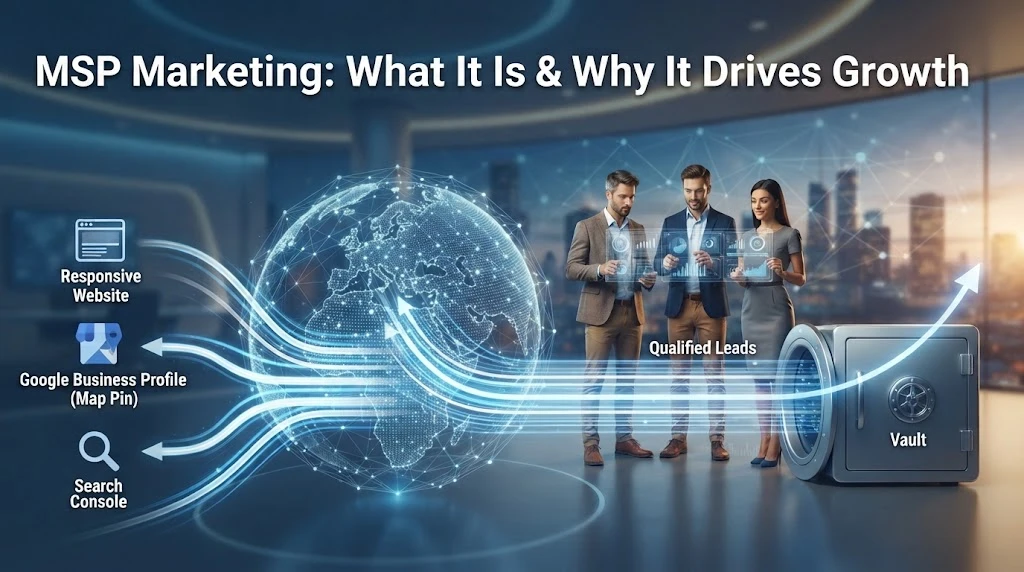
MSP marketing is the set of activities a managed service provider uses to get found by new clients, build trust with them, and turn that trust into signed contracts. It is not the same as sales, marketing brings the right people to your door, and sales closes them.
Most MSP owners are great at fixing networks and terrible at getting found. That gap is why some MSPs grow every year while others stay stuck on referrals alone. This guide breaks down what MSP marketing actually means, which channels work, and how to get started without wasting your budget.
What Is MSP Marketing?
MSP marketing is the process of building awareness, establishing trust, and generating qualified leads for a managed IT services business. It covers everything from your website and local search rankings to email campaigns, content, and paid ads, anything that helps a business owner find you before their next IT problem becomes an emergency.
The goal isn’t just traffic. It’s getting in front of the right people, decision-makers who already know what services an MSP provides and are close to needing one, before your competitor does.
That last point matters more than it sounds. Two MSPs can offer nearly identical services, the same backup tools, the same helpdesk hours, the same security stack, and still get completely different results. The one that shows up first in a search, answers a question clearly on their website, or stays visible on LinkedIn is the one that gets the call. Technical quality gets you a good reputation once someone becomes a client. Marketing is what gets you the chance to become their provider in the first place.
MSP Marketing vs. MSP Sales, What’s the Difference?
These two get lumped together constantly, but they do different jobs:
| MSP Marketing | MSP Sales | |
| Job | Build awareness and generate leads | Convert leads into signed clients |
| When it happens | Before a prospect talks to you | After a prospect reaches out |
| Main tools | Website, SEO, content, ads, email | Calls, proposals, demos, contracts |
| Success metric | Qualified leads generated | Deals closed |
If you understand the difference between managed IT services and an MSP itself, this distinction will make more sense: marketing explains what you do and why it matters, sales handles the close. Skip marketing, and your sales team spends its time chasing cold prospects instead of talking to people who already want what you offer.
Why It Matters for Client Growth in 2026
Referrals used to be enough. They aren’t anymore.
Word-of-mouth has a ceiling. Once your existing client base stops sending new business, growth stalls, and most MSP owners don’t notice the plateau until revenue has already flattened for a quarter or two. MSP marketing exists to build a second, predictable pipeline that doesn’t depend on someone else mentioning your name.
A few reasons this matters right now:
- Buyers research before they call. Most business owners already compare three or four providers online before reaching out to any of them.
- Switchers outnumber first-timers. Most new MSP clients aren’t buying managed services for the first time, they’re leaving a provider that let them down. Your marketing has to show you’re the safer choice, not just explain what managed IT is.
- AI search changes discovery. More buyers now find providers through AI-generated answers, not just a list of blue links, which is why structured data and AI-overview readiness matter more than they did two years ago.
A well-run marketing engine turns this uncertainty into something predictable, a steady flow of qualified leads instead of a feast-or-famine referral cycle. That’s the entire point of a working MSP growth and optimization strategy: consistency over luck.
There’s also a cost side to this. Every month you delay building a real pipeline is a month your competitor spends building theirs. MSPs that start early compound their rankings, their content library, and their reputation, and by the time a competitor decides to catch up, that gap is expensive to close. Waiting for referrals to slow down before you invest in marketing means you’re already behind when you finally start.
Core Marketing Channels for MSPs
You don’t need every MSP marketing channel at once. You need the right two or three, done well. Here’s what each one actually does.
Website & Local SEO
Your website is your storefront. If it loads slowly, doesn’t rank locally, or isn’t mobile-friendly, you lose leads before they ever contact you. Local SEO, ranking for service businesses in your area, is usually the highest-ROI channel for an MSP because your buyers are searching by location (“IT support near me,” “MSP in [city]”).
Three things to check first:
- Is your site fast and mobile-friendly? Run through a mobile SEO checklist built for MSP websites if you’re not sure.
- Is your Google Business Profile filed under the right categories? Wrong category selection quietly kills local rankings.
- If your site isn’t showing up at all, start with the basics: why your website isn’t appearing on Google usually comes down to indexing or technical errors, not content quality.
Content Marketing
Blog posts, guides, and case studies that answer real questions your buyers are searching for, ransomware recovery time, compliance requirements, backup costs. Content builds trust before a sales call ever happens, and it compounds: a good article keeps generating leads two years after you publish it.
The mistake most MSPs make here is writing about their own services instead of their prospect’s problems. “What We Offer” pages rarely rank or convert. “Why Is My Server Slow Every Monday Morning” does both, because it matches what a frustrated office manager is actually typing into Google at 9 a.m.
Email Marketing
Not every lead is ready to buy today. Email keeps you in front of prospects who downloaded a guide or requested a quote but went quiet. A simple monthly security tip or update email costs almost nothing and keeps your name top-of-mind for the moment their current provider fails them.
Keep the cadence realistic, one solid email a month beats a weekly newsletter nobody opens. Focus each send on one useful idea (a patch reminder, a compliance deadline, a quick security tip) instead of trying to cram in every service you offer.
LinkedIn & Social Media
LinkedIn works better than most other platforms for MSPs because your buyers, IT directors, operations managers, small business owners, are already there for work. Consistent posting plus direct outreach to your ideal customer profile beats a generic company page nobody checks.
Personal profiles usually outperform company pages here. A post from your own account, showing real opinions about IT trends or a lesson from a recent client project, gets more reach and more trust than the same content posted from your business logo.
Paid Ads (Google Ads / PPC)
Paid search puts you in front of buyers who are actively searching right now. It’s the fastest channel to produce leads, but also the most expensive per lead, best used to fill gaps while your SEO and content build up organic traffic over time.
Set a hard budget before you launch anything, and track cost per lead from day one. Without that number, it’s impossible to know if a campaign is working or quietly draining your budget on clicks that never convert.
Referrals & Word of Mouth
Still valuable, still worth encouraging with a formal referral program, just not something you can build a growth plan around alone.
None of these channels work in isolation. A blog post drives SEO rankings, that post gets shared over email and LinkedIn, and a well-optimized website turns that traffic into an actual lead form submission. Treat them as one connected system rather than five separate projects competing for the same hour of your week.
Choosing the Right Approach by Business Size
The right mix of channels depends heavily on how big your team is and how much time you can actually spend on this.
Solo and Small MSPs
If you’re a one- or two-person shop, don’t try to run five channels at once. Pick one, usually local SEO or a simple referral system, and get it right before adding a second. Small MSPs that try to launch a website redesign, email campaign, and content calendar simultaneously usually finish none of them. A look at what typically works for MSP services aimed at small businesses in 2026 shows the pattern clearly: focus wins over breadth at this stage.
Growing and Mid-Size MSPs
Once you have a few employees and steadier cash flow, you can run two or three channels together, typically SEO, content, and email, because each one reinforces the others. A blog post supports SEO rankings; that post gets promoted through email and LinkedIn; the traffic from all three feeds your lead list.
This is also the stage where a dedicated owner matters. Whether that’s an internal hire, a partner, or an agency, someone needs to be accountable for the calendar, the numbers, and the follow-through, otherwise “we’ll get to marketing next quarter” becomes a permanent excuse, and the compounding advantage of starting early quietly disappears.
In-House Team vs. Marketing Agency, Which Fits You?
There’s no universal right answer here, but a simple test helps:
- Go in-house if you can hire (or already have) someone with real marketing skill and enough budget to keep them full-time.
- Hire an agency if you want expertise without the overhead of building a team from scratch. Look for one that understands MSP-specific buyers, not just generic “digital marketing.” Reviewing a semantic SEO consultant selection guide is a useful exercise even outside SEO, the same vetting questions (results shown, process explained, industry experience) apply to any marketing hire.
- Go hybrid if you want to keep strategy and relationships in-house but outsource execution, content writing, technical SEO, ad management, to specialists.
How Long Until You See Results?
This is the question every MSP owner asks, and the honest answer depends on the channel.
Short-term (1–90 days): Paid ads and outbound outreach move fastest. You’ll see leads within weeks because you’re placing yourself directly in front of people already searching.
Medium-term (3–6 months): Local SEO improvements, consistent social posting, and email nurture campaigns start producing steady leads in this window. This is also when prospects who saw your content months earlier start reaching out, often after their current provider drops the ball.
Long-term (6–12+ months): Organic content, domain authority, and thought leadership take the longest to build, but once established, they produce the lowest cost per lead of any channel. This is the compounding part of MSP marketing that pays off for years, not months.
Don’t judge a content or SEO investment at the 60-day mark. That’s simply too early for organic channels to have kicked in. If a provider or in-house hire tells you SEO will show real results inside a month, treat that as a red flag, not a promise.
Tools That Support Your Growth
You don’t need a massive stack. A lean setup covers most of what a growing MSP needs:
- CRM – tracks every lead and follow-up so nothing falls through the cracks
- Call tracking – shows which channel actually produced the phone call, not just the click
- Content and design tools – for blog graphics, social posts, and simple video
- Email automation – sends nurture sequences without manual follow-up
If you’d rather have this built and managed for you, a full breakdown of what MSP marketing services typically include is worth reading before you buy any tool or sign any contract.
One warning before you buy anything: tools don’t fix a broken strategy. A CRM with no clear lead-follow-up process just becomes an expensive contact list. Get the process right first, who follows up, how fast, and with what message, then use tools to make that process faster, not to replace it.
Getting Started: Your Action Plan
Skip the overwhelm. Here’s the order that actually works:
- Audit what you have. Check your website speed, mobile experience, and Google Business Profile before spending on anything new.
- Pick one primary channel. Local SEO is usually the best starting point for most MSPs because buyers are already searching by location.
- Build a simple content routine. One useful blog post a month beats five rushed ones nobody reads.
- Add email nurturing. Capture leads who aren’t ready yet and stay in front of them.
- Track everything. If you can’t tell which channel produced a lead, you can’t tell what to do more of.
- Review quarterly, not weekly. Marketing channels, especially organic ones, need months to show their real performance. Checking numbers every few days leads to abandoning things that were about to work.
For a more detailed breakdown of this process, a dedicated MSP marketing plan walks through each step with more depth than a single section can cover here. And if you want to see which tactics are already working for other providers, this roundup of MSP marketing strategies that work is a solid next read.
None of this requires guesswork. It requires picking one channel, doing it properly, and giving it enough time to compound, which is exactly what separates MSPs that grow from MSPs that stay stuck on referrals. If you’d rather have a team handle this end-to-end, Miracle Concepts works specifically with MSPs on this exact process, from technical SEO improvements to AI-search readiness, and you can review what’s included in top-rated MSP marketing services before deciding what fits your budget.
FAQs
What is MSP marketing in simple words?
It’s how a managed service provider gets found by potential clients and earns their trust before ever making a sales pitch, through a website, content, local search, ads, and email.
Is MSP marketing different from IT marketing in general?
Yes. General IT marketing can target consumers or large enterprises. MSP marketing is narrower, it speaks directly to small and mid-size business owners who need ongoing, outsourced IT support, not a one-time tech purchase.
How much should an MSP spend on marketing?
There’s no fixed number, but most growing MSPs reinvest a set percentage of revenue rather than a flat dollar amount, adjusting up once a channel proves it produces qualified leads.
Can a small MSP do marketing without an agency?
Yes, especially early on. A solo or small MSP can run a focused local SEO or referral effort without outside help, the key is picking one channel and doing it consistently rather than spreading thin.
What’s the fastest way to get MSP leads?
Paid search (Google Ads) produces leads the fastest because you’re reaching people already searching for IT support. It’s also the most expensive per lead, so it works best alongside, not instead of, organic channels.
How long until MSP marketing shows ROI?
Paid channels can show results in weeks. Organic channels like SEO and content usually need three to six months for steady traction, and even longer to reach their lowest cost-per-lead.
Do MSPs really need SEO, or is paid advertising enough?
Both play different roles. Paid ads produce fast, expensive leads. SEO produces slower, cheaper leads that keep coming long after you stop actively promoting a piece of content. Most MSPs that grow steadily use both together.
What’s the difference between MSP marketing and MSP sales?
Marketing builds awareness and brings qualified leads to your door. Sales takes it from there, the conversation, the proposal, and the signed contract.