
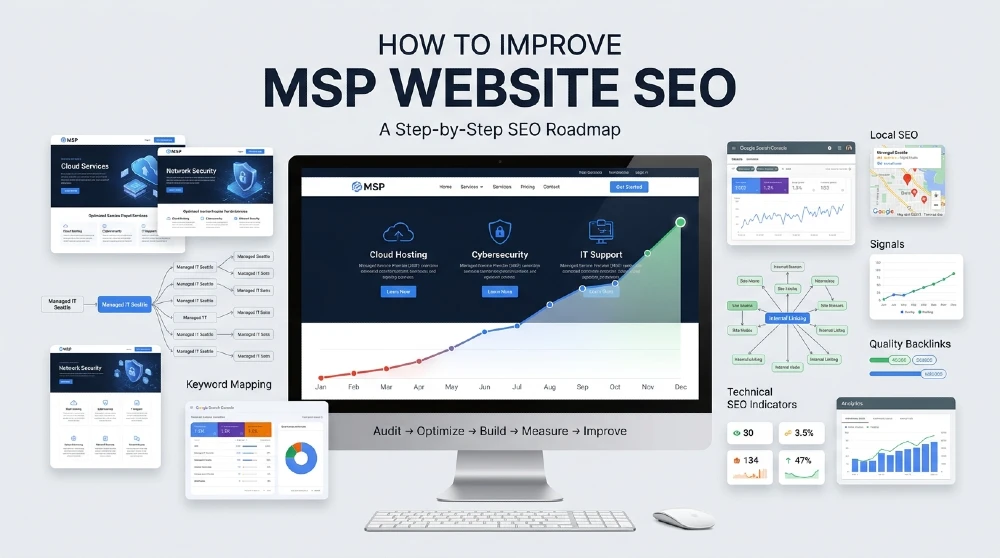
Learning how to improve MSP website SEO starts with knowing exactly where you stand today, not with publishing more content. Most managed service providers jump straight to writing blog posts before checking which pages are already close to ranking, which services have no real landing page, and which parts of the site are quietly losing traffic.
This guide walks through a complete, practical system: a baseline audit, service-to-search mapping, page architecture, content depth, local visibility, internal linking, and a 30-day plan to put it all into action. Each section gives you the direct fix first, then the reasoning behind it.
Start With a 15-Minute MSP SEO Baseline Check
Before changing anything, you need a clear snapshot of where the site currently stands. This baseline check takes about 15 minutes and tells you exactly what to prioritize.
Pull this data from Google Search Console and GA4 side by side, not separately, Search Console shows what Google is doing with your pages, and GA4 shows what visitors do once they arrive.
| What to Check | Where to Find It | Why It Matters |
| Current rankings | Search Console → Performance | Shows real position, not guesswork |
| Organic clicks/impressions | Search Console → Performance | Reveals visibility vs. actual traffic |
| Top landing pages | GA4 → Landing Page report | Shows which pages carry the site |
| Pages losing traffic | GA4 → date comparison | Flags problems before they compound |
| Pages with impressions but no clicks | Search Console → Queries | Points to weak titles or wrong intent match |
Once you have this baseline, every decision that follows, which pages to fix first, which services need new pages, which content to remove, is based on actual data instead of assumption.
Map Your MSP Services to Real Search Demand
This isn’t generic keyword research. It’s mapping each service you actually sell to the specific way people search for it.
- List every service your MSP actually sells, not just the ones featured on the homepage, but every service that generates revenue.
- Separate core services from add-on services. Core services (managed IT support, cybersecurity, cloud services) deserve dedicated pages. Add-ons can live as sections within a related page.
- Map each service to its own search intent, someone searching “managed IT services near me” wants a provider; someone searching “what does an MSP do” wants an explanation.
- Find the “problem” searches behind MSP services, people often search their symptom (“network keeps disconnecting”) before they search the service name.
- Identify industry-specific MSP searches, healthcare, legal, and finance clients often search with industry-specific compliance terms attached.
- Identify location + service combinations worth targeting, based on where your actual client base and service area are.
This mapping exercise is what separates a site that ranks for real buyer searches from one that only ranks for its own service names. For a broader look at where this fits into overall demand generation, this guide on marketing strategies that work for MSPs covers the wider picture beyond organic search alone.
Fix Your MSP Website’s Service-Page Architecture
Weak architecture is one of the most common reasons MSP websites underperform, even with decent content, this is usually the biggest lever when working out how to improve MSP website SEO. Fixing the structure is often more valuable than writing new pages.
- Give every major MSP service its own strong landing page. A service buried inside a paragraph on the homepage has almost no ranking potential.
- Build a clear service → industry → location structure, so Google (and visitors) can see how pages relate to each other.
- Stop using one page to rank for every IT service. A single “IT Services” page trying to cover managed support, cybersecurity, cloud, and backup at once dilutes relevance for all of them.
- Connect related services without creating duplicate pages, link them contextually instead of copying the same content across multiple URLs.
| Structure Level | Example |
| Service | Managed IT Services |
| Service + Industry | Managed IT Services for Healthcare |
| Service + Location | Managed IT Services in Denver |
| Service + Industry + Location | Managed IT Services for Law Firms in Denver |
To understand what a well-built service page should actually contain before you rebuild yours, this breakdown of what’s included in MSP marketing services is a useful reference point.
Turn Generic MSP Service Pages Into Decision-Making Pages
This is where the real value of the page comes from. A page that just defines “Managed IT Services” doesn’t help a buyer decide anything, it needs to give them what they need to actually make a decision.
- Explain what the service actually includes, in specific terms, not vague marketing language.
- Show which business problems the service solves.
- Show what the client gets after implementation, the concrete outcome, not just the process.
- Add response times, coverage, support models, or other real details that a buyer would compare between providers.
- Add pricing context where appropriate, even if it’s a range or “starting from” figure.
- Show who the service is and isn’t for, this builds trust and filters out poor-fit leads before the sales call.
- Add real FAQs based on actual sales and support questions, not invented ones.
If you’re unsure how a “managed IT services” page should differ from a general “MSP” page, this comparison of managed IT services vs. MSP clarifies the distinction, and this explainer on what MSP services actually provide is a good model for decision-focused content.
Build MSP Topical Authority Around Your Core Services
Topical authority means Google sees your site as a genuine source on a subject, not just one page that happens to mention it.
- Choose one primary service as the topic hub, usually your highest-revenue or most searched service.
- Create supporting content around real client problems, not generic industry explainers.
- Connect supporting articles back to the money page with clear, contextual internal links.
- Use support content to answer pre-sales questions that come up before a lead is ready to talk to sales.
- Remove or consolidate articles that compete for the same search intent, multiple weak articles targeting the same query hurt more than they help.
Building this kind of structured authority is closely tied to broader on-site optimization work. This resource on MSP growth and online optimization services covers how topical structure and technical optimization work together.
Optimize Your MSP Website for Local + Service Searches
Local visibility matters as much as topical depth for most MSPs, since the majority of buyers want a provider who can actually show up on-site when needed.
- Build location relevance without copy-pasting city pages. Swapping only the city name across identical pages reads as duplicate content to Google.
- Show local proof instead of just adding city names, mention actual local clients, service calls, or projects.
- Connect Google Business Profile signals with your website, so both reinforce the same local relevance.
- Create location pages only when you have something local to say, otherwise, a single well-built service area page is stronger than five thin city pages.
- Build local relevance through projects, clients, areas served, and community signals, rather than location keywords alone.
Mobile visibility plays directly into local search performance too, since most local searches happen on a phone. This mobile SEO checklist for MSP websites covers the technical side of that.
Add Proof That Generic MSP Websites Don’t Have
Most MSP websites look nearly identical to each other. The sites that stand out add real proof that can’t be copied by a competitor overnight.
- Add real client results and case studies, with specific outcomes where possible.
- Show certifications and technology partnerships clearly, not buried on an about page.
- Introduce the people behind your MSP, buyers trust a team they can see, not just a logo.
- Show your support process end to end, from ticket submission to resolution.
- Add real deployment examples, including timelines and what changed for the client.
- Use original screenshots, photos, diagrams, and data instead of stock imagery.
- Turn sales-team knowledge into website content, the objections and questions your sales team hears daily are some of the strongest content ideas available.
This kind of proof-driven content is also what separates a generic listing from a genuine MSP services provider page that actually converts visitors into leads.
Find and Fix Your “Almost Ranking” MSP Pages
This is usually the most practical section of any MSP SEO plan, because it produces results faster than creating new content from scratch.
- Find pages ranking in positions 11–30 in Search Console, these are the closest to a real traffic increase.
- Find pages getting impressions but few clicks, which usually points to a weak title or meta description.
- Find pages ranking for unexpected queries, sometimes a page is already attracting the right audience through an angle you didn’t plan for.
- Compare those pages with the current SERP to see exactly what’s missing versus what’s already ranking.
- Improve the existing page before creating another one targeting the same topic.
| Page Status | Search Console Signal | Recommended Action |
| Almost ranking | Position 11–30 | Expand depth, strengthen internal links |
| High impressions, low clicks | High impressions, low CTR | Rewrite title and meta description |
| Unexpected query match | Ranking for unplanned terms | Add a section covering that query directly |
| Declining page | Falling clicks over time | Compare against updated competitor pages |
Upgrade MSP Content Using Search Console Data
Search Console data tells you exactly what to add to a page, rather than guessing what might help.
- Find queries your page already appears for, these show what Google already associates the page with.
- Find queries you didn’t intentionally target, these often reveal real audience intent you can build on.
- Add missing subtopics based on real impressions, not assumptions about what readers want.
- Improve titles when impressions are high but CTR is low, this is usually a quick, high-impact fix.
- Don’t delete a page just because its primary keyword isn’t ranking, it may still be contributing to related queries or supporting other pages.
Build Internal Links Based on Business Importance
Internal linking should reflect which pages actually matter to the business, not just link every page to every other page.
- Link high-authority pages to your priority service pages, passing relevance where it counts most.
- Link supporting MSP articles to their relevant service page, not to the homepage by default.
- Use contextual anchors instead of repetitive exact-match anchors, natural, varied anchor text reads better to both users and Google.
- Find important pages with very few internal links using Search Console’s Links report.
- Make your most valuable services only a few clicks away from the homepage and main navigation.
Remove SEO Waste From Your MSP Website
Not every page on an MSP website is helping. Some are actively working against the pages you actually want to rank.
- Find thin service and location pages with little unique content.
- Identify duplicate or near-duplicate content across service and location combinations.
- Review old MSP articles that no longer serve a purpose, outdated pricing, retired services, or old technology references.
- Consolidate pages fighting for the same keyword into one stronger page.
- Check tag, category, and archive pages for thin, auto-generated content.
- Don’t keep publishing when existing pages need improvement first.
Build Backlinks Around MSP Expertise, Not Just Link Quantity
Backlink strategy for an MSP should be built around genuine expertise, not volume.
- Create link-worthy MSP resources, original guides, checklists, or tools that other sites want to reference.
- Use original data and industry insights from your own client base or support tickets.
- Earn links from technology and business publications relevant to the MSP space.
- Build partnerships with relevant technology vendors, who often link to certified or partner MSPs.
- Avoid cheap, irrelevant, or mass-produced link building, which can dilute trust signals rather than build them.
Measure Whether Your MSP SEO Work Is Actually Working
Tracking the right numbers keeps SEO work honest and shows what’s actually moving the business forward.
- Track non-branded vs. branded organic traffic separately, since branded traffic doesn’t reflect new-visitor growth.
- Track rankings by service and location, not just as one blended average.
- Track impressions before clicks, impressions often rise weeks before clicks do.
- Monitor which pages gain or lose visibility month over month.
- Measure leads, not just keyword positions, rankings only matter if they convert.
- Create a monthly “keep, improve, remove” SEO review to keep the site lean and focused.
| Metric | What It Tells You |
| Non-branded organic traffic | Real growth in new-visitor discovery |
| Rankings by service/location | Where specific pages actually stand |
| Impressions vs. clicks | Visibility gap before traffic gap |
| Leads from organic | Whether SEO is producing business results |
The 30-Day MSP SEO Implementation Plan
A clear timeline turns this guide into an actual plan instead of a list of ideas.
| Week | Focus |
| Week 1 | Find the biggest ranking opportunities (baseline audit, almost-ranking pages) |
| Week 2 | Fix priority service and location pages |
| Week 3 | Strengthen topical coverage and internal links |
| Week 4 | Build authority, measure results, and plan the next sprint |
What to Fix First When Your MSP Website Isn’t Ranking
When there’s more to fix than time to fix it, work through this priority order:
- Pages already close to ranking
- Important service pages
- Pages with high impressions but low CTR
- Pages with strong impressions but weak relevance
- Internal-link gaps
- Thin or duplicate content
- Authority and backlink gaps
- New content opportunities
This order matters because fixing what’s already close to working produces results faster than starting from zero. If you’re specifically working with a smaller client base, this guide to the best MSP services for small businesses in 2026 can help prioritize which service pages matter most for that segment.
It’s also worth building your pages so they’re structured for how search itself is changing. AI-generated answers and overviews increasingly pull from well-structured, clearly marked-up content, which is where schema markup for MSP AI overviews and broader generative engine optimization come in, both extend traditional SEO into how AI systems read and summarize your pages.
Final: Don’t Do More MSP SEO, Do the Right MSP SEO
Learning how to improve MSP website SEO isn’t about publishing more articles or adding more pages. It’s about asking the right question first: which existing page has the strongest opportunity, what’s stopping it from performing, and what evidence tells you what to change?
Start with the data, fix what’s already close, and only then look at building something new. That order alone is what separates MSP websites that actually grow from ones that just accumulate content.