
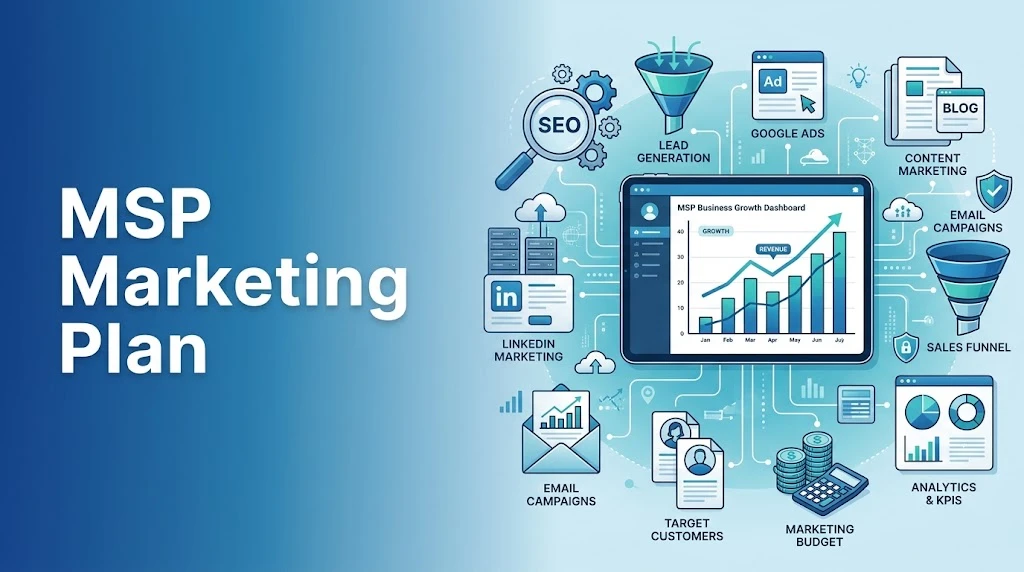
An MSP marketing plan is a documented strategy that lays out your goals, ideal client profile, positioning, offers, marketing channels, budget, and KPIs, everything your business needs to attract and convert the right clients on a predictable basis. Without one, most MSPs end up reacting to whatever tactic sounds interesting that month instead of building something that compounds.
This guide walks through every part of building an MSP marketing plan step by step: setting goals, defining your ideal client, choosing your positioning, picking the right channels, setting a realistic budget, building a content plan, and tracking the KPIs that actually matter. By the end, you’ll have a full framework, plus a template and a working example, you can apply to your own business.
What Is an MSP Marketing Plan?
An MSP marketing plan is a written strategy that defines who you’re trying to reach, what you’re offering them, which channels you’ll use, how much you’ll spend, and how you’ll measure success, all tied back to revenue, not just traffic.
A good marketing plan should achieve a few specific things:
- Give your team a shared direction instead of ad-hoc decisions
- Connect every marketing activity to a business outcome
- Make budget allocation a deliberate choice, not a guess
- Create a way to measure whether marketing is actually working
It’s worth separating two terms that get used interchangeably. Your MSP marketing strategy is the overall direction, who you serve, how you’re positioned, and why you win. Your MSP marketing plan is the operational document that turns that strategy into goals, channels, a calendar, a budget, and KPIs. Strategy answers “why” and “what.” A plan answers “how” and “when.”
If you’re still shaping your broader strategy before building out the plan itself, marketing for MSPs and the strategies that actually work is a good starting point.
What Should an MSP Marketing Plan Include?
A complete MSP marketing plan should include clear goals, a defined ideal customer profile, a positioning statement, a core offer, a channel mix, a funnel, a budget, a content plan, a 90-day and 12-month calendar, sales alignment, and a KPI framework.
Each of these pieces builds on the one before it. Goals shape who you target. Your ideal client shapes your positioning. Positioning shapes your offer. Your offer determines which channels make sense. Channels and offers determine your budget. And every part of the plan needs KPIs attached, or you won’t know if it’s working.
The rest of this guide walks through each step in order.
Step 1: Set Clear MSP Marketing Goals
The first step in any MSP marketing plan is setting specific, measurable goals, not vague ambitions like “grow the business,” but numbers you can actually track and hold your team accountable to.
Useful goal categories include:
- Revenue goals, total revenue target for the period
- New client goals, how many new accounts you need to sign
- MRR goals, how much new monthly recurring revenue you need to add
- Lead goals, how many leads your channels need to generate to hit those numbers
- Appointment goals, how many qualified sales conversations you need booked
The most useful goals follow the SMART format: specific, measurable, achievable, relevant, and time-bound. “Add $15,000 in new MRR by the end of Q2 through 8 new signed clients” is a goal you can plan a whole marketing plan around. “Grow the business” isn’t.
Step 2: Define Your Ideal MSP Client
The second step is building a detailed ideal customer profile (ICP), the specific type of business your marketing plan is built to attract, rather than trying to appeal to every business that might need IT support.
Your ICP should define:
- Industry, which verticals you serve best
- Company size, employee count or device count sweet spot
- Location, your realistic service area
- Decision-maker, who actually signs off on the contract
- IT problems, the specific pain points you solve well
- Buying triggers, what event pushes them to act (an incident, growth, compliance deadline, provider frustration)
- Budget, whether the account can meet your minimum contract value
A tight ICP matters because every part of your marketing plan depends on it. Your positioning, your offer, your content, and even your ad targeting all get sharper, and cheaper to run, when you know exactly who you’re talking to. A vague target market produces vague marketing, and vague marketing produces expensive, low-converting leads.
Step 3: Choose Your MSP Market Positioning
The third step is deciding what makes your MSP different and building a clear value proposition around it, because “we do everything for everyone” isn’t a position, it’s an absence of one.
Ask directly: what makes your MSP different from the ten other providers a prospect could call instead?
There are a few common positioning routes:
- Niche vs. general MSP, specializing tends to outperform trying to serve everyone
- Vertical specialization, becoming known for a specific industry (healthcare, legal, accounting, manufacturing)
- Geographic positioning, owning a specific regional market
Your value proposition should combine who you serve, the outcome you deliver, and what makes your delivery model different. This becomes the foundation for your website copy, ad messaging, and sales conversations, it should show up consistently everywhere a prospect encounters your brand.
Step 4: Create an MSP Marketing Offer
The fourth step is turning your services into a specific, well-defined offer, because a list of services on a page isn’t an offer, and it rarely converts on its own.
Your core service areas likely include:
- Managed IT services
- Cybersecurity
- Cloud services
- Compliance support
But listing these isn’t enough. Prospects need something concrete to say yes to. That’s where offers come in, things like IT assessments (free or paid), a cybersecurity risk review, or a Microsoft 365 security audit. These work as lead magnets because they give the prospect real value while giving you a natural reason to start a conversation.
Why service lists fall short on their own: they describe your capability, not a next step. An MSP marketing plan needs at least one clearly scoped offer that a prospect can act on immediately, that’s usually what turns a website visitor into a lead.
Step 5: Choose the Right MSP Marketing Channels
The fifth step is selecting the marketing channels that match your ICP, budget, and sales cycle, most MSPs succeed with a focused combination of two or three channels, not by trying to run all of them at once.
SEO for MSPs
SEO builds long-term, compounding organic visibility for the searches your ICP is already running, things like “managed IT services [industry]” or “MSP vs internal IT.” It takes months to build momentum but keeps generating leads without ongoing ad spend. For a deeper look at execution, see MSP SEO and how to rank on Google.
Local SEO
Local SEO focuses your visibility on the specific geographic area you actually serve, which matters heavily for MSPs since most clients want a provider who understands their region and can respond quickly.
Google Business Profile
An accurate, fully optimized Google Business Profile, correct category, service area, photos, and service descriptions, is one of the simplest, highest-leverage local marketing assets an MSP has.
Google Ads
Paid search puts your MSP in front of buyers actively searching right now. It works best with tightly matched landing pages per campaign, strong negative keyword lists, and clear conversion tracking, without those, budget gets wasted fast.
LinkedIn Marketing
LinkedIn builds familiarity with decision-makers over time through executive-level content, industry insights, and visible technical credibility. It rarely converts directly, but it warms up prospects before they ever fill out a form.
Email Marketing
Email nurtures leads who aren’t ready to buy yet, segmented by industry, company size, and buying stage, so each contact gets relevant messaging instead of a generic newsletter.
Content Marketing
Content marketing builds the educational and proof assets that move prospects through every stage of your funnel, from early awareness articles to detailed case studies.
Referral Marketing
Referral marketing turns happy clients into a lead source by asking for reviews and introductions after clear success events, like a resolved incident or a completed migration.
Partner Marketing
Partner marketing builds referral relationships with complementary professionals, accountants, cyber-insurance brokers, compliance consultants, who regularly encounter businesses in need of an MSP.
Events and Webinars
Events and webinars work well for building authority and generating direct conversations with decision-makers, particularly for vertical-specific or compliance-focused topics.
Outbound Marketing
Outbound marketing, direct outreach via email or LinkedIn to a defined target list, can accelerate pipeline for MSPs with a well-defined ICP, especially when combined with a relevant offer.
Step 6: Build Your MSP Marketing Funnel
The sixth step is mapping your marketing funnel so every stage moves a prospect closer to becoming a client, rather than expecting one landing page to do all the work.
Traffic → Leads → MQLs → Appointments → Proposals → Clients
- Traffic, visitors from SEO, ads, referrals, and social
- Leads, visitors who provide contact information, usually through an offer
- MQLs (marketing qualified leads), leads that match your ICP and show genuine buying intent
- Appointments, MQLs who book a sales conversation
- Proposals, qualified prospects who receive a formal proposal
- Clients, signed accounts
Every part of your MSP marketing plan should map to a specific stage in this funnel. If you can’t identify which stage a piece of content or a campaign is meant to move someone through, it probably needs a clearer purpose.
Step 7: Set Your MSP Marketing Budget
The seventh step is setting a marketing budget based on your goals and channel mix, not an arbitrary percentage pulled from an industry average with no context.
What affects the budget?
- Your target market size and competition level
- Current website condition and how much rebuilding it needs
- Number of service, industry, and location pages required
- Content depth needed to compete
- Paid media goals
- Internal marketing capacity vs. needing outside help
How to calculate the budget
A practical approach: work backward from your MRR goal, estimate how many new clients you need, estimate how many qualified leads it takes to close one client, then calculate what it costs to generate that many leads through your chosen channels.
Budget by channel
Most growing MSPs split budget across SEO and content (compounding, longer-term), paid search (faster, ongoing), and referral/partner programs (low cost, high trust), rather than putting everything into a single channel.
Small MSP vs. growing MSP
A small MSP with limited budget usually gets more from a tight local SEO and referral focus. A growing MSP with more resources can layer in paid search, content at scale, and outbound.
Marketing vs. sales costs
Keep marketing spend (attracting and qualifying leads) separate from sales costs (closing them) in your budget and reporting, blending the two makes it hard to see where your money is actually working.
Step 8: Build Your MSP Content Marketing Plan
The eighth step is building a content plan that maps to every stage of the buyer journey, since a single blog post format won’t serve someone just noticing a problem the same way it serves someone comparing providers.
- TOFU (top-of-funnel) content, problem-awareness articles for readers who don’t yet know they need an MSP
- MOFU (middle-of-funnel) content, comparison guides and evaluation content for readers actively researching options
- BOFU (bottom-of-funnel) content, case studies, proof assets, and service details for readers close to deciding
Your content plan should also include the core pages your site needs to actually convert:
- Service pages
- Location pages
- Industry pages
- Case studies
- Comparison content
- Problem-based content
Each piece should connect back to a real buyer question and, ideally, a relevant offer or service page through internal links.
Step 9: Create a 90-Day MSP Marketing Plan
The ninth step is breaking your first 90 days into three clear phases, foundation, building, and launching, so you’re not running paid campaigns before your website can convert the traffic.
- Month 1, Define your ICP, audit your website and tracking, select your primary offer, and fix your core positioning
- Month 2, Build your core service pages, one case study, your primary offer landing page, and your first nurture sequence
- Month 3, Launch paid campaigns, publish comparison content, start review requests, activate referral partners, and begin weekly lead-quality reviews with sales
Step 10: Build a 12-Month MSP Marketing Calendar
The tenth step is planning your marketing activities across the full year in quarters, so campaigns, content, and reporting build on each other instead of starting from scratch every few months.
- Q1, Foundation and core asset building: positioning, service pages, tracking, and your first offer
- Q2, Expand content and launch paid campaigns; begin building case studies and referral relationships
- Q3, Scale what’s working, add industry-specific content, and deepen partner and referral programs
- Q4, Review annual performance, refresh offers and positioning if needed, and plan the following year’s goals and budget
Step 11: Align MSP Marketing With Sales
The eleventh step is making sure marketing and sales are working from the same definitions and handoff process, otherwise even a strong marketing plan produces leads that stall out before they close.
- Lead qualification, agree on what actually counts as a qualified lead
- Lead response time, fast follow-up significantly affects conversion rates
- CRM, a shared system so both teams see the same lead history
- Follow-up, a defined cadence for reaching out to leads who don’t respond immediately
- MQL → SQL, a clear process for handing marketing qualified leads to sales as sales qualified leads
- Proposal process, a consistent, repeatable way proposals get built and sent
Step 12: Track MSP Marketing KPIs
The twelfth step is tracking the KPIs that connect marketing activity to actual revenue, not just activity for its own sake.
| KPI | What it tells you |
| Leads | Volume of interest generated |
| Cost per lead (CPL) | Efficiency of lead generation |
| MQLs | Whether leads match your ICP |
| Appointments | Whether leads convert to conversations |
| Conversion rate | Efficiency of your funnel overall |
| Customer acquisition cost (CAC) | True cost to win a client |
| Monthly recurring revenue (MRR) | Direct commercial value |
| Customer lifetime value (CLV) | Long-term value per client |
| Return on investment (ROI) | Whether marketing spend is paying off |
How to Measure Whether Your MSP Marketing Plan Is Working
You measure whether your MSP marketing plan is working by tracking pipeline and revenue outcomes, not vanity metrics like traffic or impressions that don’t tell you anything about lead quality.
Traffic, rankings, and impressions are useful diagnostics, they tell you visibility is improving. But they don’t tell you whether the right people are showing up. Look instead at qualified lead volume, opportunity conversion rate, closed MRR, and CAC payback period. If those numbers are moving in the right direction, your plan is working, regardless of what’s happening with traffic alone.
Common MSP Marketing Plan Mistakes
The most common mistakes that undermine an MSP marketing plan include:
- Targeting everyone instead of a defined ICP
- Using too many channels at once instead of doing a few well
- Copying competitors instead of building a distinct position
- Focusing only on technical content that doesn’t speak to business outcomes
- Ignoring local SEO
- Having no clear offer for prospects to act on
- Having no consistent follow-up process
- Not tracking results at all
- Having no single owner accountable for the plan
- Changing strategy too quickly before giving it time to work
MSP Marketing Plan Example
Here’s a simplified, realistic example of how the pieces of an MSP marketing plan fit together:
- Goal, Add $20,000 in new MRR over 6 months through 10 new clients
- ICP, Accounting and legal firms, 25–150 employees, in-region
- Positioning, Managed cybersecurity and Microsoft 365 support for professional services firms
- Offer, Free cybersecurity risk review
- Channels, Local SEO, one Google Ads campaign, referral partnerships with accountants and legal-adjacent professionals
- Budget, Split roughly evenly between content/SEO, a focused paid campaign, and partner outreach
- Funnel, Risk review offer → qualified lead → appointment → proposal → signed client
- KPIs, Qualified leads per month, appointment rate, closed MRR, CAC payback
This kind of MSP marketing plan works because every piece connects, the offer matches the ICP, the channels match the offer, and the KPIs tie directly back to the original goal. For a look at what a done-for-you version of this looks like, see what’s included in MSP marketing services and what to expect.
MSP Marketing Plan Template
Use this framework as a starting point for your own plan:
| Section | What to define |
| Goals | Revenue, new clients, MRR, lead, and appointment targets |
| ICP | Industry, size, location, decision-maker, pain points, budget |
| Positioning | Value proposition and what makes you different |
| Offer | Your primary lead-generating offer and what it includes |
| Channels | Which 2–3 channels you’ll focus on first |
| Funnel | How traffic moves from visitor to signed client |
| Budget | Total spend and how it’s split by channel |
| Content plan | TOFU, MOFU, BOFU content and core pages needed |
| 90-day plan | What gets built in month 1, 2, and 3 |
| 12-month calendar | Quarterly focus areas |
| Sales alignment | Lead qualification, response time, CRM, handoff process |
| KPIs | Which metrics you’ll review, and how often |
If you’d rather have this built and managed for you, this overview of the best MSP marketing services breaks down what to look for in a provider. And if AI-driven services are part of your growth plans, monetizing AI services through MSP web and SEO strategies is worth a read as a next step.
MSP Marketing Plan FAQs
Start with clear goals, define your ideal client, choose your positioning and offer, pick 2–3 channels that fit your budget and sales cycle, then build a funnel, content plan, and KPI framework around them.
It depends on your market size, competition, and growth goals, there’s no fixed universal number. Budget should scale with your goals and the channels you choose.
A focused combination of SEO, local SEO, a well-scoped offer, and referral or partner marketing tends to outperform spreading effort thinly across every possible channel.
Through a mix of organic search, local SEO, paid search, referrals, LinkedIn, and email nurture, usually anchored by one clear, low-friction offer like an assessment or risk review.
Yes, it builds compounding, long-term visibility for the exact searches your ideal clients are already running, though it typically takes several months to build real traction.
Paid campaigns can produce leads within weeks. SEO, content, and referral programs typically take three to six months to build meaningful momentum.
Leads, cost per lead, MQLs, appointments, conversion rate, customer acquisition cost, MRR, customer lifetime value, and return on investment.
Foundation work in month one, core asset building in month two, and campaign launches with weekly lead-quality reviews in month three.
A quarterly breakdown covering foundation building, campaign scaling, content expansion, and an annual review of performance, offers, and positioning.