
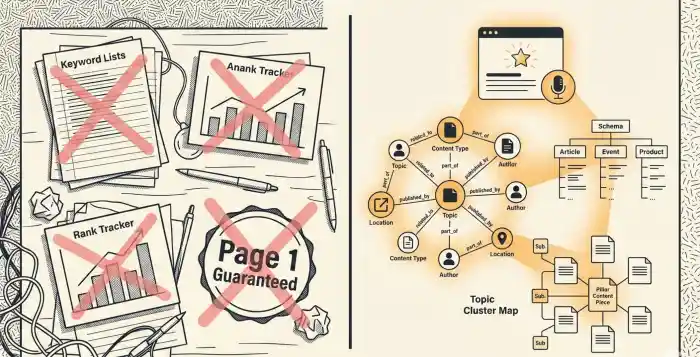
Choosing the right semantic SEO consultant comes down to one thing: can they prove that your content earns meaning in Google’s eyes not just rankings? The right consultant understands entity optimization, topical authority, structured data, and AI Overview visibility. The wrong one is still running a 2019 playbook dressed in 2025 language.
Most businesses make this decision badly. They either go with the cheapest option, or they get impressed by jargon in a sales call and sign a contract without asking the questions that actually matter. This guide cuts through all of that.
Discover how to choose semantic SEO consultant! Identify entity masters who build topical authority fast, skyrocket rankings with expert semantic strategies, turning traffic into revenue goldmines!
Quick Verdict
| What to look for | What to walk away from |
| Entity-first content architecture | “We’ll build you 50 backlinks per month” |
| Topic cluster strategy with internal linking logic | Keyword-only proposals |
| Schema markup implemented correctly per page type | Generic Yoast plugin setup |
| AI Overview and GEO optimization awareness | No mention of structured data at all |
| Transparent KPIs tied to revenue, not just traffic | Rank #1 guarantees |
| Verifiable case studies with before/after data | Testimonials with no specifics |
What Is a Semantic SEO Consultant and Why Is This Different From Regular SEO?
A semantic SEO consultant is specifically trained to help search engines understand the meaning behind your content — not just match keywords. The practical difference: regular SEO optimizes for words. Semantic SEO optimizes for concepts, entities, relationships, and context.
That distinction matters more than ever in 2025.
Google’s algorithm has evolved significantly since Hummingbird (2013) introduced intent-based search, followed by BERT (2019) and MUM (2021) which brought deep natural language understanding. Today, Google doesn’t just check whether your page contains the phrase “best accounting software.” It evaluates whether your page demonstrates genuine expertise about accounting software as an entity who makes it, how it works, what problems it solves, how it relates to adjacent topics.
So the regular SEO consultant who focuses on keyword density, meta tag optimization, and raw link building is optimizing for a version of Google that no longer exists.
A semantic SEO consultant thinks differently. They build topic clusters and interlinked content ecosystems that signal comprehensive coverage of a subject. They implement structured data so Google can read your content as machine-readable facts, not just text. They map your brand as an entity in Google’s Knowledge Graph. And increasingly, they optimize for AI Overviews of the AI-generated summaries at the top of Google results that now appear for roughly 13% of searches and are growing.
Hiring the wrong type is expensive. Not just in the consultant’s fees but in the months or years of content produced with the wrong framework, which then needs to be rebuilt from scratch.
The One Test That Immediately Separates Real Semantic SEO Consultants From Pretenders
Here’s a direct test you can run before any contract is signed: ask the consultant to look at your website and tell you three things within 24 hours which entities your site is currently associated with in Google’s knowledge systems, which topic areas you have topical authority gaps in, and which schema types are missing from your key pages.
A real semantic SEO consultant can answer all three from a proper site audit. They’ll use tools like InLinks, Screaming Frog, Google Search Console, and Ahrefs and they’ll reference specific findings, not generalities.
A fake one will talk around these questions. They’ll say things like “we’ll do a full audit after onboarding” without being able to give you any preliminary signal that they understand your site’s semantic structure right now.
That 24-hour response tells you everything about their actual competence level before you pay anything.
Explore what’s included in a semantic SEO audit! Entity analysis, topical gaps, and schema fixes unlock Google dominance, transform weak content into an unbeatable authority overnight!
What Does a Semantic SEO Consultant Actually Do Day to Day?
Short answer: they build the content and technical infrastructure that tells Google exactly what your website is an authority on.
More specifically, here’s what their actual work looks like:
Entity mapping and Knowledge Graph optimization. They identify what entities your brand, products, and content are currently associated with in Google’s Knowledge Graph — and which associations are missing or weak. They then build strategies to strengthen those associations through authoritative external mentions, properly structured About pages, Google Business Profile optimization, Wikipedia presence where relevant, and consistent entity data across the web.
Topical authority architecture. They audit which subtopics within your niche you currently cover, which you don’t, and how those gaps affect your overall authority signal. Then they design a content roadmap — not just a list of blog posts, but a structured cluster system where pillar pages link to supporting pages, supporting pages reinforce the pillar, and every piece of content serves the semantic map rather than existing in isolation.
Schema markup implementation. They don’t just add FAQ schema. They implement the right schema types for each page Product, Article, HowTo, Organization, Person, BreadcrumbList, Event, Local Business, configured correctly to represent the actual entities on each page. They test implementation in Google’s Rich Results Test and monitor which schema types are earning rich results in Search Console.
Content gap analysis. Using tools like MarketMuse, Clearscope, or Semrush’s Topic Research, they identify which questions, concepts, and related entities your competitors are covering that you aren’t. These gaps are where lost ranking opportunities live.
AI Overview optimization (GEO). They structure content with clear, direct answer formats short definitive paragraphs followed by supporting detail that AI systems can extract and cite. They use what the industry now calls “trigger formatting”: TL;DR boxes, quick verdict tables, and structured summaries that Google’s AI can pull into an Overview while crediting your source.
This is fundamentally different from traditional SEO work. A traditional SEO consultant writes keyword-rich content and builds links. A semantic SEO consultant builds a meaning infrastructure that signals expertise to both humans and machines simultaneously.
The Five Skills That Separate Good Semantic SEO Consultants From Average Ones
Not every semantic SEO consultant is equally capable. These five skills are the dividing line between consultants who produce lasting results and those who produce activity reports with little movement.
1. NLP and entity understanding. The consultant should understand how Google’s natural language processing systems analyze content, specifically how entities are identified, disambiguated, and associated with topics. Ask them: “How would you use NLP analysis to improve this specific page?” If they reach for a Yoast score, they don’t understand NLP. If they mention Google’s Natural Language API, InLinks entity analysis, or Koray Tuğberk Gübür’s micro-semantic content principles, they’re working at the right level.
2. Internal linking strategy. Internal linking is the mechanism through which topical authority is distributed across a site. A semantic SEO consultant should design internal link architecture deliberately — anchor text choices, link placement, page hierarchy, and crawl priority all matter. Most consultants treat internal linking as an afterthought. Semantic SEO specialists treat it as a primary authority signal.
3. Schema markup fluency. Not just knowing what schema is knowing which types apply to which page types, how to configure them for specific entities, how to connect schema to real-world data sources, and how to debug schema errors that suppress rich results. Ask them to walk you through how they’d implement schema on your homepage, a product page, and a blog article. Their answer will immediately reveal their depth.
4. AI Overview and GEO Awareness. Content that earns AI overview citations ranks above organic results. The right consultant understands what triggers citation: direct answers to specific questions, clear attribution to named authors or organizations, structured formatting that AI can parse, and E-E-A-T signals that establish the source as authoritative. They should be building content specifically to be cited, not just ranked.
5. Measurement fluency. They should track metrics that connect to business outcomes organic conversion rate, qualified lead volume from organic traffic, revenue attributed to organic sessions not just keyword rankings and impressions. Rankings are a means. Revenue is the end. A consultant who can’t explain how their work connects to your bottom line is optimizing for their own report rather than your business.
Uncover problems semantic SEO solves! Ends keyword failure, crushes ranking drops, builds E-E-A-T fortress dominate SERPs with content Google loves forever!
The Questions You Must Ask Before Signing Any Contract
These aren’t interview softballs. These are the questions that reveal whether a semantic SEO consultant is genuinely capable or competently pretending.
“Can you show me a site you’ve built topical authority for and walk me through what the content architecture looked like before and after?”
This requires a real case study with specific structural details. “We helped a client increase traffic by 200%” is not an answer. The answer should include: the topic cluster structure they built, how many pillar and supporting pages there were, how internal linking was restructured, which entity associations were targeted, and what the measurable result was over what time period.
“How do you decide which schema types to implement on which page types?”
This tests practical schema knowledge. A knowledgeable consultant will explain that schema selection depends on what Google can verify Product schema only works if the page actually sells a product, HowTo schema only applies to genuine step-by-step instructions. They’ll mention testing in Google’s Rich Results Test and monitoring performance in Search Console.
“How do you approach AI Overview optimization and what does that look like in practice?”
If they look confused or give a generic answer about “optimizing for featured snippets,” they haven’t adapted to the current search landscape. The right answer involves structured answer formats, TL;DR sections, direct definitional paragraphs, and entity attribution that signals source credibility to AI summarization systems.
“What happens if my site gets hit by a Google algorithm update? How do you diagnose what changed and what you’d do about it?”
This reveals their diagnostic capability. The right answer references specific Google update types Helpful Content, Core Updates, Spam Updates and explains how each affects different site types differently. They should be able to describe a specific diagnostic process: checking Search Console impressions by query type, comparing traffic changes against update dates, identifying whether the issue is content quality, entity associations, technical signals, or link profile.
“What business metrics do you track and how do you connect your SEO work to those metrics?”
Rankings alone are not a business result. The consultant should track and report on: organic traffic to commercial intent pages, organic conversion rate, assisted conversions from organic, qualified lead volume from organic, and cost-per-acquisition comparison against paid channels. If their answer is “we track keyword rankings and organic traffic,” they’re reporting on inputs, not outcomes.
Learn semantic SEO ranking recovery guide! Proven tactics restore lost traffic fast, implement clusters that make your site algorithm-proof for lasting success!
Red Flags That Should End the Conversation Immediately
These aren’t minor concerns. Each of these is a reason to stop the conversation and look elsewhere.
They guarantee specific ranking positions. Google itself states that no one can guarantee rankings. Any consultant who promises “#1 for [keyword] in 60 days” is either lying to win the contract or using black-hat tactics that will earn your site a manual penalty. Walk away.
Their own website has weak SEO. A semantic SEO consultant whose personal or agency website has thin content, no schema markup, no clear topic authority, and no Google Business Profile presence cannot credibly claim to build those things for your business. Check their site before the first call.
They propose the same package regardless of your situation. A 10-page local services website needs fundamentally different semantic SEO work than a 500-page e-commerce store. A consultant offering a one-size package without a diagnostic audit first doesn’t understand your specific situation or doesn’t care to.
They can’t explain their methodology in plain language. Using terms like “semantic optimization” and “entity building” without being able to explain concretely what those activities involve is a significant red flag. The inability to communicate clearly about methodology usually reflects the inability to execute it clearly.
They don’t ask about your business. A semantic SEO consultant who doesn’t ask about your revenue model, your customer type, your sales cycle, your competitive landscape, and your conversion points is building an SEO strategy in a vacuum. SEO that doesn’t connect to how your business makes money is just traffic production and traffic that doesn’t convert has no value.
They focus entirely on content volume. Publishing more content isn’t a semantic SEO strategy. A consultant who proposes “publish 20 blog posts per month” without talking about topic cluster architecture, internal linking structure, entity associations, or content depth is running a content mill, not a semantic SEO program.
They treat schema as optional. In 2025, structured data is the primary mechanism through which search engines read your content as machine-understandable facts. A consultant who considers schema implementation a secondary priority or an “add-on” is not operating at the current standard of semantic SEO practice.
How to Evaluate a Semantic SEO Consultant’s Previous Work
Case studies are the most reliable signal but you need to know how to read them.
What a real case study includes:
- The site’s starting condition (what the content architecture looked like, what entities it was associated with, what the topical gaps were)
- The specific interventions (what schema was implemented, what content clusters were built, what internal linking changes were made)
- The timeline and measurement methodology (how were results attributed to semantic SEO work rather than other factors)
- The outcome in business terms, not just traffic terms
Questions to ask about their case studies:
- “Can I speak with this client directly?”
- “What specific changes drove the biggest movement and how do you know?”
- “Were there any interventions that didn’t work? What did you learn from them?”
- “What does the maintenance phase of this work look like what happens after the initial build?”
The last question is especially revealing. Semantic SEO is not a set-and-forget activity. The Knowledge Graph changes. Algorithm updates shift which signals matter most. Competitor sites build authority in your topic space. A consultant who has no answer for the maintenance and monitoring phase is building you a strategy without a sustainability plan.
Dive into geo and entity-based SEO power! Local dominance through semantic entities—capture hyper-targeted traffic converting visitors into loyal customers instantly!
Freelancer vs. Agency vs. Boutique Consultant: Which Is Right For You?
Each delivery model has real trade-offs. The right choice depends on your budget, your internal team’s capacity, and how complex your semantic SEO needs are.
Freelance semantic SEO consultant. Best for: businesses with a smaller budget, clear and specific projects (a schema audit, a topic cluster plan), or companies with strong internal implementation capacity who need strategic direction. The risk: a single person can only track and implement so much. If your site is large or your competitive landscape is complex, a freelancer may be stretched thin.
Boutique SEO consultancy (2–10 specialists). Best for: mid-market businesses that need ongoing strategy and implementation without the overhead of a large agency. Boutique firms typically offer deeper specialization and more direct access to senior practitioners than large agencies. The risk: smaller teams mean bandwidth constraints during busy periods.
Large SEO agency. Best for: enterprise clients with complex sites, international SEO requirements, and large monthly budgets. The risk: you often pay senior-level rates but get junior-level execution. The partner who closed your deal is rarely the person doing the work.
The decision framework is simple: be honest about what you have internally. If you have a content team that can execute but lacks strategic direction, a freelance semantic SEO strategist fills the gap. If you have no internal digital marketing capacity, you need a team that can handle both strategy and implementation. If you have a large budget and complex multinational requirements, an agency with demonstrated enterprise-scale semantic SEO capability is the right fit.
What Does Semantic SEO Consulting Actually Cost — And What Should You Expect for Your Budget?
Pricing transparency is rare in this industry. Here’s an honest breakdown:
Freelance semantic SEO consultants: $75–$250 per hour, or $1,500–$5,000 per month for ongoing retainer work. On the lower end, you’re getting implementation-focused work. On the higher end, you’re paying for senior strategic thinking and deep entity/schema expertise.
Boutique agencies: $2,500–$8,000 per month for ongoing programs. This typically includes a semantic audit, topic cluster architecture, schema implementation, content briefs, and monthly performance reporting.
Enterprise agencies: $8,000–$25,000+ per month for full-service programs at scale.
Project-based work: A semantic SEO audit with a detailed roadmap typically runs $1,500–$5,000 depending on site size and complexity. This is often the right starting point you pay for the diagnosis and the strategic plan, then decide whether to implement with the same consultant or take it in-house.
The question isn’t “how much does semantic SEO cost?” it’s “what is the cost of not doing it?” A site with no topical authority, weak entity associations, and no structured data is systematically losing ground to competitors who are building these foundations. The cost of that competitive disadvantage compounds monthly.
Explore what makes Ben Stace semantic SEO unique! Knowledge scaffolding via NLP and entities outranks DR60 domains adopt methods dominating modern search!
The Deliverables You Should Expect From a Semantic SEO Engagement
Before signing anything, confirm which of these specific deliverables are included:
Phase 1 — Semantic audit (weeks 1–4):
- Current entity association analysis (what does Google currently associate your site with?)
- Topical authority gap report (what subtopics are you missing coverage on?)
- Schema markup audit (what’s missing, what’s misconfigured, what’s earning rich results?)
- Competitor semantic structure analysis (how is your topic architecture compared to ranking competitors?)
- AI Overview citation audit (is your content currently being cited in Overviews? If not, why not?)
Phase 2 — Architecture (weeks 4–8):
- Topic cluster map with pillar and supporting page structure
- Internal linking architecture plan with anchor text guidelines
- Schema implementation specifications per page type
- Entity building strategy (which external mentions, which directories, which associations to target)
Phase 3 — Execution and measurement:
- Content briefs for each cluster piece that include semantic requirements, entity associations, and schema markup specs
- Monthly performance report tied to business metrics not just traffic
- Quarterly strategy review to adjust based on algorithm changes and competitive shifts
If a consultant’s proposal doesn’t specify deliverables at this level of detail, ask for it in writing before signing. Vague scopes produce vague results.
Why Semantic SEO and Technical SEO Must Work Together
Some consultants sell semantic SEO as a pure content strategy. That’s incomplete. Semantic optimization fails if the technical foundation doesn’t support it.
Specifically:
Crawlability. If Google can’t efficiently crawl your internal link structure, the topical authority you’re building through content clusters won’t be fully recognized. Your site’s crawl budget, robots.txt configuration, sitemap structure, and Core Web Vitals all affect how deeply Google indexes your semantic content architecture.
Core Web Vitals. As of August 2025, only 53.5% of websites pass all three Core Web Vitals (LCP, INP, CLS). Pages that fail Core Web Vitals face ranking suppression in competitive SERPs. Semantic optimization on a slow, unstable page doesn’t work as intended — the technical deficit cancels the semantic gain.
Indexation. Content that isn’t indexed isn’t contributing to topical authority. A semantic SEO consultant should audit your indexation coverage which pages are indexed, which are excluded, and whether the excluded pages should be indexed as part of the foundational work.
URL structure and site architecture. The hierarchical structure of your URLs signals topical relationships to Google. A flat URL structure with no logical hierarchy makes it harder for Google to understand how your content clusters are organized. Semantic SEO and site architecture work together to signal the same topical relationships.
The right semantic SEO consultant won’t treat technical SEO as someone else’s problem. They’ll either handle it themselves or coordinate tightly with whoever manages the technical layer of your site.
Analyze Ben Stace SEO results timeline! Visible gains in 3-6 months through topical depth sustainable rankings compounding for long-term victory!
How to Know When the Engagement Is Working (And When It Isn’t)
Semantic SEO results take time but they should be measurable within 90–120 days. Here’s what “working” looks like at each stage:
Days 1–30: Deliverables are clear. The audit is comprehensive and specific. The strategy makes logical sense for your business. The consultant asks intelligent questions and gives direct answers. Communication is proactive, not reactive.
Days 30–90: Schema implementations are live and showing in Search Console. New content is indexed. Internal linking changes are visible in crawl analysis. Entity associations are beginning to strengthen — you can test this by searching your brand name or main topics and observing what Google’s Knowledge Panel or People Also Ask results say about you.
Days 90–180: Impressions on topic-cluster-related queries are growing in Search Console. Target pages are moving up in average position for relevant queries. Organic traffic to commercial intent pages is increasing. AI Overview citations, where applicable, are beginning to appear.
Days 180+: Topical authority is measurable Google is consistently ranking your site for sub-topic queries within your cluster without requiring individual optimization of each page. Organic conversion rate is stable or improving as traffic quality improves. The site requires less individual page-by-page optimization because the authority architecture is doing the work.
What “not working” looks like: consistent deliverable delays, reports that show rankings without explaining the strategic rationale, no schema implementations after 60 days, no measurable movement in Search Console impressions after 90 days, and a consultant who can’t explain why a specific metric moved (or didn’t move).
Why Miracle Concepts Is Built to Deliver Exactly This
Choosing a semantic SEO consultant is a significant decision. You’re not just buying a service — you’re choosing a strategic partner for how your website earns visibility in an increasingly AI-driven search landscape.
At Miracle Concepts, semantic SEO isn’t a checkbox service. It’s built into how every engagement is approached from the initial audit that maps your entity landscape and topical gaps, to the content architecture that earns AI Overview citations, to the schema implementation that makes your content machine-readable. Every deliverable is tied to specific business outcomes, not vanity metrics.
The work is transparent. The methodology is explainable. And the results are measurable against real business KPIs not just keyword rankings that look impressive in a report.
If you’re ready to move from keyword-based guesswork to a content architecture that builds genuine topical authority and earns citations in AI systems, the conversation starts with a single honest audit of where your site stands today.
Get your semantic SEO audit from Miracle Concepts →
Frequently Asked Questions
What is a semantic SEO consultant?
A semantic SEO consultant optimizes your website for meaning and context — not just keywords. They build topic cluster architectures, implement structured data (schema markup), optimize entity associations in Google’s Knowledge Graph, and structure content to earn citations in AI Overviews and generative search results.
How is semantic SEO different from traditional SEO?
Traditional SEO focuses on keyword matching, meta tags, and backlinks. Semantic SEO focuses on entities, topical authority, content relationships, and how search engines understand the meaning of your content — not just its literal text. Semantic SEO is what positions your content for Google’s current NLP-driven algorithms and for AI Overview citations.
What qualifications should a semantic SEO consultant have?
Look for demonstrated knowledge of entity optimization, schema markup implementation, topical authority architecture, and AI Overview optimization. Verifiable case studies showing semantic SEO results in your industry are more important than certifications. Ask for specific examples of topic clusters they’ve built and schema implementations they’ve configured.
How long does semantic SEO take to show results?
Initial measurable movement improved impressions in Search Console, schema-rich results appearing, early ranking improvements typically becomes visible at 60–90 days. Meaningful topical authority and consistent ranking improvements take 4–6 months. Full authority establishment in competitive niches takes 9–18 months. Any consultant promising significant results in 30 days is misrepresenting how Google’s systems work.
What is the difference between semantic SEO and GEO?
GEO (Generative Engine Optimization) is specifically about optimizing content to be cited by AI systems ChatGPT, Google AI Overviews, Perplexity, and others. Semantic SEO is the foundation that GEO builds on. Without strong entity associations, topical authority, and structured data the core of semantic SEO GEO optimization has nothing to work with. The right consultant works on both simultaneously.
How much does semantic SEO consulting cost?
Freelance semantic SEO consultants typically charge $75–$250 per hour or $1,500–$5,000 per month. Boutique agencies run $2,500–$8,000 per month for ongoing programs. Project-based audits with strategic roadmaps range from $1,500–$5,000. The right starting point is usually a comprehensive semantic audit that identifies your specific gaps and builds a prioritized roadmap before any ongoing commitment.
Beyond SEO: How Miracle Concepts Supports Your Full Digital Presence
At Miracle Concepts, semantic SEO is one layer of a broader digital growth ecosystem. The same strategic thinking that drives semantic content architecture also powers the agency’s full-service offerings including technical SEO, UX design that turns organic traffic into qualified leads, web development that builds fast and crawlable site infrastructure, document formatting that makes professional deliverables look as polished as the strategy behind them, and MSP services that keep your digital infrastructure secure, reliable, and ready to scale. Whether you need a single-service engagement or a fully integrated digital presence partner, Miracle Concepts brings the same standards of clarity, measurability, and genuine expertise across every service. Visitmiracleconcepts.net to explore what the right partnership looks like for your business.