
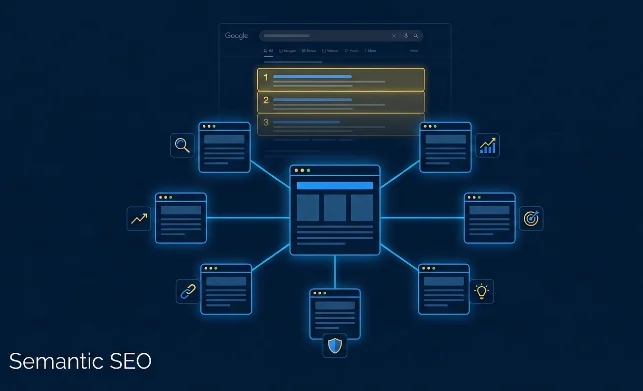
Semantic SEO solves the gap between what you publish and what Google actually understands about your website. Most businesses rank poorly not because they lack content but because Google cannot connect that content to a clear topic, authority, or intent. Semantic SEO fixes the structure, the meaning, and the relationships between your pages so Google stops guessing what you are about and starts ranking you for what you actually do.
If your pages are indexed but invisible, if competitors with less content outrank you, or if your traffic brings zero leads semantic SEO is the direct answer to each of those problems.
Why Good Content Stops Ranking The Real Reason
Most businesses hit the same wall. They publish regularly. The writing is solid. The keywords are placed correctly. But rankings do not move. Or they move briefly, then drop. Or they rank for terms that bring irrelevant traffic that never converts.
The instinct is to write more content. Or chase more backlinks. Or change the meta title for the third time this quarter.
None of that fixes the actual problem.
The actual problem is that Google does not understand what your website is truly about. Not because your writing is unclear but because the structure of how your content relates to each other, the topics you cover, and the intent signals in your pages are either incomplete or contradictory.
That is what semantic SEO exists to fix. Not the content itself. The meaning behind it, the relationships between pages, and the signals those relationships send to Google’s algorithm.
Traditional SEO optimizes for keywords. Semantic SEO optimizes for meaning, topic relationships, and search intent which is how Google has actually worked since the Hummingbird update in 2013, and increasingly so after every major update through 2024.
Boost local rankings with geo-entity SEO using schema markup. Link places & concepts for Knowledge Graph wins. Miracle Concepts delivers top geo-entity strategies.
Problem 1 Google Is Ranking You for the Wrong Topics
This is the first sign something is structurally broken. You open Google Search Console, look at the queries driving impressions, and find that the keywords you are appearing for are loosely connected to your business not the core service you sell.
A web development firm ranks for “what is responsive design” instead of “custom web development for enterprises.” A B2B SEO agency ranks for “what is a backlink” instead of “B2B SEO services for growing companies.” The content is on-topic. The ranking is completely off-target.
Why does this happen? Because Google reads your entire site and determines your topical authority from the whole not individual pages. If your site mixes general educational content with specific service pages, without a clear internal structure that signals what you specialize in, Google treats you as a general resource. Not a specialist. Generalists do not rank for high-intent commercial keywords.
How Semantic SEO Fixes This Topic Clusters and Pillar Pages
Topical authority is built when Google can confirm from your site structure and content that you cover a subject comprehensively from multiple angles. Not just one page about it. A full body of connected work.
The fix is a content cluster structure. Here is how it works in practice:
First, identify your core service topic. For example, technical SEO for enterprise clients.
Second, build a pillar page a comprehensive, detailed page covering all major dimensions of that topic. This page is the center of the cluster. It links to every related page and receives links from all of them.
Third, build cluster pages around specific sub-topics that fall under the pillar. For technical SEO: crawl budget optimization, Core Web Vitals, structured data implementation, log file analysis, canonicalization, JavaScript SEO, site architecture. Each of these gets its own page with proper depth.
Fourth, link every cluster page back to the pillar using descriptive anchor text. Link the pillar to each cluster page the same way.
Fifth, give Google time to crawl the structure. Over 60 to 90 days, it reads the network of connections and concludes that your site is the authority on this topic not just a site that occasionally mentions it.
What not to do: do not publish cluster content before the pillar exists. A cluster page pointing to a thin or generic pillar weakens your authority signal instead of building it. Build the pillar first, with real depth, then expand outward.
The result is that your site stops competing for generic educational queries and starts earning visibility for the commercial terms your clients actually use when they are looking to hire.
Problem 2 Stuck on Page 2 With No Way Forward
Being on page 2 is different from not ranking at all. It means Google understands what your page is about it just does not trust it enough to show it in the top 10. This is an authority and semantic relevance gap. Semantic SEO addresses both.
The pages ranking above you are not always better written. In most cases, they have stronger entity coverage and better semantic relationships. They mention the right tools, the right methodologies, the right related concepts. Their internal link structure reinforces the relevance signals. Your page, by comparison, is too narrow even if it is longer.
Entity Coverage The Gap Most Businesses Miss Completely
Google’s Knowledge Graph organizes information around entities named things it can verify and connect: companies, tools, people, frameworks, technical concepts. When Google evaluates a page about a topic, it checks whether the entities associated with that topic are present.
A page about “enterprise content strategy” should naturally include entities like content audit, content calendar, editorial workflow, content management system, SEO-driven content, and conversion funnel alignment. Not as keyword stuffing as genuinely relevant concepts that any credible resource on enterprise content strategy would cover.
If those entities are thin or missing, Google’s confidence in your page drops. A shorter competitor page that covers all the relevant entities often outranks a longer page that stays too narrow.
How to audit your entity coverage practically: take the top three ranking pages for your target keyword and list every named tool, concept, method, and platform mentioned across all three. Compare that list against your page. The gaps are your missing entity coverage. Add those entities naturally integrated into your existing explanations, not tacked on as a separate section.
Then add internal links from your page to existing pages on your site that cover those entities in more detail. This reinforces the semantic relationship between your pages and builds the relevance signal Google needs to promote your page past the competition.
Build trust via EEAT backlinks with smart digital PR. Secure guest posts & mentions from authorities. Grow rankings sustainably—see EEAT PR guide.
Problem 3 High Traffic, Zero Leads
This is perhaps the most painful situation in organic SEO. The traffic numbers look good. Rankings appear solid in reports. But the contact forms are empty. The phone is quiet. Revenue from organic is flat.
What is happening is an intent mismatch. You are ranking for informational queries people in learning mode but your business needs commercial or transactional intent traffic people ready to hire or buy. Driving the wrong intent traffic is indistinguishable from driving no traffic at all when measured by revenue.
Semantic SEO solves this by aligning your content portfolio with search intent at every stage of the buying journey.
The Three Intent Stages and What Content Belongs at Each
Informational intent covers queries like “what is semantic SEO,” “how does Google understand content,” and “what is a content cluster.” These readers are researching. They are not ready to buy today. The purpose of this content is to build brand authority and establish familiarity. A soft, specific call to action works here not a hard sell. Something like “If you want this implemented for your site, see how our SEO service is structured.”
Commercial investigation intent covers queries like “best enterprise SEO agency,” “SEO services for B2B companies,” and “SEO agency vs in-house team.” These readers know what they need. They are comparing providers. This is the highest-value content to rank for because the intent is one step from contact. These pages need to answer the comparison question directly with real specifics about what your service includes, what outcomes clients achieve, and what makes your approach different from a generic provider.
Transactional intent covers queries like “hire enterprise SEO agency,” “SEO services for corporate website,” and “technical SEO audit for large site.” These readers have made a category decision. They are looking for a specific provider. Your service pages need to rank for these. The optimization is different less educational, more specific. Outcomes, process clarity, trust signals, and a low-friction contact path.
What not to do: do not optimize your service pages with educational content about the topic. A service page for “enterprise SEO” that explains what enterprise SEO is will rank for informational queries, not commercial ones. Keep the educational explanation on blog content. Keep service pages focused on what the service delivers, who it is for, and what the next step is.
Problem 4 Your Pages Are Indexed but Never Shown to Anyone
There is a meaningful difference between being indexed and being discovered. Indexed means Google found your page and stored it. Discovered means Google actively serves it to relevant searches. Most websites that have been publishing content for two or more years have hundreds of indexed pages that Google shows to virtually no one.
This happens when Google cannot connect your pages to a clear user need with sufficient confidence. The content exists it just lacks the semantic relationships and structural signals needed for Google to serve it with confidence.
Structured Data Telling Google What Your Content Actually Is
Structured data is code added to a page using schema.org markup that tells Google explicitly what type of content the page contains. Instead of Google inferring whether your page is a service listing, a how-to guide, an FAQ resource, or a company profile you state it directly in machine-readable language.
The impact on discovery is real and measurable. Pages with proper structured data are eligible for rich results the enhanced listings that display star ratings, FAQ dropdowns, step previews, and pricing information directly in the search result. These take up more visual space and earn higher click-through rates than standard blue links.
For service-based businesses, the most important schema types are:
Service schema marks up your service pages with the service name, description, provider details, and geographic area served. This is directly relevant for agencies, consultancies, and MSP businesses that want to appear in local and industry-specific service searches.
FAQ schema marks up question-and-answer sections and makes your answers expand directly in Google’s search results putting your content in front of users without them clicking. This is one of the fastest ways to increase visibility for pages that already have some ranking traction.
Organization schema signals your business name, contact information, website, and logo to Google’s Knowledge Graph. It builds the entity association for your brand and helps Google understand your business as a verified entity, not just a collection of web pages.
HowTo schema marks step-by-step guide content and makes it eligible for rich result display with numbered steps visible directly in search.
What not to do: do not apply structured data to pages that do not genuinely match the schema type. Google’s quality systems check for accuracy. Marking a page as HowTo that contains no actual steps will result in demotion, not a rankings boost.
Semantic audits check entities, SERPs & content gaps. Fix schema, co-occurrences for authority. Get full checklist in semantic SEO audit.
Problem 5 Keyword Cannibalization Is Quietly Destroying Rankings
Keyword cannibalization happens when two or more pages on your site compete for the same keyword or close variations of it. Google cannot determine which page you want to rank, so it often ranks both weakly or constantly alternates between them preventing either from accumulating the authority needed to break into the top positions.
This is extremely common on sites that have been publishing content for more than two years without a documented content strategy. A blog post about “technical SEO best practices” and a service page about “technical SEO services” will compete with each other if they are both optimized similarly, cover overlapping content, and use similar anchor text in internal links.
How to Find It, Then Fix It
Open Google Search Console. Go to the Performance report. Filter by a target keyword. If more than one URL appears in the results for the same query that is cannibalization happening in real time.
Once you find it, the fix depends on what the two pages are actually doing. If they serve genuinely different intent stages one informational, one commercial make their semantic focus clearly distinct. The service page should contain zero educational explanation about the topic. The blog post should contain no direct sales language. They serve different users at different stages. Make that distinction obvious in the content, the title, and the internal link context.
If both pages serve the same intent, consolidate them. Redirect the weaker page to the stronger one using a 301 redirect. Merge the best content from both into one well-structured page. One strong page earns authority. Two competing pages split it and both rank poorly.
A practical example: if you have “/blog/what-is-on-page-seo” and “/services/on-page-seo-optimization” and both contain similar explanations of what on-page SEO involves, remove the explanation from the service page entirely. Link the service page to the blog post for background reading. Now each page serves a distinct intent and they stop competing.
Problem 6 Google AI Overview Is Not Citing Your Content
As of 2024 and 2025, Google’s AI Overview sits above organic results for an increasing share of searches. It summarizes answers and cites three to five sources. If your site is not among those sources, a growing segment of search traffic becomes completely invisible to you even if you rank well in the organic listings below.
AI Overview pulls from pages that are structured to answer specific questions with direct, concise language. It favors content organized in formats the AI can extract and summarize cleanly not long-form prose that buries the answer in the fifth paragraph.
How to Structure Content to Get Cited
Start every major section with a direct one-sentence answer to the heading question. Not a buildup. Not context. The answer first, then the supporting explanation. AI extraction systems look for the fastest path to the answer.
Add a TL;DR summary box near the top of long articles. Use specific, declarative statements: “Semantic SEO solves X by doing Y” not “there are many approaches that can help with semantic SEO.” Vague language is never extracted. Clear, specific language is.
Include FAQ sections with answers under 60 words each. These are the easiest content format for AI systems to extract, summarize, and attribute. A page with five well-answered FAQs has five opportunities to be cited in AI Overview results.
Use clean heading structures H1, H2, H3 in logical hierarchy. AI systems read heading structure to understand how content is organized. Flat content with no hierarchy is harder to parse and cite.
Add FAQ schema and HowTo schema where applicable. Structured data signals machine readability explicitly and increases the likelihood of extraction.
Problem 7 New Content Drops Off After 3 Months
A new page publishes. It ranks reasonably well in the first 6 to 10 weeks — Google is actively evaluating it. Then it drops. Nothing changed. Nothing broke. But the rankings deteriorate slowly and steadily.
What is happening: Google gave the page a temporary evaluation boost. When it observed that the page was not gaining external links, sustained engagement signals, or internal link support from established pages, it gradually lowered its confidence and pulled the ranking back.
The fix is not writing better content for the next piece. The fix is building a structural support system around every new page before it goes live.
Link to the new page from at least three existing pages on your site within the first two weeks. Not from the footer or sidebar from contextually relevant paragraphs in established content that already has traffic. This sends crawl equity and relevance signals directly to the new page.
Update the page at the three-month mark with new information, a fresh example, or an expanded section. Google’s freshness signal rewards pages that evolve. A page that looks identical at month six as it did at month one signals that no one is maintaining it which reduces confidence in its ongoing accuracy.
The deeper structural fix is making sure every new page is part of a topic cluster from the moment it is published. A page connected to seven related pages through relevant internal links has structural support. A page published as a standalone piece has nothing holding it up if early engagement signals are weak.
Prep sites for SGE with Core Web Vitals & entity schema. Optimize clusters for AI search. Achieve zero-click wins via SGE tech SEO.
How to Implement Semantic SEO The Practical Sequence
Understanding semantic SEO is the easy part. Implementation requires a clear sequence. Skipping steps does not save time it means doing it twice.
Phase 1 Audit What You Have
Export all indexed URLs from Google Search Console. Map each URL to a topic and an intent stage. Identify pages that compete for the same keyword. Identify core service topics that have no pillar page. Score each important page on three criteria: entity coverage, intent match, and internal link support.
Phase 2 Fix the Architecture
Consolidate cannibalized pages. Build or designate the pillar page for each core topic cluster. Create an internal linking map — which cluster pages link to the pillar, which pages cross-link to each other, what anchor texts they use. Add structured data to service pages and any content with FAQ or step-by-step sections.
Phase 3 Enrich Existing Content
For each important ranking page, audit entity coverage against the top three competitors. Add missing entities where they genuinely belong in the content. Restructure introductions to lead with the direct answer. Add FAQ sections to service pages and key educational posts.
Phase 4 Publish Strategically Going Forward
Only publish new content that fills a specific gap in an existing cluster. Every new page needs three internal links from existing pages ready before it goes live. Monitor new pages in Search Console weekly for the first six weeks. At three months, review and update any page that has not broken into the top 20 for its target keyword.
Does Semantic SEO Actually Produce Results?
The pattern is consistent across implementations. Semantic improvements produce slower initial gains than keyword targeting but the rankings are far more stable and the compounding effect is significant.
A site that builds a proper topic cluster around a core service keyword typically sees three things happen over four to six months.
The pillar page’s average position improves first usually by 5 to 15 positions because cluster pages are feeding authority to it through internal links.
Then cluster pages start ranking for long-tail variations of the main keyword terms that were never explicitly targeted but fall within the semantic space of the topic. This is organic reach expansion without additional content investment.
Then the overall topical authority for that subject area begins lifting other related pages across the site pages that were not directly part of the cluster but benefit from the domain-level authority signal.
A single well-built topic cluster drives more cumulative organic traffic over 12 months than 20 standalone blog posts targeting individual keywords. That is the compounding nature of semantic SEO done correctly.
Google’s algorithm has moved in this direction consistently: Hummingbird in 2013 introduced semantic query understanding. RankBrain in 2015 added machine learning to query interpretation. BERT in 2019 brought deep language understanding to ranking. MUM in 2021 added multi-modal topic understanding. The Helpful Content updates of 2022 through 2024 added behavioral signals measuring whether users actually find your content useful. Semantic SEO addresses every layer of this evolution which is why it consistently outperforms pure keyword optimization on any timeline beyond six months.
Semantic SEO Is the Fix But Only If the Execution Is Right
Understanding the problem is straightforward. Executing the solution correctly the audit, the cluster architecture, the entity mapping, the internal linking structure, the structured data requires time, precision, and consistency over months.
Most businesses that try to implement semantic SEO internally encounter the same friction: the audit reveals more issues than expected, the cluster planning stalls without a clear framework, and the content updates get deprioritized when operational work takes over.
The difference between average organic growth and compounding organic growth is not the strategy it is the execution discipline.
Target AI Overviews with intent sections & FAQ schema. Deliver scannable, fresh answers. Rank in generative search—learn AI Overview tips.
Work With a Team That Builds Semantic SEO the Right Way
Miracle Concepts helps small businesses and enterprise clients build organic visibility that compounds over time not rankings that spike and disappear.
Our SEO service is built around semantic depth: topical authority mapping, content cluster architecture, technical SEO audits, structured data implementation, and entity-driven on-page optimization. We do not sell monthly reports. We build search visibility that drives leads.
Beyond SEO, we are a full-service digital partner:
UX Design If your site gets traffic but not conversions, the user experience is the problem. We audit and redesign interfaces that reduce friction, improve engagement, and turn visitors into clients.
Web Development Custom, fast, mobile-first websites engineered for performance and search visibility from day one. Whether you need a new build or a complete rebuild, we develop for results.
MSP Services Managed IT support, infrastructure management, and technology consulting for businesses that need reliable systems without the overhead of an in-house IT team.
Document Formatting Professional design and formatting for reports, proposals, pitch decks, and business documentation. Your documents represent your brand they should reflect the quality of your work.
If your business is ready to stop guessing and start building organic growth with a clear strategy behind it, visit miracleconcepts.net and get a free consultation.