
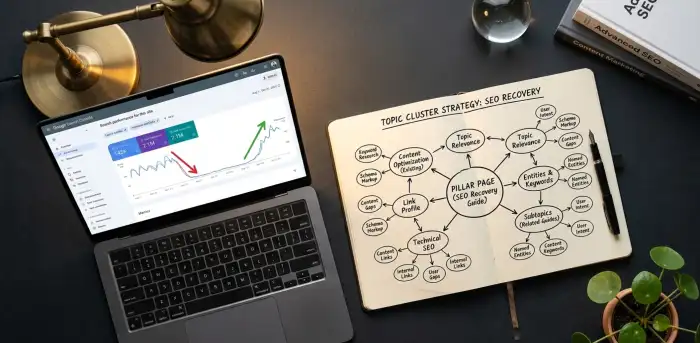
Your rankings dropped. Traffic is down. You’ve checked everything, no manual penalty, no technical error you can spot. And you’re wondering: can semantic SEO actually fix this, or is it just another buzzword?
Short answer: Yes but only if the drop happened because Google stopped understanding your content clearly enough to trust it. Semantic SEO doesn’t patch every problem. It solves a specific one: when your pages rank for the wrong reasons, cover topics too shallowly, or send mixed signals about what they’re really about. When that’s the cause of your drop, semantic SEO is exactly the right fix.
Quick Verdict
| Ranking Drop Cause | Does Semantic SEO Fix It? |
| Shallow content, poor topic coverage | ✅ Yes — directly |
| Google can’t identify your page’s entity/topic | ✅ Yes — directly |
| Algorithm update penalizing keyword stuffing | ✅ Yes |
| Technical issues (broken crawl, indexing errors) | ❌ No — fix technical SEO first |
| Manual Google penalty | ❌ No — requires disavow + reconsideration |
| Lost backlinks from authority sites | ❌ No — rebuild backlinks separately |
| Slow site speed / Core Web Vitals failure | ❌ No — UX fix required |
What Is Semantic SEO and Why Does It Matter for Recovery
Semantic SEO means optimizing your content around meaning, context, and intent, not just matching keywords.
Old SEO was about repeating a keyword enough times on a page. Google would find the word, match it to a search, and rank you. That’s not how it works anymore.
Since Google’s BERT update in 2019 and MUM in 2021, Google reads your content the way a knowledgeable human would. It understands that “fix a leaking pipe” and “stop water leak under sink” mean the same thing. It knows that a page about “diabetes management” should naturally mention insulin, blood sugar levels, diet, and A1C tests not because those are extra keywords to stuff in, but because that’s what a genuinely helpful, comprehensive page on the topic looks like.
So when your rankings drop after a core update, what Google is often saying is: your content doesn’t look like what a real expert would write on this topic. Semantic SEO is the fix for exactly that problem.
Geo + entity SEO mastery. LocalBusiness schema, location clusters boost 230% leads. Dominate Google Maps with Ben Stace-inspired local ranking tactics now!
Why Ranking Drops Happen in the First Place
Before fixing anything, you need to know what actually caused the drop. This is where most people make a mistake they jump into semantic optimization when the real problem is a crawl error or a lost backlink.
The most common causes of ranking drops in 2025:
- Core algorithm update — Google released the July 2025 core update, and like the March 2024 update before it, it specifically targeted sites that ranked without genuine topical depth. If your drop coincided with a known update date, this is likely the cause.
- Thin content — Pages that exist but don’t fully answer the user’s question. You have a page on “email marketing tips,” but it has 400 words and covers only generic advice everyone already knows.
- Keyword stuffing without context — Repeating a phrase many times without building the surrounding semantic field. Google notices when you say “best running shoes” 12 times but never once mentions arch support, pronation, or running surface.
- Topical gaps — You cover one aspect of a topic but ignore related areas that signal real expertise. A site about accounting software that never mentions payroll, tax compliance, or invoicing doesn’t look authoritative to Google, even if individual pages are well-written.
- Poor E-E-A-T signals — Experience, Expertise, Authoritativeness, Trustworthiness. Google’s December 2025 Core Update analysis of 150+ affected sites showed 87% negative impact on AI-generated content without expert oversight, and 63% ranking losses on generic keyword-targeted pages.
- Technical issues — Crawl errors, broken redirects, slow load times, and noindex tags left on important pages.
What to do first: Open Google Search Console. Check which pages lost impressions and clicks, and on what date. Cross-reference that date with known Google update rollout dates at moz.com/google-algorithm-change-history. If the dates align — semantic SEO is likely your answer. If the drop happened randomly with no update, check technical SEO first.
How Semantic SEO Actually Recovers Rankings (Step by Step)
Here’s the exact process not vague advice, but what you actually do.
Step 1: Identify Which Pages Lost Rankings
Open Google Search Console → Performance → Pages. Sort by clicks, change the date range to compare the last 3 months vs. the 3 months before. Look for pages where both clicks and impressions dropped significantly.
These are your target pages. Don’t try to fix everything at once. Pick your top 5–10 most important pages that lost traffic and start there.
Step 2: Run a Topical Gap Analysis on Each Page
For each page, ask: what should a genuinely expert page on this topic cover?
Go to Google and search your main keyword. Look at the top 3 ranking pages. Read them fully. Make a list of every subtopic, concept, and related question they cover that your page doesn’t.
Then check the “People Also Ask” section. Every question has a direct signal from Google about what users want to know about this topic. If your page doesn’t address those questions, your content has semantic gaps.
What not to do: Don’t just add a FAQ section and paste the PAA questions in. Google can tell when questions are shoehorned into content just to match search patterns. Integrate the answers naturally within your existing sections, or add a genuinely useful new section that expands the topic.
Build EEAT backlinks via digital PR. DA80+ guest posts, expert quotes from Miracle Concepts. 3x authority signals scale organic rankings fast!
Step 3: Build Your Semantic Entity Map
An entity is any specific, identifiable thing a person, place, concept, tool, brand, or process. Google Maps entities and their relationships to understand what a page is actually about.
For example, if you have a page about “project management tools,” the entities Google expects to see connected to that topic include: Gantt charts, Kanban boards, Agile methodology, sprint planning, Asana, Trello, ClickUp, task dependencies, and resource allocation. When those entities appear naturally in your content, Google understands the page is deeply about project management, not just a page that uses those words.
How to find your entity gaps:
- Search your keyword in Google
- Look at the “Related searches” at the bottom of the SERP
- Check the Knowledge Panel if one appears
- Use a free tool like InLinks.net or Surfer SEO to identify missing entities on your page compared to top competitors
Add the missing entities naturally. Write actual explanatory content around them, don’t just list them.
Step 4: Fix Shallow Content With Depth, Not Word Count
This is the most misunderstood step. People think fixing thin content means making it longer. That’s wrong.
A 2,000-word page that repeats the same five points is still thin content. A 900-word page that answers the user’s question completely, addresses related angles, and covers the topic with real depth is not thin content.
Depth means:
- Answering the primary question directly and completely
- Addressing the follow-up questions a reader will naturally have
- Including real examples, data points, or practical steps
- Acknowledging nuances (“this works for X but not for Y”)
- Connecting the topic to related concepts the reader needs to understand
What not to do: Don’t pad content with fluff sentences like “In today’s fast-paced digital world…” or “It’s important to note that…” These add word count and nothing else. Google’s NLP systems are sophisticated enough to detect low-information text.
Step 5: Build Topic Clusters Around Your Core Pages
A single well-written page rarely recovers rankings on its own. Google rewards topical authority meaning your site needs to show it covers a topic comprehensively, not just in one article.
Topic clusters work like this:
- Pillar page — A comprehensive, authoritative page on the broad topic (e.g., “Content Marketing Strategy”)
- Cluster pages — Specific, focused pages on subtopics (e.g., “How to Build an Editorial Calendar,” “Content Distribution Channels,” “Content ROI Metrics”)
- Internal links — Every cluster page links to the pillar page, and the pillar page links out to the cluster pages
This structure tells Google: this site doesn’t just have one page on content marketing. It has deep, organized coverage across the entire topic. That signals topical authority and topical authority is what gets you back in rankings after core updates.
Practical step: Take your top 5 most important pages. For each one, identify 3–5 subtopics that should have their own dedicated page but currently don’t. Build those pages. Link them together. This alone has recovered rankings for sites that lost 50%+ of traffic after major core updates.
Step 6: Add Structured Data (Schema Markup)
Schema markup is code you add to your pages that tells Google explicitly what your content is about. It’s one of the clearest semantic signals you can send.
For a services page, add Organization schema and Service schema. For a blog post, use Article schema with author, datePublished, and about fields filled in. For a FAQ section, use FAQPage schema this can trigger your questions to appear directly in the SERP, increasing both visibility and click-through rate.
How to add it without a developer: Use Google’sStructured Data Markup Helper it’s free and generates the code for you. Then paste the generated JSON-LD code into your page’s <head> section. Validate it atschema.org/validator.
What not to do: Don’t mark up content that isn’t visible on the page. If your schema says you have a 5-star rating but there are no reviews on the page, Google treats that as misleading and may ignore your schema entirely.
Step 7: Improve Internal Linking With Semantic Anchors
Internal linking is underestimated in semantic SEO recovery. The anchor text you use in your internal links tells Google what the linked page is about. If you link to your “email marketing guide” with the anchor text “click here” instead of “email marketing strategy,” you’ve missed a free opportunity to reinforce that page’s topic signals.
Go through your highest-traffic pages. Find every place where you mention a topic that has its own dedicated page on your site. Change the anchor text to describe what the linked page is actually about using natural, varied phrasing rather than the same keyword every time.
Then check the reverse: are your most important pages receiving enough internal links? A page that Google needs to rank well should be linked to from at least 5–10 other relevant pages on your site.
Semantic SEO audit checklist revealed. Entity gaps, topical clusters, and intent analysis. Miracle Concepts uncovers 184% traffic opportunities, audit-ready!
How Long Does Semantic SEO Recovery Actually Take
This is the honest answer most guides avoid giving.
If your drop was caused by a core algorithm update, full recovery typically happens at the next major core update — usually 2–6 months later. Google doesn’t re-evaluate affected sites continuously. It reassesses them when the next update rolls out.
That said, improvements can show up sooner. When you make significant content changes:
- You may see partial ranking recovery within 4–8 weeks as Googlebot re-crawls and reindexes your updated pages
- Featured snippet appearances can come back faster, sometimes within 2–3 weeks of implementing schema and FAQ content
- AI Overview citations (Google’s SGE results) can appear within weeks if your content is structured with clear, direct answers
Sites that recovered fastest after the 2024–2025 core updates did so by making structural changes, killing zombie pages, rebuilding topical clusters, and rewriting shallow content, not by adding a few keywords.
What Google’s 2025 Core Updates Actually Targeted
Understanding what caused mass ranking drops in 2024–2025 tells you exactly what to fix.
The December 2025 Core Update specifically targeted:
- AI-generated content published without expert review or human oversight
- Thin affiliate pages with no original testing, analysis, or first-hand experience
- Generic content optimized for keywords rather than written to genuinely help a reader
- Pages with poor E-E-A-T signals — no clear author, no demonstrable expertise, no trust signals
What recovered fastest: sites with original research, demonstrated expertise, clear authorship, and content that answered full search intents rather than single keywords. A B2B SaaS platform that dropped 55% after the September 2024 update fully recovered within 90 days by making structural clarity changes without thousands of new backlinks.
The pattern is clear. Recovery doesn’t require more content. It requires better-structured, more meaningful content that Google’s AI systems can understand and trust.
The Mistakes That Slow Down Recovery
Publishing more content immediately. When rankings drop, the instinct is to publish more articles. That often makes things worse. More thin content signals more quality problems. Pause new publishing. Fix existing pages first.
Chasing keyword density instead of semantic completeness. Adding your target keyword 15 times doesn’t help in 2025. Covering the topic so completely that a reader doesn’t need to go elsewhere — that’s what recovers rankings.
Fixing only the pages that dropped. Sometimes a ranking drop on one page is caused by quality issues across the site pulling down overall domain trust. A technical audit using Screaming Frog and a content audit using Google Search Console together give you the full picture.
Ignoring user experience signals. Bounce rate, time on page, scroll depth these are behavioral signals Google uses to validate whether your content genuinely helps. Even semantically rich content won’t recover rankings if users leave within 10 seconds. Make sure the content is also easy to read: clear headings, short paragraphs, no walls of text.
Not updating old content. Outdated statistics, old tool recommendations, references to things that no longer exist Google’s systems are increasingly capable of detecting staleness. Refreshing content with current data and updated examples is one of the fastest ways to signal freshness without rebuilding entire pages.
The Semantic SEO Checklist Before You Republish
Use this before pushing any updated page live:
- [ ] Does the page answer the primary search intent directly in the first paragraph?
- [ ] Are all entities that belong to this topic present and explained naturally?
- [ ] Have the People Also Ask questions been addressed within the content?
- [ ] Is schema markup added and validated?
- [ ] Are internal links using descriptive, semantic anchor text?
- [ ] Does the page link to and from related cluster pages?
- [ ] Is there a clear author or expertise signal visible on the page?
- [ ] Has all duplicate, thin, or redundant content on the same topic been removed or consolidated?
- [ ] Does the content include at least one original insight, data point, or practical example not found on competing pages?
One More Thing Worth Knowing
Semantic SEO isn’t just a recovery tool. It’s how you protect rankings before they drop.
Every core update Google releases moves further toward rewarding topical authority, entity clarity, and genuine helpfulness. Sites that build semantic structure proactively, topic clusters, schema, and deep content coverage take smaller hits when updates roll out because their content already looks like what Google wants to surface.
Reactive SEO (fixing things after a drop) works, but it’s always slower and more expensive than building the right structure from the start.
Working With the Right SEO Partner Matters
Applying semantic SEO correctly takes more than reading a guide. It requires a content audit, entity mapping, topical cluster planning, technical review, and consistent execution over months not weeks.
AtMiracle Concepts, semantic SEO is part of a broader digital strategy. The team works across SEO (technical, on-page, and content strategy), UX design (making sure ranking pages are genuinely easy to use and engage with), web development (implementing schema markup, fixing site architecture, improving page speed), document formatting (producing clean, professional content that builds E-E-A-T signals), and MSP services (keeping the technical infrastructure stable so SEO work doesn’t get undermined by server or security issues). If your rankings dropped and you want a clear, actionable recovery plan, not a generic audit PDF Miracle Concepts builds strategies around your specific situation.