
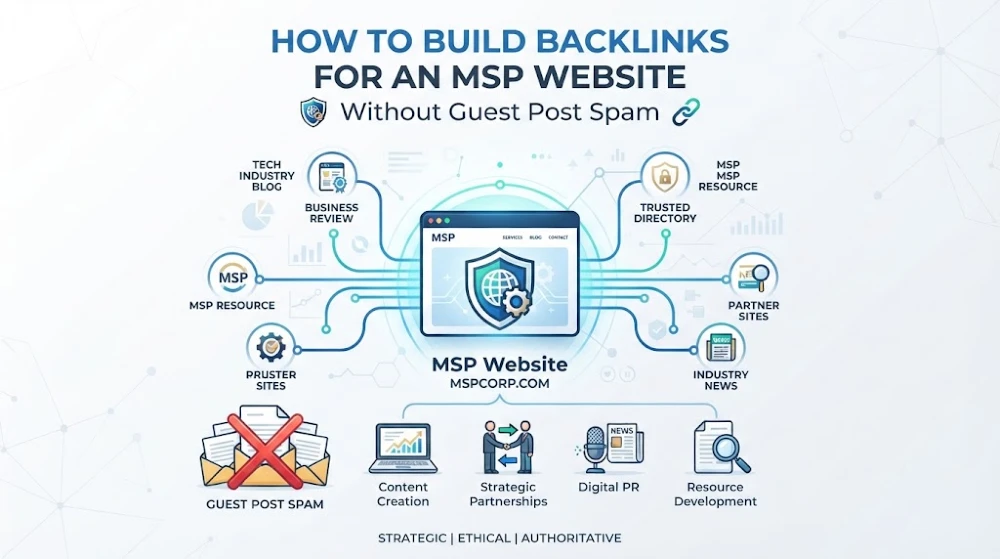
If you want to build backlinks for an MSP website that actually move the needle, the answer is simple: stop chasing guest post networks and start earning links from sources that are genuinely connected to your business. That means vendor partners, IT directories, local sponsorships, and real digital PR not paid link farms that promise “50 backlinks for £99.”
This guide walks through exactly where those real links come from, how to judge whether an opportunity is worth your time, and how to keep your MSP SEO strategy safe from Google penalties.
Why MSP Websites Need Real, High-Quality Backlinks
MSP websites need backlinks because search engines use them as trust signals. A link from a relevant, credible site tells Google that other reputable sources vouch for your content and that pushes your domain authority up.
Without a healthy backlink profile, even a technically perfect MSP website struggles to outrank competitors for terms like “IT support near me” or “managed services provider.”
How Strong Links Build Domain Authority and Trust for IT Buyers
The direct answer: quality backlinks raise your domain authority and signal trustworthiness to both search engines and IT buyers researching vendors.
IT buyers rarely make a decision after one visit to your site. They check reviews, look for third-party mentions, and read case studies before requesting a quote. A backlink from a respected vendor, association, or publication does double duty:
- It passes link equity that helps your organic search rankings.
- It acts as social proof that a prospect notices during their own research.
This is exactly why backlink strategy should sit alongside your keyword research work, not come as an afterthought.
Why Low-Quality Guest Post Networks Can Hurt More Than Help
The direct answer: spammy guest post networks and private blog networks (PBNs) can trigger manual penalties and tank your rankings instead of improving them.
These networks sell links on irrelevant, low-authority sites stuffed with unrelated content gambling, forex, and generic “business tips” blogs with no connection to IT services. Google’s algorithms are very good at spotting unnatural anchor text patterns and link velocity that doesn’t match a site’s real growth.
Common warning signs of a bad link network:
- Sites accept any topic for a fee, with no editorial review.
- The same “author” appears across hundreds of unrelated domains.
- Anchor text is over-optimized (exact-match keywords every time).
- Domain metrics look inflated but referring traffic is near zero.
Partner and Vendor Links MSPs Can Earn Naturally
The most reliable backlinks for an MSP website usually come from businesses you already work with vendors, distributors, and technology partners.
These links tend to carry strong topical relevance because both sites operate in the same industry, which is exactly the kind of contextual signal search engines reward.
Backlinks from Vendor Portals and Partner Pages
The direct answer: most MSP software and hardware vendors maintain a “find a partner” directory, and getting listed there earns a free, relevant backlink.
Vendors such as Microsoft, Datto, ConnectWise, N-able, and Cisco all run partner locator pages. To get listed:
- Log in to your vendor’s partner portal and check your listing status.
- Confirm your business profile, service area, and certifications are current.
- Ask your partner account manager directly if you’re not automatically listed.
These links are dofollow in most cases and sit on high-authority domains a genuine win for your backlink profile.
Mutual Content and Case Studies With Complementary IT Providers
The direct answer: co-authoring case studies or joint content with complementary providers (not direct competitors) creates natural, two-way links.
For example, a cybersecurity vendor you resell for might feature a joint case study on their site, linking back to yours. A cloud backup partner might do the same. This works because:
- The content is genuinely useful to both audiences.
- The link sits within relevant, on-topic content not a random footer.
- It strengthens the relationship, not just the SEO metric.
Industry Directories and Associations in the MSP/IT Space
Directory and association links are some of the easiest backlinks for an MSP website to secure, and they also send referral traffic from buyers actively looking for a provider.
MSP and IT Service Directories Your Website Should Be Listed On
The direct answer: list your business on established, industry-specific directories rather than generic business listing sites for the best relevance and trust value.
Worthwhile directories include:
| Directory Type | Example Sources | Why It Helps |
|---|---|---|
| MSP-specific | Clutch, GoodFirms, The Channel Co | Industry-relevant audience and context |
| General business | Google Business Profile, Bing Places | Local SEO and map pack visibility |
| Tech review sites | G2, Capterra (if you sell software too) | Buyer intent traffic |
Keep your business name, address, and phone number (NAP) identical across every listing — inconsistent details confuse both users and search engines.
Trade Associations, Chambers, and Local Business Groups With Member Profiles
The direct answer: joining a trade association or local chamber of commerce usually includes a member profile link, and it’s a legitimate, low-effort backlink source.
Look at organisations like CompTIA, your regional MSP alliance, or your local chamber of commerce. Membership often comes with:
- A profile page on the association’s site, usually linking to yours.
- Eligibility for award nominations or member spotlights (more link opportunities).
- Networking access that can lead to referral partnerships later.
Local Sponsorships, Events, and Community Links
Local backlinks matter more than many MSP owners realise, especially if you serve a specific city or region rather than operating nationwide.
Turning Local Sponsorships Into Contextual Backlinks
The direct answer: sponsoring local events, sports teams, or charity drives almost always comes with a link back to your site from the event page.
This works well because:
- It’s a natural, non-commercial context, which search engines trust.
- It reinforces your presence for location-based keyword targeting.
- It builds genuine community goodwill alongside the SEO benefit.
When sponsoring, always confirm the organiser will add your business name and link to their website or sponsors page — don’t assume it happens automatically.
Links From Regional Business Publications and Community Blogs
The direct answer: regional business journals and community blogs often cover local company news, expansions, and hires — and that coverage includes a backlink.
Ways to get featured:
- Send a short press release when you hire, open a new location, or hit a milestone.
- Offer to comment as a local IT expert when journalists cover tech or cybersecurity stories.
- Sponsor a local podcast or newsletter that links to sponsor sites.
Digital PR and Thought Leadership for MSPs
Digital PR is where MSPs can earn backlinks from genuinely high-authority publications but only with content that’s worth covering.
Original Research, Surveys, or Checklists That Journalists Want to Cite
The direct answer: publish original data a survey of local businesses, a security incident report, or a practical checklist because journalists and bloggers link to sources with unique numbers, not opinions.
Ideas that consistently earn links:
- An annual survey on small business cybersecurity readiness in your region.
- A breakdown of common ransomware entry points based on your own client data (anonymised).
- A free downloadable audit checklist that other sites reference as a resource.
Original research pairs well with content built around long-tail keyword targeting, since journalists often search specific, niche phrases when looking for sources.
Getting Mentioned in Roundups and Expert Quote Articles Without Spammy Outreach
The direct answer: respond to legitimate journalist request platforms and industry roundups with genuinely useful quotes, rather than mass-emailing bloggers for a link.
Practical steps:
- Sign up for journalist request services (HARO-style platforms) using your real business email.
- Answer only questions where you have direct, first-hand expertise.
- Keep quotes short, specific, and free of obvious self-promotion.
- Follow up politely once don’t chase repeatedly.
How to Judge Whether a Backlink Opportunity Is Worth It
Not every backlink opportunity deserves your time. The direct answer: check relevance, trust, and audience fit before pursuing any link volume alone means nothing.
Relevance, Trust, and Audience Fit for MSP SEO
Before agreeing to any link exchange, sponsorship, or directory listing, ask:
- Is the site actually relevant to IT services, business, or your local area?
- Would a real person on this site plausibly click through to an MSP?
- Does the site have genuine organic traffic, not just inflated domain metrics?
- Is the link placed within real content, not a spammy footer or sidebar list?
If you can’t answer “yes” to most of these, skip it a smaller number of relevant links consistently outperforms a large batch of irrelevant ones.
Simple Rules to Avoid Low-Quality Guest Post Networks and PBNs
Keep these rules in mind before accepting any outreach pitch:
- Never pay a flat fee for “guaranteed” placement on multiple unrelated sites.
- Be wary of sites offering to publish content on any topic you request.
- Check if the domain has a real editorial history, not just recent link-selling content.
- Avoid exact-match anchor text on every single link vary it naturally.
- If an offer sounds too easy or too cheap, it usually is.
Building backlinks for an MSP website takes patience, but it’s far more durable than gaming the system. Combine this link-building approach with solid technical SEO and the right terminology across your site including the difference between MSP and IT support keyword targeting and your rankings will hold up long after a rented PBN link gets deindexed.