

Long-tail keywords are the specific, multi-word search phrases your actual buyers type when they’re close to ready to hire, and in 2026 they matter more than ever because AI-powered search has made short, generic terms even harder to rank for and even less likely to convert. A buyer searching “IT support” could want anything. A buyer searching “24/7 IT support for clinics in Leeds” wants exactly one thing, from a very specific kind of provider.
If your MSP is still chasing broad, one- or two-word keywords, you’re competing against every IT company in the country for traffic that rarely converts. Here’s the full set of long-tail patterns worth building your 2026 keyword strategy around, including the AI-driven searches that didn’t exist in most keyword lists even a year ago.
Why Long-Tail Keywords Matter More for MSPs in 2026
Long-tail keywords matter more for MSPs in 2026 because they carry far higher buyer intent than short, generic terms, and because AI-powered search results have made those generic terms even more crowded and less rewarding to chase.
Higher Buyer Intent and Lower Competition
A short keyword like “managed IT services” pulls in a huge mix of searchers: researchers, competitors checking pricing, job seekers, and the rare qualified buyer buried somewhere in the mix. A long-tail phrase like “flat-fee managed IT services for small businesses in Manchester” filters almost all of that noise out on its own. The person typing that phrase already knows what they want, roughly what they’re willing to pay, and where they need service delivered.
Lower competition is the practical bonus. Fewer MSPs are actively targeting five- and six-word phrases, which means a well-built page can realistically rank for a long-tail term far faster than it could ever rank for a single competitive word.
How AI-Era Search Behaviour Is Changing MSP Queries
Search behavior itself has shifted. AI-powered search results and chat-based assistants increasingly answer broad questions directly, without sending the searcher to a website at all. That makes ranking for a vague query less valuable than it used to be, since fewer of those searches result in a click regardless of your ranking position.
What still reliably sends a visitor to your site is a specific, actionable query, something an AI answer engine can’t fully resolve without pointing to an actual provider. That shift is part of why specific, buyer-intent phrases deserve more of your keyword strategy in 2026 than they did a few years ago.
Core Long-Tail Keyword Patterns for MSP Services
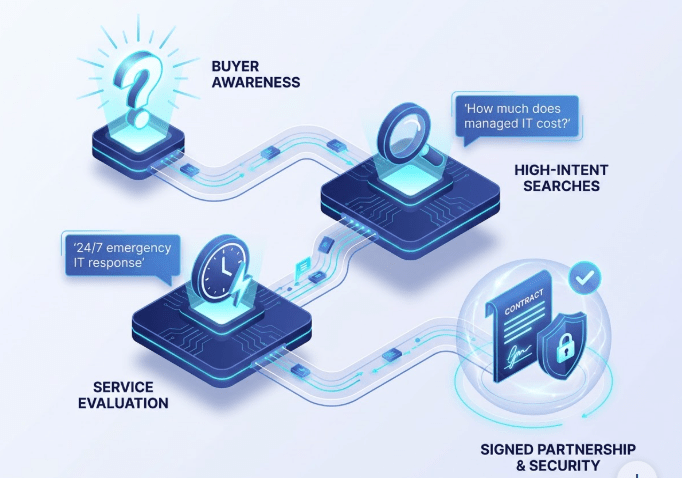
The core long-tail keyword patterns for MSP services combine a specific offering with an industry or business size and a location, mirroring exactly how a real buyer describes their need when they search.
Managed IT Support for [Industry] in [Location]
This is the foundational MSP long-tail pattern: “Managed IT support for law firms in Leeds,” “Managed IT support for architecture firms in Bristol.” Run this pattern across every industry you serve and every city in your service area to build a solid working list.
Cybersecurity and Compliance Services for [Industry] in [Location]
Security and compliance searches tend to carry even higher intent than general IT support searches, because the buyer usually has a specific regulatory or risk concern driving the search. “Cybersecurity services for financial firms in Edinburgh” or “Compliance-focused IT support for healthcare providers in Cardiff” both signal a buyer who already knows security is the priority, not an afterthought.
Cloud Migration and Ongoing Management for [Business Size] in [Location]
Cloud-related searches increasingly specify company size, since a 10-person firm and a 200-person firm need very different migration and management approaches. “Cloud migration and management for small businesses in Glasgow” targets a buyer whose expectations, and budget, look very different from an enterprise search.
AI-Era Long-Tail Keywords MSPs Should Not Ignore
AI-era long-tail keywords reflect a genuinely new category of buyer demand: businesses that have already adopted AI tools and now need someone to manage, secure, and support them, a service category that barely existed in most MSP keyword lists a couple of years ago.
“AI-Powered IT Monitoring” and “Automated Threat Detection” Phrases
Buyers researching modern security tooling increasingly search using the AI-specific terminology vendors have trained them on: “AI-powered IT monitoring for small businesses” or “automated threat detection services.” If your MSP already uses AI-driven monitoring or detection tools as part of your stack, these terms let you speak directly to buyers who are specifically looking for that capability, not just generic security coverage.
Keywords Around “AI Helpdesk” and “AI Chat Support” for Businesses
As AI chat tools become standard in customer-facing software, business buyers are starting to search for MSPs who can implement and support that layer directly: “AI helpdesk setup for small businesses” or “AI chat support implementation for SMEs.” This is a genuinely new keyword category worth testing content against, even in a small way, before your competitors claim it.
Queries Combining AI Tools With MSP Services (e.g., “MSP that manages Microsoft Copilot for SMEs”)
The clearest AI-era opportunity right now centers on Microsoft Copilot. As Copilot has moved into affordable, always-on pricing tiers built specifically for smaller organizations, a real and growing number of businesses need an MSP to handle the governance, security, and rollout side of adoption.
Search phrases like “MSP that manages Microsoft Copilot for SMEs” or “Copilot deployment support for small businesses” reflect that exact need, and this is a category most MSP websites still haven’t built dedicated content around, which makes it one of the better-timed opportunities on this list.
Buyer-Question Keyword Formats That Convert in 2026
Buyer-question keyword formats convert well because they match the exact way people phrase searches when they’re actively comparing providers, rather than casually researching a topic.
“Who Provides Ongoing IT Support for [Industry] in [Location]?”
This full-question format signals a buyer actively looking for a specific provider match, not general information. A page built to directly answer “Who provides ongoing IT support for dental practices in Sheffield?” in its opening section gives both the searcher and search engines a clear, immediate answer.
“How Much Does Managed IT Cost for a [Business Size] Company in [Location]?”
Pricing questions are some of the highest-intent searches an MSP can target, since a buyer researching cost has usually already decided they need the service and is now comparing options.
Content answering this question should give real, honest pricing context, ranges, common pricing models, factors that affect cost, rather than dodging the question and hoping for a form fill instead.
“Which MSP Can Handle Cybersecurity and Compliance for [Industry]?”
This format combines the “who” and “capability” question in one search, and it’s common among buyers in heavily regulated industries who need to confirm a provider’s specific expertise before they’ll even consider a call.
Answering it directly, with specifics about which regulations and frameworks you support, does more to build trust than a generic security overview page ever will.
Long-Tail Keywords for Specific Buyer Pain Points
Long-tail keywords built around specific buyer pain points, downtime risk, security exposure, and unpredictable costs, consistently convert well because they match the actual reasons businesses go looking for a new MSP in the first place.
Downtime and Response Time Concerns (e.g., “24/7 IT support for clinics in [Location]”)
Downtime is one of the most urgent pain points a business can search around, and it shows up in phrases like “24/7 IT support for clinics in Newcastle” or “emergency IT response for retail businesses.” These searches often come from someone dealing with an active problem, or someone who just experienced one and is now shopping for better coverage.
Security, Data Protection, and Regulation (e.g., “HIPAA/GDPR-compliant IT support for [Industry]”)
Regulatory compliance searches, “GDPR-compliant IT support for legal firms,” “HIPAA-compliant managed IT for healthcare practices”, target buyers who need proof of specific compliance capability, not general reassurance. These buyers convert well because the search itself already filters out providers who can’t credibly make that claim.
Budget and Predictable Pricing (e.g., “flat-fee managed IT services for small businesses in [Location]”)
Small and mid-sized businesses in particular search for pricing predictability directly: “flat-fee managed IT services for small businesses in Nottingham” or “fixed-price IT support for startups.” This pain point, unpredictable IT costs, is common enough that a dedicated page addressing it head-on tends to perform well against competitors who bury pricing information behind a contact form.
Building Your 2026 MSP Keyword List From These Patterns
Building your 2026 keyword list means systematically applying these patterns to your actual services, industries, and locations, then prioritizing the resulting list based on real buyer intent and your ability to deliver, rather than trying to target everything at once.
How to Turn Patterns Into Actual Target Keywords for Your Geography and Verticals
Take each pattern from this article and run it against three lists you should already have: your core services, your priority industries, and your actual service area locations. The combinations that fall out of that exercise, service plus industry plus location, or pain point plus location, become your working keyword list. This is mechanical, deliberate work, not guesswork, and it produces a far more useful list than brainstorming keywords from memory.
Prioritising Keywords Based on Buyer Intent and Service Fit
Not every combination deserves a dedicated page immediately. Prioritize keywords where you have real service capability and existing proof, case studies, certifications, client examples, since a page making a claim you can’t back up will convert poorly even if it ranks well. Buyer-question and pain-point formats generally deserve priority over broader service pages, since they carry the clearest signal of someone close to a buying decision.
Updating Your Long-Tail Set As New AI Tools and Regulations Appear
Your keyword list shouldn’t be static. As new AI tools reach mainstream business adoption, and as new regulations affect how businesses need to handle data and AI governance, new search patterns will keep emerging the same way “AI helpdesk” and “Copilot management” searches emerged over the past year. Revisit your keyword list regularly rather than treating it as a one-time project.
Spotting the right long-tail keywords is only the starting point. Building the pages, content, and technical SEO foundation that actually rank for them, and keeping that list current as AI tools and buyer behavior keep shifting, is ongoing work most MSPs don’t have the internal bandwidth for. That’s exactly what our MSP SEO Services and MSP Growth Services are built to handle.
If you want a keyword strategy built around your actual services, verticals, and service area instead of a generic template, book a free consultation and we’ll show you exactly which long-tail terms your competitors haven’t claimed yet.