
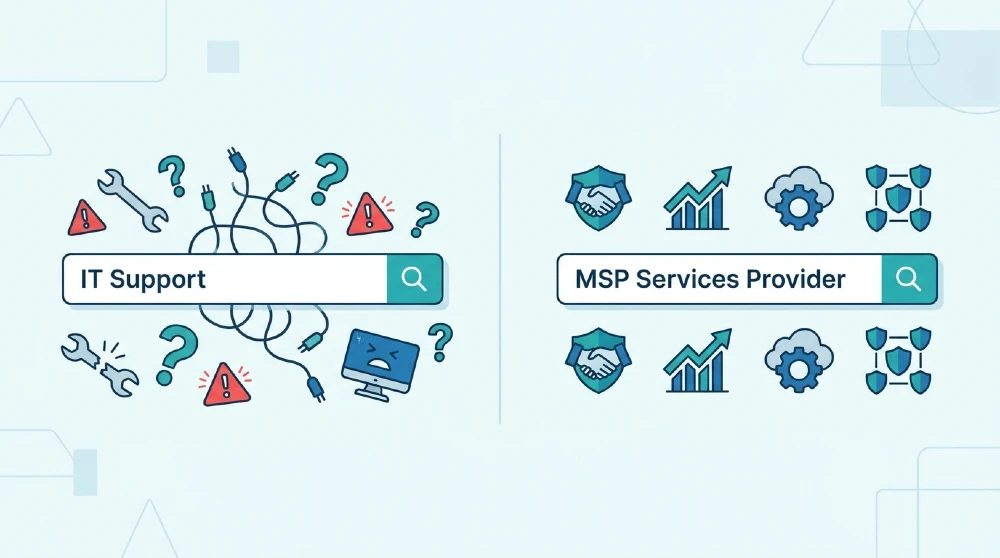
If you sell managed IT services, the keywords you target decide who shows up in your inbox. A MSP services provider keyword strategy consistently pulls in better leads than a generic “IT support” strategy, because it matches searchers who already want ongoing, contract-based help, not a one-time fix. This article breaks down why that gap exists and how to shift your keyword plan to close it.
The Real Difference Between “IT Support” and “MSP Services Provider” Searches
“IT support” and “MSP services provider” look similar on the surface, but they attract two very different types of buyers. One is looking for quick help. The other is looking for a partner.
What Buyers Usually Mean When They Type “IT Support”
Most people searching “IT support” have a problem right now. A server is down, a laptop won’t boot, or an employee is locked out of email.
This search intent is broad and often transactional. It includes:
- One-time repair needs
- Emergency, break-fix requests
- Low-budget shoppers comparing hourly rates
- People who don’t yet know what an MSP even is
Some of these searchers do turn into long-term clients. But a large share just want the fire put out, not a relationship.
What Buyers Usually Mean When They Type “MSP Services Provider”
Someone searching “MSP services provider” already understands the managed services model. They’re typically a business owner, IT director, or operations manager comparing vendors for ongoing support.
This search intent points to:
- Monthly, contract-based service agreements
- Proactive monitoring and maintenance, not just repairs
- A desire for strategic IT planning, not emergency triage
- Buyers further along in their decision process
That single word, “managed”, signals recurring revenue instead of a one-off ticket.
Buyer Intent: Why MSP Keywords Attract Better Leads
MSP keywords convert better because they filter out low-intent traffic before it ever reaches your site. The searcher has already decided they want managed support, you just need to be the option they pick.
“MSP Services” Implies Ongoing, Managed, Monthly Support
When someone searches for MSP services, they’re usually evaluating vendors for a recurring contract, not a same-day fix. This aligns directly with how most managed IT companies actually generate revenue: monthly retainers, not hourly invoices.
“IT Support” Often Captures One-Off, Low-Budget Needs
Generic IT support searches mix in students, home users, and small shops looking for the cheapest possible fix. Your ad spend and content effort get diluted across people who were never going to sign a service agreement.
How Intent Differences Show Up in Lead Quality and Close Rates
| Signal | “IT Support” Traffic | “MSP Services Provider” Traffic |
| Typical budget | Low, one-time | Higher, recurring |
| Deal type | Break-fix invoice | Monthly retainer |
| Sales cycle | Short, price-driven | Longer, relationship-driven |
| Close rate on qualified calls | Lower | Higher |
The pattern shows up almost every time a natural language processing tool analyzes search queries for semantic intent: phrases with “managed,” “provider,” and “outsourced” cluster around bottom-of-funnel (BOFU) buying behavior, while “support” and “fix” cluster around urgent, short-term need.
Competition and SERP Landscape: Easier Wins With MSP Keywords
You’ll rank faster and spend less on ads if you stop chasing “IT support” nationally and focus on “MSP” and “managed IT services” terms instead. The competition is lighter and the traffic converts better.
Why “IT Support” Is Crowded With Big Brands and General IT Competitors
Generic IT support search results are dominated by large national brands, marketplaces, and broad directory sites. Ranking on page one for a plain “IT support” term with no city or niche attached is close to impossible for a local MSP.
How “Managed IT Services” and “MSP Provider” Niches Are Less Saturated but Highly Valuable
Search terms like “managed IT services provider” or “MSP for healthcare” have far less competition because fewer companies bother targeting them specifically. Yet the buyers searching these phrases are exactly who MSPs want: informed, ready to compare vendors, and looking for a long-term fit.
What 2025–2026 MSP SEO Benchmarks Show About Conversion vs. Volume
Search volume for “MSP services provider” and related managed IT phrases is smaller than for “IT support.” That’s expected, and it’s fine. Lower volume with higher qualified-lead conversion beats high volume with poor fit almost every time.
The practical advice repeated across MSP marketing benchmarks is simple: don’t fight for the impossible national “IT support” keyword. Combine “managed IT” or “MSP provider” with your city and industry instead.
Revenue Model Fit: MSP Keywords Align With Recurring Contracts
MSP keywords convert better because they match your actual business model. You sell monthly retainers, not one-time repairs, so your keywords should say exactly that.
Keywords That Signal Buyers Looking for Long-Term Partnerships
Watch for phrases that carry commitment language: “provider,” “partner,” “managed,” “ongoing.” These words tell you the searcher isn’t just looking for a quick fix, they’re vetting a vendor relationship.
Why Break-Fix and Generic Support Keywords Rarely Lead to MSP Retainers
Someone typing “fix my computer near me” almost never converts into a signed managed services agreement. The intent mismatch means you’re paying to attract the wrong audience, even if the click is cheap.
Examples of High-Intent MSP Phrases
Use these as a starting template for your own keyword list:
- Managed IT services provider
- Outsourced IT provider
- Co-managed IT services
- MSP for small business
- Managed IT services [city name]
- IT managed services provider near me
Each of these phrases carries stronger buyer intent than a bare “IT support” query.
How to Shift Your Keyword Strategy From “IT Support” to “MSP Services Provider”
Moving your keyword strategy means rebuilding your core pages around managed IT language, then layering in industry and location terms for extra precision.
Rebuilding Service Pages Around Managed IT and MSP Language
Update your homepage, service pages, and title tags to lead with “managed IT services” or “MSP services provider” instead of generic “IT support.” This single change improves both topical relevance for search engines and clarity for human visitors.
Combining “MSP Provider” Phrases With Industry and Location (Vertical + Geo)
Layering an industry (healthcare, legal, finance) or a city name onto your MSP keywords sharpens intent even further. “MSP services provider for law firms in Dallas” attracts a much more qualified visitor than “IT support Dallas.”
For a deeper walkthrough on combining industry and location targeting, see this guide on MSP keyword research by industry and location.
Using “IT Support” Only Where It Still Makes Strategic Sense
“IT support” isn’t useless, it just needs a narrower job. Keep it on:
- Local, hyper-specific landing pages
- Emergency or after-hours support pages
- Pages meant to capture urgent, same-day requests
Let “managed IT” and “MSP” carry your main brand positioning, and let “IT support” handle the emergency-page niche.
Measuring the Conversion Lift From MSP-Focused Keywords
You confirm MSP keywords are working by tracking lead source against deal size and contract length, not just click volume. The numbers will show the shift clearly within a few months.
What to Track: Lead Source, Deal Size, Retainer Length
Set up tracking that ties every inbound lead back to the keyword or landing page that brought them in. At minimum, track:
- Lead source (organic keyword or ad campaign)
- Initial deal size
- Contract length (one-time vs. monthly retainer)
- Time from first contact to signed agreement
Comparing Performance of “IT Support” vs. “Managed IT Services Provider” Keywords
After 60–90 days of data, compare the two keyword groups side by side. Look specifically at close rate and average contract value, not just traffic numbers. This is usually where the case for MSP keywords becomes obvious.
When It’s Time to Drop Low-Intent Generic Terms
If a keyword group consistently produces clicks but few signed retainers, it’s time to scale back your investment in it. Redirect that budget toward long-tail MSP phrases instead, for ideas on where that traffic tends to convert best, review this breakdown of MSP long-tail keywords for 2026.
FAQs
Not always, it depends on your goal. For building recurring, contract-based clients, MSP keywords win. For capturing emergency or one-time repair traffic, “IT support” still has a role.
Start with core managed IT terms, then narrow by industry and location. A full walkthrough on this process is available in this MSP SEO keyword research guide.
No. Keep it on a small set of pages built for urgent, local searches. Just don’t lead your main brand messaging with it.
Most MSPs start seeing clearer lead-quality data within 60–90 days, though full retainer-signing cycles can take longer depending on your sales process.
They mean the same thing to most buyers. “MSP” is the industry shorthand for “managed service provider,” and both terms carry the same recurring-support intent in search.