
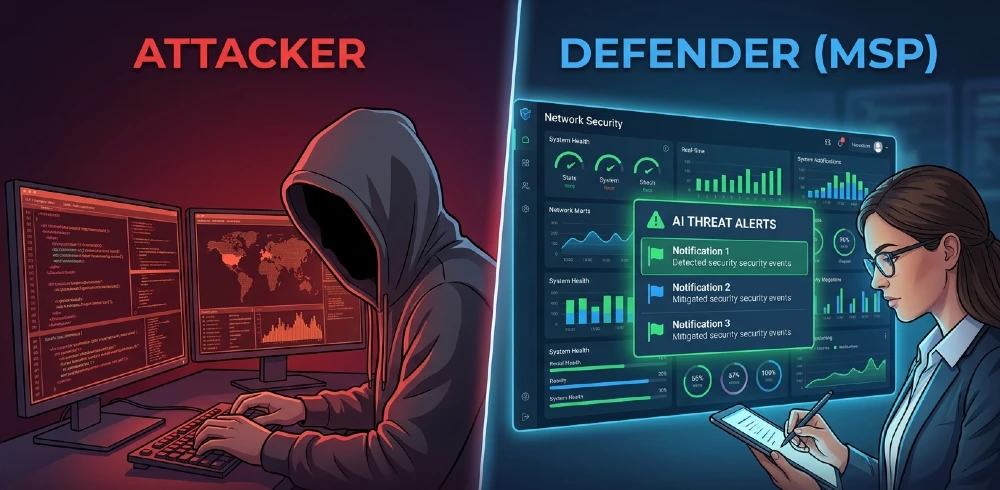
Something changed in early 2026. The cyberattacks hitting Managed Service Providers stopped feeling random. They felt calculated — almost personal. That is because they are. Attackers now use artificial intelligence to study your clients, mimic your team’s voices, and hit you at your weakest moment. AI cybersecurity for MSPs is no longer a buzzword. It is survival.
According to a 2026 industry survey cited by CompTIA and cross-referenced in Datto’s MSP Threat Landscape Report, over 56% of MSPs already use some form of AI for threat detection. But here is the uncomfortable truth — the attackers adopted AI faster. And they are using it better.
This is not a doom-and-gloom piece. This is a practical, honest look at what is happening, what it means for your clients, and what MSPs who are winning actually do differently.
The AI vs. AI Arms Race Is Real — And MSPs Are Caught in the Middle
Let’s be direct. The old model — perimeter firewall, antivirus, monthly patching — is dead against AI-powered attackers. Full stop.
What has changed? Attackers now have access to AI tools that automate the most time-consuming parts of hacking: reconnaissance, payload creation, and target selection. What used to take a skilled attacker three weeks now takes three hours. Sometimes three minutes.
Here is what that looks like on the ground:
• A threat actor uses AI to scrape LinkedIn, your website, and your client’s invoicing portal. In 20 minutes, it knows your client’s CEO’s name, writing style, vendor relationships, and recent travel.
• It generates a hyper-personalized phishing email — not a generic “Dear Customer” scam, but a message that references a real invoice number and sounds exactly like someone from your team.
• Your client clicks. The AI-driven payload adapts in real time, avoiding your existing signature-based detection.
• Within hours, ransomware is spreading — not just in one client network, but potentially across multiple clients through your shared MSP tooling.
This is not hypothetical. Cybersecurity firm CrowdStrike documented a 2025 incident where an MSP’s remote management platform was used as a launchpad against 47 SMB clients simultaneously. The entry point was a deepfake voice call that successfully convinced an IT admin to reset credentials.
Understanding how your MSP business is structured is the first step to hardening it. If you haven’t reviewed your core service architecture lately, this overview of what MSP services actually provide is worth ten minutes of your time.
Breaking Down the AI-Powered Threats MSPs Face in 2026
1. AI-Driven Ransomware: Smarter, Faster, More Destructive
Traditional ransomware was blunt. It encrypted everything and hoped for the best. AI-driven ransomware is surgical.
According to Sophos’s 2026 State of Ransomware report, AI-assisted ransomware variants now include adaptive spreading logic — they analyze network topology in real time and prioritize the highest-value targets first. Backups get hit before you even notice the breach.
For MSPs, this is catastrophic. One compromised client can become the entry point for a cascading attack across your entire client base. The attacker is not just hitting Company A. They are using Company A’s trusted relationship with your platform to get to Companies B through Z.
2. Hyper-Personalized Phishing and BEC: The Deepfake Problem
Business Email Compromise (BEC) attacks have always been personal. AI makes them frighteningly accurate.
Researchers at IBM’s X-Force threat intelligence division reported in Q1 2026 that AI-generated phishing emails now bypass human detection at a rate of 78% — meaning most people simply cannot tell the difference. These emails reference real project names, real contacts, and are written in the exact tone of whoever they are impersonating.
Voice cloning is the newest front. All an attacker needs is a 30-second audio sample — often scraped from a public Teams recording or a YouTube appearance — to clone a CEO’s voice well enough to authorize a fraudulent wire transfer by phone.
What this means for your clients:
• Finance teams need explicit verbal-plus-written verification protocols for any transfer over a threshold amount.
• Any employee who regularly appears in public audio/video is a high-value target for voice cloning.
• Generic security awareness training no longer cuts it — employees need to specifically learn to recognize AI-generated content.
3. Supply Chain Attacks: The MSP Is the Target
Here is something the industry does not say loudly enough: MSPs are not just caught in the crossfire. They are the primary target.
Why? Because a single compromised MSP gives attackers authenticated access to dozens or hundreds of SMB networks simultaneously. The ROI for a criminal is extraordinary.
CISA (Cybersecurity and Infrastructure Security Agency) flagged MSP supply chain compromise as a top-three threat vector entering 2026. AI accelerates these attacks by automating credential stuffing, identifying unpatched RMM vulnerabilities, and adapting payloads to bypass MSP-specific security tools.
If your clients are still debating whether to bring IT in-house or keep their MSP, the security implications of that decision are significant. Here is a balanced breakdown of MSP services vs. in-house IT teams that addresses real security trade-offs.
4. Shadow AI and Agentic AI: The Threat Inside Your Own House
This one surprises a lot of MSPs. The threat is not just external.
Shadow AI refers to AI tools your employees and clients use without formal approval or governance — ChatGPT plugins, AI coding assistants, browser-based summarizers. Each one is a potential data leakage point.
Agentic AI is more advanced. These are autonomous AI systems that take actions on behalf of users — browsing the web, sending emails, executing code. When an agentic AI gets compromised through prompt injection (a technique where malicious instructions are hidden in content the AI reads), it can exfiltrate data or take damaging actions without any human in the loop.
According to the 2026 OWASP Top 10 for LLM Applications, prompt injection remains the number one risk in AI-integrated systems. For MSPs who are deploying or managing AI tools for clients, this is your responsibility to address.
How MSPs Are Fighting Back: Defensive AI That Actually Works
Enough about the threats. Let’s talk about what the best MSPs actually do.
The MSPs winning in 2026 did not just buy a new security tool. They restructured their entire approach around three principles: detect faster, respond automatically, and prove it to clients.
AI-Powered MDR: Detection That Does Not Sleep
Managed Detection and Response (MDR) powered by AI is now the baseline for competitive MSPs. Traditional SIEM tools generate thousands of alerts per day. Human analysts cannot keep up. AI-driven MDR correlates those alerts, filters noise, and surfaces only the events that need human judgment.
ConnectWise and SentinelOne both published case studies in early 2026 showing MSPs using AI-powered MDR achieved 60-70% reductions in mean time to detect (MTTD) and significant drops in mean time to respond (MTTR). In ransomware scenarios, that time difference is the gap between contained and catastrophic.
For MSPs looking to operationalize AI tools across their service stack, there is a practical guide worth reading on AIOps for MSPs in 2026 that covers implementation without the hype.
Automated Incident Response: Buying Back Time
Speed is everything in a breach. Every minute of dwell time is another minute for ransomware to spread, for credentials to be exfiltrated, for damage to compound.
Top MSPs now use AI-driven playbooks for the first 15 minutes of incident response. The system isolates affected endpoints automatically, revokes compromised credentials, and begins forensic logging — all before a human analyst even opens a ticket. That buys your team precious time to think strategically rather than reactively.
Predictive Analytics: Knowing Before the Hit
This is where AI genuinely changes the game. Predictive threat analytics analyze behavioral patterns across your client base — unusual login times, abnormal data movement, atypical API calls — and flag potential compromises before they escalate.
Darktrace, a leader in AI-driven network security, documented cases in 2025 where their predictive systems identified attacker behavior up to 72 hours before a ransomware deployment triggered. That is the difference between a near miss and a headline.
Proving It to Clients: AI Governance as a Differentiator
Here is the angle most MSPs miss completely. Clients are nervous about AI. They are reading the same headlines you are. They want to know their MSP has a governance framework — not just tools.
MSPs that document their AI governance policies, show clients how their AI tools handle data, and provide regular transparency reports are winning contracts that purely technical competitors are losing. Trust is the differentiator.
If you are thinking about how to position AI security capabilities as a growth driver rather than just a cost, the guide on MSP growth strategies addresses this directly.
What MSPs Must Do Right Now: A Practical Checklist
No fluff. These are the actions that matter in the next 90 days:
• Audit every AI tool in your stack — yours and your clients’. If it is not approved and governed, it is a liability.
• Implement MFA everywhere. Not optional. AI-powered credential stuffing makes password-only access indefensible.
• Run a tabletop exercise simulating an AI-assisted supply chain attack on your RMM platform. Find the gaps before the attacker does.
• Update your client security awareness training to specifically cover AI-generated phishing, deepfake voice calls, and how to verify suspicious requests.
• Deploy or upgrade to AI-powered MDR. Traditional SIEM is not sufficient against adaptive, AI-driven malware.
• Establish a written AI governance policy and share it with clients. Make it part of your service agreement review.
• Segment client environments so a breach in one cannot laterally move to others through your shared tooling.
Not sure if your business is ready to handle this level of security management? Here are clear signs your business needs an MSP services provider — including security capability gaps that indicate it’s time to escalate.
The Numbers: What the Data Actually Shows
Let’s anchor this in hard facts, because opinion without data is just noise.
• 56%+ of MSPs already use AI for threat detection as of early 2026 — CompTIA MSP Trends Report, Q1 2026.
• 78% of AI-generated phishing emails bypass human detection — IBM X-Force, Q1 2026.
• MSPs account for a disproportionate share of supply chain attacks due to their trusted access model — CISA Advisory AA24-242A.
• AI-driven ransomware variants are now documented in the wild with adaptive spreading logic — Sophos State of Ransomware 2026.
• MSPs using AI-powered MDR report 60-70% reductions in MTTD — ConnectWise and SentinelOne published case studies, 2026.
• Voice cloning attacks increased dramatically through 2025 into 2026, requiring only 30 seconds of audio — Pindrop Security Research.
• Prompt injection remains the #1 AI application security risk — OWASP Top 10 for LLMs, 2025/2026 edition.
These are not projections. These are current documented realities.
The Uncomfortable Conversation MSPs Need to Have
Some MSPs reading this will think: “We’re too small to be targeted.” That is the exact mindset attackers count on.
AI-powered attacks do not discriminate by MSP size. In fact, smaller MSPs are often preferred targets precisely because they have enterprise-level access to client networks but smaller security teams. You become a high-value, lower-risk entry point.
The MSPs that survive the next two years will be the ones who accept that AI has fundamentally changed the threat landscape — and respond accordingly. Not with panic. With preparation.
For a broader context on what separates strong MSPs from vulnerable ones, this comparison of managed IT services vs. MSP models explores the structural differences that affect security posture.
And if you are evaluating or choosing an MSP provider with the right security capabilities, this guide to finding the right MSP services provider walks through what to look for in 2026.
⚡ WHY THIS MATTERS
MSPs sit at the intersection of trust and access — the exact combination attackers exploit most effectively. AI does not change the fundamental nature of cyberattacks; it collapses the timeline from weeks to hours and removes the human bottleneck from the attacker’s process.
For SMBs who rely on MSPs, the security posture of their provider is now directly tied to their own survival. For MSPs, investing in AI-powered defenses is not just a competitive move — it is an ethical obligation to clients who depend on their protection.
The MSPs who treat this moment as a differentiation opportunity — rather than just a cost center — will define the next generation of managed security services.
Recommended Reading on This Site
→ AIOps for MSPs 2026 — Practical Implementation Guide
→ What MSP Services Actually Provide (And What They Don’t)
→ MSP Services vs. In-House IT Team: A Security Perspective