
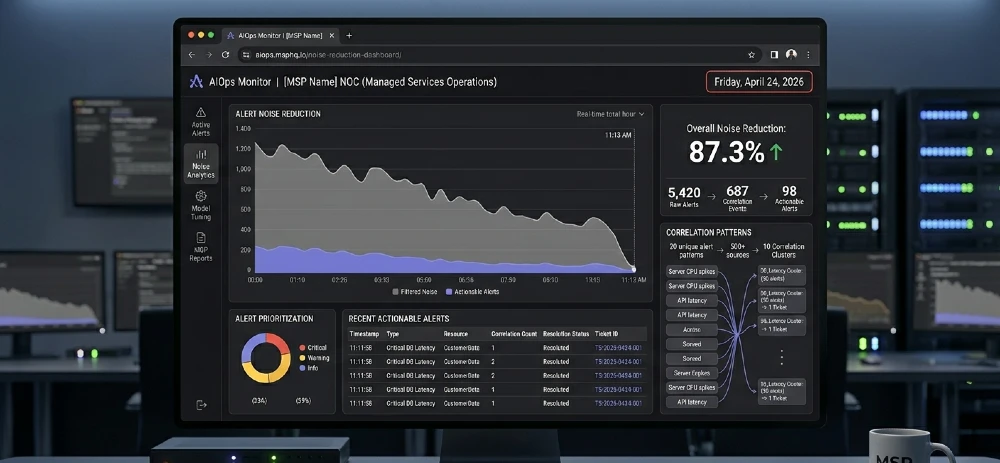
MSPs are drowning in alerts. Thousands every day, most of them meaningless. AIOps — Artificial Intelligence for IT Operations is the technology quietly changing that, and the numbers coming out of real deployments in 2026 are hard to ignore.
Right now, in April 2026, the MSP market is under real pressure. Clients want faster responses, smarter monitoring, and fewer outages — but MSP teams aren’t growing as fast as client environments are. That gap? AIOps for MSPs is how the smart operators are closing it.
It’s not hype anymore. Real MSPs are deploying AIOps platforms and posting real results. Alert noise down by 78%. Ticket resolution 40–70% faster. On-call engineers finally sleeping through the night. This is the story of what’s actually working in 2026 — and why MSPs who ignore it are falling behind.
80%Alert noise reduction (Synoptek via LogicMonitor)
70%Faster ticket resolution reported by MSPs
87%of MSPs plan to increase AI investment in 2026
$93BGlobal managed security market size in 2025
What Is AIOps and Why Does It Matter for MSPs Specifically?
AIOps uses machine learning to analyze huge volumes of IT data — logs, metrics, events, traces — in real time. Instead of a human sitting there trying to figure out which of 3,000 alerts actually matters, the AI does the filtering, the grouping, and the prioritization. The engineer only sees what actually needs attention.
For a regular enterprise IT team, that’s useful. For an MSP managing 50, 200, or 1,200 client environments simultaneously? It’s survival. According to Integris IT’s 2026 MSP trend report, an AIOps platform can reduce operational issues like system downtime by 30%, and resolve help desk tickets up to 50% faster. Those aren’t vanity numbers — that’s real labor saved, real SLAs protected.
The Three AIOps Use Cases Driving Real ROI for MSPs in 2026
1. Alert Noise Reduction — The Biggest Win
This is where MSPs feel the immediate pain. A mid-size MSP can receive tens of thousands of alerts per day, many of them duplicates, false positives, or low-priority noise. Technicians burn out. Critical alerts get missed.
Synoptek, a managed IT services provider supporting over 1,200 customers, shared results at AWS re:Invent 2024 that tell the story clearly. After deploying LogicMonitor’s AI-powered observability platform, they cut alert noise by 80% and reduced cloud costs by 20%. Their operations team described the old system — static thresholds triggering constant false alarms from normal CPU spikes — as overwhelming. Dynamic AI baselines replaced that entirely.
“Modern ITOps generates a storm of signals no human team can sift alone. AI lets our people do more with less and still raise the bar on service.”— MSP Operations Lead, quoted in LogicMonitor case study (August 2025)
Another MSP case study published by LogicMonitor in mid-2025 showed 78% alert noise reduction, 70% fewer duplicate tickets, and an 85% drop in ITSM incidents after deploying AIOps-driven filtering. These are the numbers circulating on LinkedIn and in MSP owner groups right now — and they’re verifiable.
2. Intelligent Ticket Triage and Automated Routing
AIOps doesn’t just filter noise — it classifies what survives. A well-configured system automatically assigns tickets based on severity, business impact, and likely root cause. It suppresses duplicates before they ever reach the queue.
The result: technicians stop wasting time on low-value tickets. According to DeskDay’s 2026 MSP trends analysis, AI-driven service desk automation is expected to cut total ticket volume by 40–60%, with forward-thinking MSPs already seeing 3x faster resolution times for common issues through deployed AI agents.
3. Predictive Anomaly Detection — Before the Client Calls
Traditional monitoring watches for threshold breaches — CPU above 90%, disk space below 10%. That works until it doesn’t. By the time the alert fires, the damage is often done.
AIOps builds dynamic baselines. It learns what “normal” looks like for every metric, at every time of day, for every environment it monitors. Then it flags deviations — subtle ones, early ones — before they become outages. LogicMonitor’s Edwin AI platform, for instance, claims 90% alert noise reduction through advanced AI reasoning across cross-domain observability data.
For MSPs, this shift from reactive to predictive isn’t just efficiency. It’s a premium service tier. Clients pay more for “we stopped that outage before you knew it was coming.”
Which AIOps Platforms Are MSPs Actually Using?
The platforms driving the most discussion in MSP communities right now include LogicMonitor (with its Edwin AI agent), BigPanda (event correlation and automation), PagerDuty AIOps (noise reduction and incident management), ScienceLogic, Atera, and ServiceNow.
- LogicMonitor + Edwin AI — Agentic AIOps with autonomous remediation; case studies show 78–80% noise reduction
- BigPanda — Built for large-scale environments; uses AI-powered event correlation to surface only critical alerts
- PagerDuty AIOps — Works out of the box with minimal setup; strong for NOC teams and major incident management
- ScienceLogic — MSPs using it report 34–40% support noise reduction and $50K+ annual savings
- Atera — Popular with smaller MSPs; combines RMM, PSA, and AI-driven automation in one platform
Gartner Peer Insights lists all of these in its AIOps platform reviews, noting that the best tools analyze telemetry, identify meaningful patterns, and support proactive responses — not just passive monitoring.
The Market Backdrop: Why MSPs Can’t Afford to Wait
The numbers around the MSP market in 2026 paint a clear picture. According to Support Adventure’s 2026 MSP industry benchmarks, 55% of MSPs expect revenue growth above 10% this year, but 26% report they don’t have enough staff to onboard new clients. That’s a growth bottleneck. AIOps is one of the few levers that directly addresses it.
Meanwhile, DeskDay’s analysis puts the global MSP market on a path from $377.5 billion in 2025 to $731.1 billion by 2030. AI adoption is the dividing line between MSPs capturing that growth and those getting squeezed out. Providers that can articulate how AI delivers measurable outcomes — faster resolution, fewer incidents, lower costs — are already commanding premium pricing and better client retention.
The Honest Limitation: AIOps ROI Isn’t Automatic
Something worth saying clearly: deploying AIOps doesn’t guarantee these results out of the box. LogicMonitor published a guide in February 2026 specifically on this point — ROI from agentic AIOps requires proper data integration, clean telemetry pipelines, and realistic expectations about the learning curve.
MSPs that see the biggest gains are the ones who treat AIOps as an operational shift, not a plug-in. That means training teams, refining playbooks, and measuring MTTR and alert-to-incident ratios consistently. The technology is ready. The readiness to change operations is the harder part.
Why This Matters
AIOps for MSPs has crossed from “early adopter” territory into mainstream necessity in 2026. With proven results showing 60–80% alert noise reduction, faster resolution times, and direct cost savings, MSPs that delay adoption risk falling behind on client expectations and operational efficiency — especially as the market grows toward $731B by 2030. The question is no longer whether to adopt AIOps, but which platform and how fast.
Related articles:
What is an MSP Services Provider? (Complete Guide 2026)
10 Signs Your Business Needs an MSP Services Provider
MSP Services vs In-House IT Team: Which is Better?