
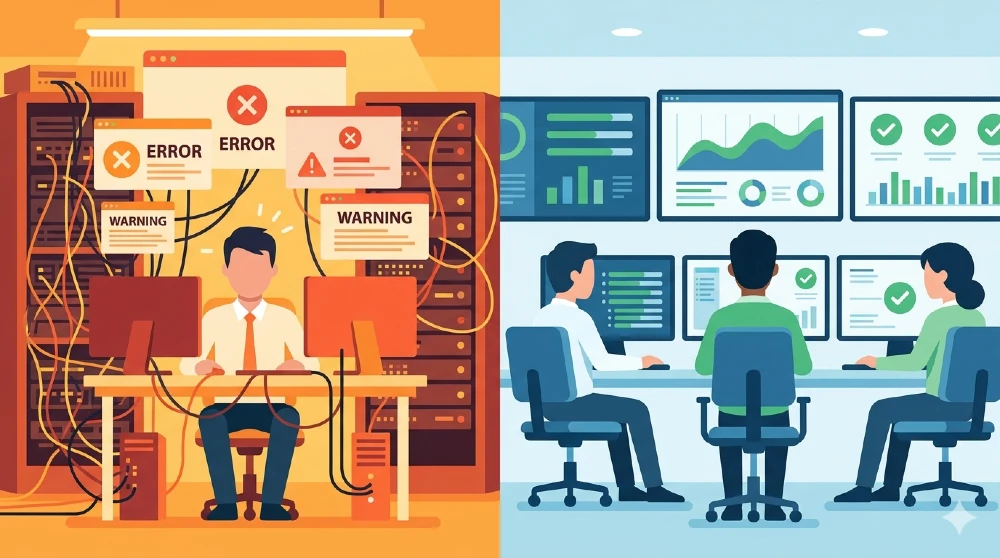
| Factor | MSP Services | In-House IT |
|---|---|---|
| Monthly Cost | Predictable flat fee | Salary + benefits + tools = high fixed cost |
| Response Time | 24/7 (contract-defined SLA) | Business hours unless on-call is arranged |
| Scalability | Scale up or down instantly | Hiring takes weeks to months |
| Expertise Depth | Access to a full team of specialists | Limited to who you hired |
| Best For | SMBs, growing companies, lean teams | Large enterprises with complex proprietary systems |
What Is the Actual Difference Between MSP and In-House IT?
Short answer: one is a team you hire, the other is a team you rent — but the difference goes much deeper than that.
In-house IT means you employ one or more full-time IT staff. They sit in your office, know your systems, and handle everything from fixing the printer to managing your network security. You pay their salary, benefits, training, and tools. All year. Whether it is a slow Tuesday or a ransomware incident at 2 AM.
An MSP — Managed Service Provider — is an external company that takes over some or all of your IT operations under a contract. They monitor your systems, handle support tickets, manage your infrastructure, and respond to incidents. You pay a monthly fee. The fee is usually fixed and covers a defined scope of services.
That sounds simple. The complexity shows up when you get into the real numbers and real scenarios.
The Cost Comparison Nobody Wants to Do Honestly
The honest answer: in-house IT almost always costs more than businesses expect.
A single mid-level IT support hire in the US costs $55,000 to $75,000 in salary alone. Add employer-side payroll taxes, health insurance, paid leave, and IT training certifications — you are looking at $80,000 to $100,000 per year per person for someone who covers basic support.
That one person cannot cover security, cloud infrastructure, networking, compliance, and helpdesk simultaneously. So you hire more people. Or you live with the gaps.
An MSP typically runs $150 to $300 per user per month for comprehensive managed IT services, depending on scope. For a 20-person company, that is $3,000 to $6,000 per month — or $36,000 to $72,000 per year. That same $72,000 cannot hire one decent in-house IT manager in most US cities.
The cost argument almost always favors MSP for companies under 100 employees. Above 100 to 150 employees, the math starts to shift — especially if you have proprietary systems, regulated data, or complex infrastructure that requires dedicated attention.
Response Time and Availability: Who Actually Picks Up at 3 AM?
MSPs win on availability — in-house IT wins on context.
A good MSP operates on defined SLAs. Critical issues get a response within 15 to 60 minutes around the clock, including weekends and holidays. That is written into the contract. If they miss the SLA, there are penalties.
Your in-house IT person? They are asleep at 3 AM like everyone else. Unless you have arranged a formal on-call rotation — which costs extra and burns out small teams quickly — you are waiting until morning.
But there is a real counterpoint here. In-house IT knows your business intimately. They know that the accounting team uses a legacy software version that breaks with certain Windows updates. They know who accidentally unplugs things. That institutional knowledge has real value and it takes an MSP months to build it up.
If you are dealing with signs your business needs MSP services like repeated downtime, slow ticket resolution, or security gaps — the availability argument becomes a lot harder to ignore.
Scalability: Growing Companies Run Into a Wall With In-House IT
This is where in-house IT genuinely struggles.
Hiring takes time. A decent IT hire — posting, screening, interviewing, onboarding — takes six to twelve weeks on a good run. During that window, your existing team carries the load. If you are growing fast, that gap does not close, it compounds.
MSPs scale immediately. Adding 10 new employees to your MSP contract is a conversation, not a hiring sprint. Spinning up a new office location? Same. Moving to hybrid work? The MSP adjusts scope.
This matters even more when you are contracting or restructuring. Laying off in-house IT staff carries severance, legal risk, and morale damage. Adjusting an MSP contract is a negotiation. The flexibility difference is significant for any business that does not have a flat, predictable headcount.
Security and Compliance: Specialized vs. Generalist
MSPs typically carry broader security capabilities than any small in-house team can build.
Cybersecurity is not one skill — it is a discipline that spans network security, endpoint protection, identity management, threat intelligence, incident response, and regulatory compliance. No single hire covers all of that well. A solo in-house IT person is necessarily a generalist.
An MSP brings a team. When your MSP responds to a security incident, the person on the call has done this hundreds of times across dozens of clients. That pattern recognition has real value.
For compliance — HIPAA, SOC 2, PCI DSS, GDPR — MSPs that specialize in your industry already know the requirements. They have documentation templates, audit workflows, and the staff to maintain compliance continuously. Building that capability in-house takes years and significant investment.
That said, regulated industries with highly sensitive proprietary data sometimes need in-house staff for certain security functions — specifically where data cannot leave internal systems even for managed monitoring.
Where In-House IT Genuinely Wins
In-house IT is not the wrong answer for every company. There are situations where it is clearly the better choice.
Large enterprises with complex infrastructure — financial institutions, manufacturing companies with proprietary systems, healthcare organizations with embedded technology — often need dedicated staff who live inside the systems full-time. The depth of knowledge required is simply not practical to outsource.
Businesses with classified, regulated, or proprietary data that cannot be shared with third parties sometimes have no real choice. Certain government contracts require in-house security operations.
And sometimes, culture matters. Some leadership teams genuinely want a face they can walk up to. That is a legitimate organizational preference.
The middle path many mid-sized companies take is a hybrid model: a small in-house team handles strategic IT direction and knows the business deeply, while an MSP handles day-to-day operations, monitoring, helpdesk, and security. This often gives you the best of both.
The Hidden Costs of In-House IT That Kill the Budget
Most businesses undercount in-house IT costs by 30 to 40%.
The salary is visible. These costs are not:
- Training and certification. Technology changes fast. Keeping one IT person current on cloud, security, and compliance requires $3,000 to $8,000 in annual training costs.
- Tooling. RMM software, security platforms, backup systems, monitoring tools — these are expensive individually and add up fast when you are buying them yourself instead of sharing cost across a provider’s client base.
- Turnover. IT staff turnover is high. Every time someone leaves, you absorb recruiting costs, onboarding time, and a period where systems are less well-managed than they should be.
- Single point of failure. One person sick, on vacation, or burned out creates a real operational gap. There is no bench.
MSPs spread these costs across their entire client base. You benefit from enterprise-grade tooling at a fraction of what it would cost to buy and maintain yourself.
How to Actually Decide: 4 Questions That Cut Through the Noise
Skip the framework articles. Answer these four questions honestly:
1. How many IT incidents do you deal with monthly? If you are resolving more than 5 to 10 tickets per week and it is pulling people away from actual work, you have an IT management problem. MSPs handle volume efficiently.
2. Do you have any compliance requirements? HIPAA, PCI, SOC 2, or GDPR exposure almost always favors an MSP with compliance expertise unless you have the budget for dedicated compliance staff in-house.
3. What is your headcount trajectory? Growing fast? MSP scales with you. Stable large organization with complex systems? In-house may be more practical.
4. What does downtime actually cost you per hour? Calculate it. If an hour of downtime costs $5,000 and your in-house IT cannot guarantee 24/7 coverage, the math for MSP becomes very clear.
If you are weighing this decision, the MSP growth and online optimization services model is worth understanding — it is not just IT support, it is operational leverage.
What MSP Services Actually Cover (Most People Get This Wrong)
MSP is not just “someone who fixes your computers.” The scope is much broader.
A full-service MSP typically covers:
- Network monitoring and management — watching your infrastructure 24/7, catching problems before users notice
- Endpoint management — all devices patched, updated, secured, and monitored
- Cybersecurity — threat detection, firewall management, vulnerability scanning, incident response
- Cloud infrastructure — managing your AWS, Azure, or Google Cloud environment
- Helpdesk support — tickets, phone, remote support for your team
- Backup and disaster recovery — ensuring you can restore operations after a failure or attack
- Vendor management — acting as the single point of contact for your internet provider, software vendors, and hardware suppliers
- Strategic IT planning — advising on technology investments, not just maintaining what exists
When you compare that scope to what one or two in-house IT hires can realistically deliver, the gap is significant.
For companies also thinking about IT staff augmentation — a model where you add specific technical resources on demand — that sits between fully in-house and fully outsourced. It is a practical option when you have a capable internal team but need to fill specific skill gaps without permanent hires.
The Transition Problem: Switching From In-House to MSP
This is where most guides go quiet. The transition is real work.
If you currently have in-house IT staff and you are considering moving to an MSP, you are dealing with a people decision, not just a vendor decision. That means handling it with transparency and fairness toward your existing team.
Some companies keep one in-house IT coordinator who manages the MSP relationship, owns vendor documentation, and handles the internal requests the MSP cannot — like physically replacing hardware or managing building access systems. The MSP handles everything remote and operational. That hybrid works well and often lets you transition one person into a higher-value strategic role rather than eliminating the position.
Operationally, the transition needs documented runbooks — what systems exist, what the credentials are, what the known quirks are. A good MSP will require this during onboarding. Building it is painful. It is also overdue regardless of whether you switch to an MSP.
MSP vs In-House IT: A Direct Comparison for SMBs
| Scenario | Better Choice | Why |
|---|---|---|
| 10–50 employees, no dedicated IT staff | MSP | Cost, coverage, expertise |
| 50–150 employees, growing fast | MSP or hybrid | Scalability, avoiding hiring lag |
| 150+ employees, complex proprietary systems | Hybrid or in-house | Depth of institutional knowledge |
| Healthcare or finance with compliance requirements | MSP with compliance specialization | Regulatory expertise, audit readiness |
| Startup needing to move fast | MSP | No hiring overhead, immediate coverage |
| Enterprise with classified data | In-house security team | Data sovereignty requirements |
One More Thing: IT Is Not Your Business’s Core Competency
And that matters more than people acknowledge.
Every hour your team spends managing IT problems is an hour not spent on customers, products, or revenue. This is the opportunity cost argument and it is the most underweighted factor in the in-house vs MSP decision.
Your competitors who outsource IT operations to an MSP are not spending Friday afternoons troubleshooting network issues. They are working on the things that actually build the business. That compounding difference over two or three years is significant.
The goal of good IT is to be invisible — systems that work, security that holds, support that resolves things fast. MSPs are specifically built to deliver that. In-house IT, especially small teams at growing companies, is often too stretched to deliver it consistently.
MSP services win for most small to mid-sized businesses on cost, coverage, scalability, and security depth. In-house IT wins when you need deep institutional knowledge, proprietary system control, or have compliance requirements that prohibit third-party access.
The answer is rarely black and white. Most companies that have been through both models end up at some version of a hybrid — strategic IT direction in-house, operational execution via MSP. That combination is hard to beat on both performance and cost.
If you are still not sure which model fits your business, the honest answer is to get a real assessment done. Not a sales call — an actual audit of your current IT state, costs, and gaps. That data makes the decision obvious.
FAQ
Is an MSP cheaper than hiring in-house IT? For most businesses under 100 employees, yes — significantly. A single in-house IT hire with benefits costs $80,000 to $100,000 annually. A comparable MSP contract for the same company runs $40,000 to $70,000 and gives you an entire team instead of one person.
What is the main disadvantage of an MSP? Less institutional knowledge, at least initially. An MSP does not know your business the way a long-tenured in-house employee does. That gap narrows over 6 to 12 months of working together, but it is real in the early period.
Can you use both MSP and in-house IT at the same time? Yes, and many companies do. A small in-house IT coordinator manages the MSP relationship, handles physical infrastructure, and owns vendor relationships. The MSP handles monitoring, helpdesk, and security operations. It combines depth of knowledge with operational scale.
How do I know if my current IT setup is failing? Recurring downtime, unresolved support tickets, security incidents, staff frustration with tech issues, and no disaster recovery plan are the clearest signals. There are specific signs your business needs an MSP that are worth reviewing honestly.
Does an MSP help with cybersecurity? Yes — and this is one of the strongest MSP arguments. Most MSPs include endpoint protection, threat monitoring, firewall management, and incident response as standard service components. Building equivalent capability in-house requires multiple specialized hires.
About Miracle Concepts
At Miracle Concepts, we work with growing businesses that need more than just IT support — they need a partner that understands the full picture. Beyond our MSP services, we help businesses grow through data-driven SEO services that drive qualified organic traffic, UX design that turns visitors into customers, and web development built for performance and conversion. We also handle document formatting for professional deliverables, and stay ahead of where search is going with Generative Engine Optimization — so your business gets found not just on Google, but inside AI-powered search results too. Whether you are starting from scratch or scaling fast, Miracle Concepts has the services to move the needle. Get in touch and let us show you what the right support model looks like for your business.