
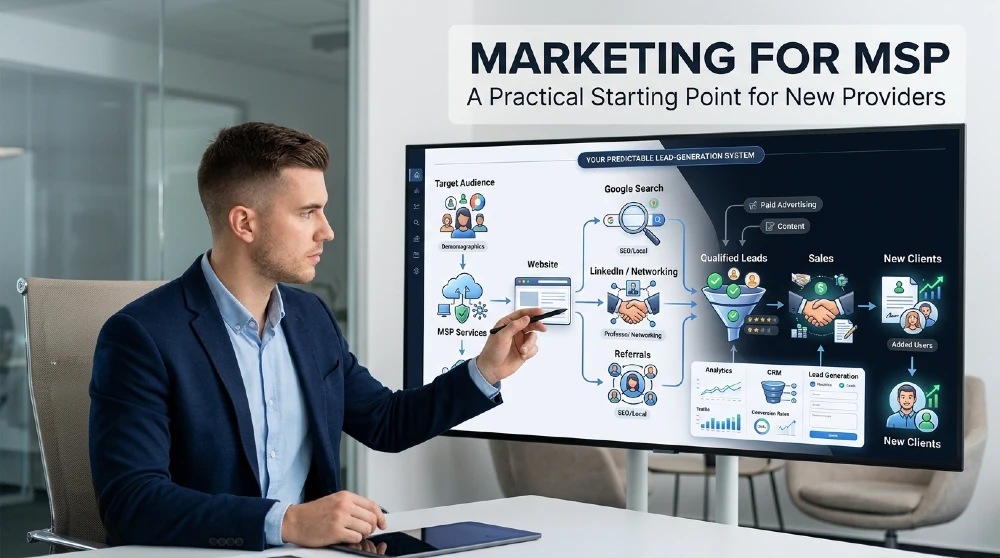
Marketing for MSP businesses is different from marketing most other services, because IT decisions are high-trust, high-stakes, and rarely made on impulse. A new provider can’t win on volume alone, the first sales usually come from clear positioning, a website that actually converts, and a handful of channels done properly instead of a dozen done half-heartedly.
This guide walks through exactly where to start: what to sell first, how to find your earliest clients, how to build a website and content system that supports sales, and how to measure results by revenue instead of vanity metrics. If you want a deeper breakdown of what a full engagement looks like, this overview of MSP marketing services covers what’s typically included.
Before Marketing Your MSP, Define What You Want to Sell
The direct answer: don’t market anything until you know exactly what you’re selling, to whom, and why it matters to them. Skipping this step is the most common reason early marketing for MSP efforts produce weak results.
Choose One Primary MSP Offer to Lead With
Pick one core offer, fully managed IT, cybersecurity-first support, or a specific compliance package, and lead with it everywhere. Trying to promote every service equally from day one dilutes your message and confuses prospects about what you actually do best.
Define the Business Problem Your Offer Solves
Your offer needs a business problem attached to it, not just a technical description. “We manage your network” is forgettable; “we stop downtime from costing you client deadlines” gives a prospect a reason to care.
Decide Which Type of Business You Want as a Client
Choose the size, industry, and budget range you can serve profitably and well. A 10-person law firm and a 200-person manufacturer need completely different messaging, pricing, and proof.
Turn Your MSP Services Into a Clear Market Position
Combine your offer, your ideal client, and the problem you solve into one clear statement you can repeat consistently across your website, sales calls, and content. This is the foundation everything else in your marketing for MSP strategy builds on.
Find Your First MSP Customers Before Spending on Marketing
The direct answer: your first clients almost always come from existing relationships and direct outreach, not paid campaigns, save the ad budget until you have proof points to show.
Start With the Client Types You Can Serve Best
Look first at businesses that match your ideal client profile closely, since they’re the fastest to close and the easiest to satisfy well.
Identify Where Your Ideal Clients Already Look for IT Help
Find out whether they search Google, ask peers, post in local business groups, or work through industry associations, and meet them there instead of guessing.
Use Existing Relationships Before Chasing Cold Traffic
Former colleagues, vendors, and personal networks are usually a faster path to a first client than any paid channel.
Build a Shortlist of Real Prospects
Write down 20–30 specific businesses that fit your ideal client profile and reach out directly, rather than waiting for inbound traffic to arrive on its own.
Build an MSP Website That Can Turn Searches Into Leads
The direct answer: a brochure-style website with no pricing signals, no proof, and no clear next step will lose most of the traffic it gets, no matter how much you spend driving people to it. This is one of the fastest ways to undercut an otherwise solid marketing for MSP effort.
Make Your Main Service Immediately Understandable
A visitor should understand what you do and who you serve within the first few seconds on your homepage, no jargon, no vague taglines.
Create Dedicated Pages for High-Value MSP Services
Each core service deserves its own page with a clear description, outcomes, and a call to action, rather than being buried in one general “services” page.
Show Who You Serve Instead of Saying “We Help Everyone”
Naming your ideal industries and business sizes builds more trust than claiming to serve everyone equally.
Put a Clear Next Step on Every Important Page
Every page should tell the visitor exactly what to do next, book a call, request a quote, or download a resource.
Add Proof Before Asking Visitors to Contact You
Testimonials, case studies, and specific results should appear before the contact form, not after it. For a technical review of how your site is currently performing, this guide on how to improve MSP website SEO is a good next step.
Build Your MSP Marketing Around Search Intent
The direct answer: match your content to what the searcher actually wants at that moment, a service page for someone ready to buy, and an educational page for someone still researching.
Target Service Searches From People Ready to Buy
Terms like “managed IT services near me” or “[industry] IT support” come from people close to a buying decision, your service pages should target these directly.
Target Problem-Based Searches From Potential Future Clients
Searches about downtime, ransomware, or compliance deadlines come from people who aren’t ready to buy yet but are worth capturing early with helpful content.
Create Content Around Questions Your Sales Team Actually Hears
The objections and questions your sales team fields on calls make excellent content topics, because they’re proven to matter to real prospects.
Separate Local, Commercial, and Educational Searches
Treat these as three different content types with different goals, rather than mixing them into one generic blog strategy.
Start With Local MSP Marketing If You Serve a Specific Area
The direct answer: if you serve a defined geography, local visibility should be one of your first priorities, since most MSP buyers still prefer a provider nearby.
Optimize Your Google Business Profile Around Your Actual Services
List your real services and service areas accurately, and keep the profile active with updates and responses to reviews.
Make Your Service Area Clear on Your Website
State plainly which cities or regions you cover so both visitors and search engines understand your reach.
Build Local Proof Instead of Creating Empty City Pages
Real client stories from your service area carry far more weight than thin, templated location pages with the city name swapped in.
Turn Local Searches Into Service-Specific Landing Pages
A page targeting “cybersecurity for [industry] in [city]” converts better than one generic local page trying to cover everything.
Build Local Visibility Beyond Your Google Business Profile
Local directories, chamber of commerce listings, and community involvement all add to local trust signals over time.
Create an MSP Content System That Supports Sales
The direct answer: content only helps marketing for MSP businesses when it’s built around real buyer questions and connects back to a service, not when it’s published just to “stay consistent.”
Create Content for Problems Your Services Solve
Start with the problems your offers actually fix, then work backward into topics.
Turn Common IT Questions Into Searchable Resources
Questions prospects ask repeatedly on calls are proven search demand, turn them into clear, useful pages.
Create Comparison Content for Buyers Evaluating Options
Comparison content, such as explaining the difference between managed IT services vs MSP, helps buyers who are actively weighing their options and searching for clarity.
Use Case Studies to Show How Your MSP Solves Real Problems
Specific, real outcomes are more persuasive than general claims about reliability or expertise.
Connect Every Useful Article to a Relevant Service
Every piece of content should link to the service page it supports, so readers have an obvious next step.
Use LinkedIn and Networking to Generate MSP Opportunities
The direct answer: LinkedIn and in-person networking work best when they build recognizable expertise over time, not when every post is a pitch.
Build Visibility Around Expertise Instead of Promotional Posts
Share what you know rather than what you sell, and the sales conversations tend to follow naturally.
Share Practical IT Insights Your Target Businesses Can Use
Useful, specific insights get remembered; generic “IT tips” posts usually don’t.
Connect With Decision-Makers Without Immediately Pitching
Build the relationship first, a pitch in the first message rarely works with business owners.
Turn Conversations Into Qualified Discovery Calls
Once trust is established, a low-pressure invitation to talk is a natural next step.
Build Referral Relationships With Complementary Providers
Accountants, insurance brokers, and business consultants often serve the same clients you want and can become a steady referral source.
Decide When Your MSP Should Use Paid Advertising
The direct answer: paid ads work best once your offer, website, and lead qualification process are already solid, spending on traffic before that just exposes weak conversion.
Don’t Buy Traffic Before Your Offer Is Ready
If your website or offer isn’t converting organic visitors, paid traffic will have the same problem, only faster and more expensively.
Start With High-Intent Searches Instead of Broad Keywords
Bid on specific, ready-to-buy terms first rather than broad industry keywords that attract unqualified clicks.
Match Each Ad to a Specific Service and Landing Page
Sending ad traffic to a generic homepage wastes budget, each ad should point to a page built for that exact search.
Set a Lead Qualification Process Before Increasing Ad Spend
Know how leads will be qualified and followed up on before scaling spend, or you’ll just generate more unqualified leads faster.
Know When to Stop a Campaign That Isn’t Producing Qualified Leads
Set a clear evaluation point in advance so underperforming campaigns get paused rather than run indefinitely out of habit.
Build an MSP Referral Engine Instead of Depending Only on Ads
The direct answer: a structured referral system produces more consistent, lower-cost leads than any single paid channel, but only if it’s built deliberately.
Identify Businesses That Already Serve Your Ideal Clients
Look for non-competing providers who already have relationships with the businesses you want as clients.
Create a Simple Partner Referral Process
Make it easy for a partner to refer someone, a short form or a direct introduction works better than a complicated process.
Give Partners a Clear Reason to Recommend Your MSP
Partners refer providers they trust to make them look good, so consistent communication and follow-through matter more than incentives alone.
Track Which Partnerships Actually Produce Opportunities
Review referral sources regularly and invest more time in the relationships that actually convert.
Turn Your Existing Clients Into a Marketing Asset
The direct answer: your current clients are one of the most underused parts of marketing for MSP growth, reviews, referrals, and case studies all come from relationships you already have.
Collect Reviews at the Right Point in the Client Relationship
Ask after a clear win, such as a resolved issue or a successful project, when satisfaction is highest.
Build Case Studies From Successful Projects
Document the problem, the solution, and the measurable result for your strongest client wins.
Turn Client Results Into Website and Social Proof
Use real numbers and outcomes on your site and social channels instead of general statements about service quality.
Identify Expansion Opportunities Inside Existing Accounts
Existing clients are often ready for additional services once you’ve built trust, this is easier revenue than winning a new client from scratch.
Ask for Referrals Without Making It Awkward
A simple, direct ask at the right moment works better than an elaborate referral pitch.
Track MSP Marketing by Revenue, Not Vanity Metrics
The direct answer: traffic and impressions don’t pay the bills, track marketing for MSP performance by qualified leads, pipeline, and closed revenue instead.
Track Where Every Lead Originally Came From
Know exactly which channel produced each lead so you can see what’s actually working.
Separate Website Leads From Qualified Opportunities
Not every form submission is a real opportunity, filter for fit before counting it as a win.
Measure Cost Per Qualified MSP Lead
This number tells you far more about channel performance than raw lead volume does.
Track Which Services Generate the Best Opportunities
Some offers convert better than others, double down on what’s already working.
Measure Pipeline and Revenue From Each Marketing Channel
Ultimately, revenue by source is the number that should guide budget decisions.
Don’t Judge SEO or Content Only by Traffic
Organic content often produces fewer but higher-quality leads, judge it by close rate and revenue, not page views.
Create a Simple MSP Marketing Funnel
The direct answer: a clear funnel, visitor, lead, qualified opportunity, sales call, proposal, client, keeps marketing and sales aligned on what happens at each stage.
Give Every Marketing Channel One Clear Conversion Goal
Each channel should be pushing toward one specific action, not several competing ones.
Qualify Leads Before They Reach Your Sales Pipeline
A basic qualification step saves your sales team time and improves close rates.
Create Follow-Up for Leads That Aren’t Ready to Buy
Not-yet-ready leads still have value, a simple nurture sequence keeps you top of mind until they are.
Connect Marketing Data With Your CRM
Linking marketing activity to your CRM makes it possible to see the full picture from first touch to closed deal.
What New MSP Providers Should NOT Do
The direct answer: most wasted marketing budget for new MSPs comes from a handful of avoidable mistakes, not from picking the wrong channel entirely.
- Don’t market every IT service at once, it dilutes your positioning and confuses prospects.
- Don’t publish content without a commercial purpose, every piece should connect to a service or a stage of the funnel.
- Don’t buy random backlinks or leads, low-quality sources rarely convert and can hurt credibility.
- Don’t copy another MSP’s positioning, it makes you interchangeable instead of memorable.
- Don’t spend on ads before measuring lead quality, you’ll scale a broken process.
- Don’t confuse website traffic with business growth, track revenue, not visits.
A 90-Day Marketing Plan for a New MSP
The direct answer: the first 90 days should move in order, foundation first, then visibility, then lead generation, rather than trying every part of marketing for MSP simultaneously.
Days 1–30: Positioning, Offer, Website, and Tracking
Lock in your ideal client, offer, and website structure, and put basic lead tracking in place before driving any traffic.
Days 31–60: Search Visibility, Content, Local Presence, and Outreach
Start building organic visibility, publish your first targeted content, complete your local listings, and begin direct outreach.
Days 61–90: Lead Generation, Partnerships, Reviews, and Optimization
Layer in paid campaigns if the foundation is solid, formalize partner referrals, start collecting reviews, and refine what’s already working.
What to Measure at the End of Each 30-Day Sprint
Review lead volume, lead quality, and any closed revenue at each 30-day mark, and adjust the next sprint based on what the data shows, not on assumptions.
How to Choose Your Next MSP Marketing Activity
The direct answer: your next move depends on where the bottleneck actually is, not on what worked for another provider.
- No website traffic? Fix visibility first, SEO, local listings, and basic content.
- Traffic but no leads? Fix conversion, messaging, proof, and calls to action.
- Leads but poor close rates? Fix qualification before your sales team wastes more time.
- Clients but few referrals? Build a referral system instead of waiting for them to happen.
- One channel producing qualified leads? Scale it before adding new ones.
If you’d rather have this mapped out for your specific business, a documented MSP marketing plan removes the guesswork from this step.
FAQs About Marketing for MSP
Most new providers start with a modest, consistent budget rather than a large one-time spend, increasing it once a channel proves it can produce qualified leads.
Organic channels typically need two to four quarters to compound, while referrals and direct outreach can produce results sooner.
It depends on internal bandwidth and expertise, many new providers start in-house for outreach and referrals, then bring in outside help for MSP growth and online optimization once there’s a foundation to build on.
There’s no single best channel, for most new providers, direct outreach and referrals produce the fastest early results, with SEO and content compounding over time.
Through a clear niche, faster response, and stronger local or industry-specific proof, not by trying to out-spend larger competitors.
Starting with one or two industries builds sharper messaging and case studies, which can later expand once positioning is proven.
Once a channel is reliably producing qualified leads at a reasonable cost, that’s the signal to invest further, not before.
Look at qualified leads, pipeline, and closed revenue tied to their work, not just traffic or content volume. If you want a second opinion on where your current marketing stands, you can contact us for a review.