
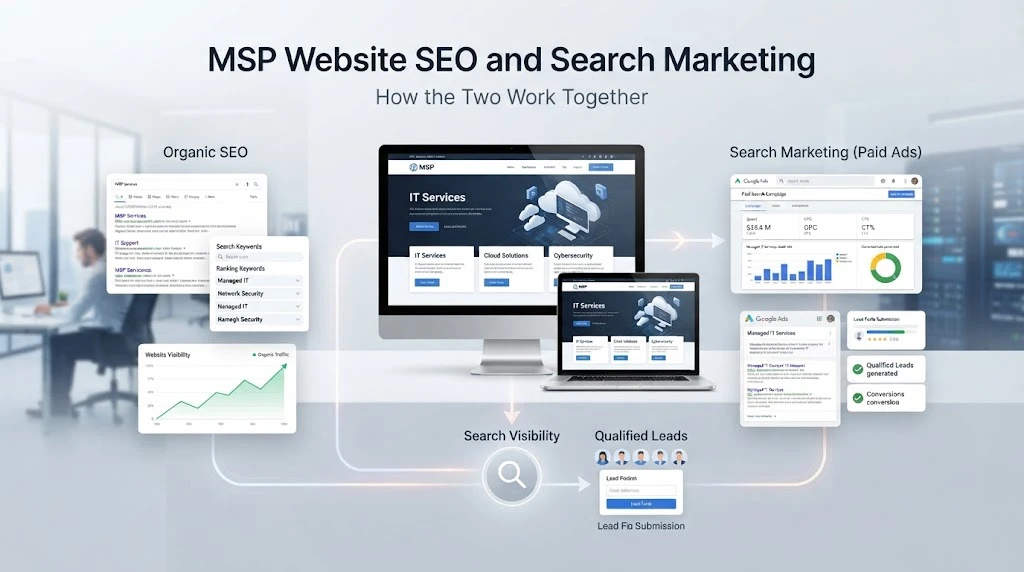
MSP website SEO improves your site’s ability to earn organic visibility, while search marketing covers the wider job of capturing demand from search, organic and paid combined. They work together because SEO builds visibility that compounds over time, while paid search captures high-intent demand right now. The goal isn’t two separate strategies competing for the same budget, it’s one search acquisition system.
Most MSPs run SEO and paid search as if they’re unrelated. They’re not. The data from one should directly shape decisions in the other. This guide shows exactly how.
What Is the Difference Between MSP Website SEO and Search Marketing?
MSP website SEO is one part of search marketing, focused specifically on organic visibility, search marketing is the broader category that includes SEO, paid search, landing pages, and conversion.
| MSP Website SEO | Search Marketing |
| Focuses primarily on organic visibility | Covers search-based customer acquisition overall |
| Builds long-term visibility | Can generate immediate visibility through paid search |
| Improves website relevance and authority | Matches search demand with marketing campaigns |
| Compounds over time | Often requires ongoing campaign investment |
| Relies heavily on website, content, and technical quality | Can include SEO, PPC, landing pages, conversion, and measurement |
SEO is a major part of search marketing, but search marketing is the bigger picture, it’s everything involved in turning a search into a client. Understanding this distinction is the starting point for getting MSP website SEO and search marketing working together instead of competing for the same budget.
How Does MSP SEO Support Search Marketing?
if you’re already running paid search, your website’s SEO still matters because it directly affects landing-page relevance, quality scores, and how much of that paid traffic actually converts.
- Better landing-page relevance makes every paid click work harder.
- Stronger service pages give both organic visitors and ad traffic somewhere worth landing.
- Better organic visibility reduces how much you need to pay for the same search over time.
- Improved user experience keeps visitors on the page instead of bouncing straight back to search.
- More useful content for buyers answers the questions ads alone can’t.
- Stronger conversion paths turn more of the traffic you’re already paying for into leads.
- Better understanding of search intent improves both your ad targeting and your content plan.
- The ability to turn paid-search data into SEO opportunities, this is the real connection most MSPs miss.
A practical example: A PPC campaign shows people repeatedly searching for “managed IT services for small business.” Instead of only paying for that query indefinitely, the MSP can improve the relevant service page, build supporting content around it, add FAQs based on the actual searches, strengthen internal links, improve the page’s conversion elements, and then track organic growth for that same topic. That creates a genuine feedback loop, a much stronger result than simply running SEO and PPC side by side and hoping they help each other.
How Can Search Marketing Data Improve MSP Website SEO?
your paid search campaigns already contain some of the best keyword research you’ll ever get, most MSPs just never look at it.
Search campaign data can reveal:
- High-converting search terms
- The actual language buyers use
- Which searches carry real commercial intent
- Services generating qualified leads
- Search terms producing poor-fit leads
- Questions prospects repeatedly search before contacting you
- Landing pages that convert well
- Locations producing better opportunities
That information should flow directly into your SEO work, in this order:
Keyword research → service pages → content → titles → landing pages → internal links
If a paid term consistently converts, it deserves a dedicated, well-optimized organic page, not just an ongoing ad budget.
How Does MSP SEO Help Reduce Dependence on Paid Search?
SEO doesn’t replace paid search, but it reduces how much of your visibility you have to keep paying for.
- Paid search requires continuing spend, the moment you stop, the visibility stops too.
- Organic visibility can keep producing impressions and clicks long after the initial work is done.
- SEO can target informational and commercial searches that aren’t always efficient to run as ads.
- Strong organic pages can capture demand that would otherwise require paid acquisition to reach.
- The two channels aren’t in competition, they can run at the same time, covering different parts of the search funnel.
SEO is not a replacement for paid search. The better approach is deciding which searches deserve paid coverage, organic coverage, or both, not picking one channel and abandoning the other.
When Should an MSP Use SEO, Paid Search, or Both?
The right channel depends on your situation, not a fixed rule, this is one of the most common questions MSPs have once they understand how MSP website SEO and search marketing connect.
| Situation | Better Approach |
| New MSP needs immediate visibility | Paid search + SEO foundation |
| Established MSP wants long-term organic growth | SEO |
| High-value service has strong search demand | SEO + paid search |
| Service has little organic visibility but converts through ads | Test paid, then build the organic asset |
| Search demand is mostly informational | SEO/content |
| Highly competitive commercial keyword | Test both |
| Limited marketing budget | Prioritize based on conversion data |
How to Build an MSP Search Strategy Around Customer Intent
Organize your search strategy around what the buyer actually wants, not around which channel you happen to be using, this is the backbone of any real MSP website SEO and search marketing plan.
- Problem searches: “Why is my business Wi-Fi slow?”, “How to prevent ransomware?”, “Why does my business need IT support?”
- Service searches: managed IT services, network management, cybersecurity services, Microsoft 365 support
- Comparison searches: MSP vs. in-house IT, managed IT vs. break-fix, outsourcing IT vs. hiring an IT manager
- High-intent searches: “MSP near me,” managed IT services for small business, IT support company, cybersecurity provider
Problem and comparison searches are usually strong SEO and content opportunities. Service and high-intent searches are often worth testing with paid campaigns, especially early on, while your organic pages for those terms are still building authority.
Why MSP Service Pages Matter to Both SEO and Search Marketing
Your service pages are where MSP website SEO and search marketing actually meet, the same page can serve organic visitors and paid-search visitors, if it’s built properly.
A strong MSP service page needs:
- A clear, specific service definition
- The specific business problems it solves
- Who the service is actually for
- What’s included and delivered
- The support model behind it
- Geographic coverage, where relevant
- Proof and trust signals
- Relevant FAQs
- A clear call to action
- Internal links to supporting resources
Don’t automatically send every ad to the homepage, a generic page converts worse than one built around the exact search that brought the visitor there. For a full breakdown of what solid service pages and supporting work should include, this overview of MSP marketing services is a useful reference.
How to Match MSP Search Intent With the Right Landing Page
Match the query to the intent, and the intent to the right page, this is where a lot of MSP search marketing budget quietly gets wasted.
| Search Query | Intent | Right Page |
| “managed IT services for small business” | Commercial | Dedicated managed IT service page |
| “how much does managed IT support cost” | Research/commercial investigation | Pricing or cost guide, with a service CTA |
| “IT support company near me” | Local commercial | Local or service-area landing page |
This is what makes MSP website SEO and search marketing feel like one connected system instead of two separate teams pointing traffic at the wrong place.
How to Use Google Search Console and Paid Search Data Together
Neither data source tells the full story alone, the real insight comes from combining them.
From Google Search Console, look at: queries, impressions, click-through rate, average position, and which pages are already earning search visibility.
From paid search data, look at: converting queries, cost per lead, lead quality, conversion rate, and commercial intent.
Then combine them by asking one question: which searches generate both visibility and business value? Those are your priority opportunities, worth investing in on both the organic and paid side.
Where MSP Search Marketing Usually Wastes Money
Most wasted search budget comes from a handful of repeatable mistakes, not from picking the “wrong” channel entirely.
- Sending every campaign to the homepage instead of a relevant page
- Paying for keywords that produce unqualified leads
- Ignoring organic opportunities revealed by paid campaign data
- Creating content with no real commercial intent behind it
- Running paid search before fixing obvious conversion problems
- Tracking clicks but not qualified opportunities
- Targeting broad IT terms with no service relevance
- Creating separate pages that target nearly identical intent
- Measuring traffic instead of pipeline
How to Create One Search Strategy Instead of Separate SEO and PPC Strategies
Use one framework for both channels instead of running them as two disconnected efforts.
Search demand → Intent → Keyword → Page → Organic/Paid decision → Conversion → Lead quality → Revenue
SEO and paid search should share the same keyword intelligence, buyer intent research, landing-page strategy, conversion data, messaging, geographic targeting, and performance data. When both channels pull from the same information, MSP website SEO and search marketing stop competing for budget and start reinforcing each other.
How to Measure Whether MSP SEO and Search Marketing Are Working Together
Don’t stop measuring at rankings and clicks, those numbers alone don’t tell you if the system is actually working.
| Track This | Why |
| Organic impressions and clicks | Shows visibility trends over time |
| Paid clicks | Shows how much traffic you’re actively paying for |
| Qualified leads | Filters out traffic that was never going to convert |
| Lead-to-opportunity rate | Shows real fit, not just interest |
| Opportunity-to-client rate | Shows how well leads actually close |
| Cost per qualified lead | The number that should guide budget decisions |
| Organic vs. paid conversions | Reveals which channel is doing the real work |
| Marketing-sourced pipeline and revenue by channel | The ultimate measure of whether it’s working |
A keyword ranking is only useful when it contributes to visibility, qualified traffic, opportunities, or revenue, not as a number on its own.
A Practical 90-Day MSP Search Marketing Plan
Use the first 90 days to connect the two channels deliberately, instead of running them in separate lanes and hoping for the best. This is where MSP website SEO and search marketing stop being theory and become an actual working system.
Days 1–30, Build the foundation: audit existing service pages, review Search Console queries, review paid-search data, identify high-value services, fix conversion problems, and map search intent to pages.
Days 31–60, Connect SEO and search campaigns: improve priority service pages, create supporting content, test high-intent paid keywords, improve landing pages, strengthen internal linking, and cut wasteful search terms.
Days 61–90, Optimize from real data: compare organic vs. paid performance, identify converting queries, expand successful topics, reduce poor-quality paid traffic, improve pages close to ranking, and measure qualified opportunities and revenue.
For a more detailed, MSP-specific version of this process, a documented MSP marketing plan can turn this outline into an actual execution schedule.
SEO vs Search Marketing for an MSP: Which Should You Prioritize?
The right priority depends on your situation, not a universal rule.
Choose SEO first when:
- You want long-term organic visibility.
- You already have some search demand.
- You have useful service expertise worth publishing.
- Budget is limited.
Prioritize paid search when:
- You need immediate visibility.
- Your service has strong commercial search demand.
- You already have a proven conversion path.
- You can measure lead quality accurately.
Use both when:
- Your highest-value services have meaningful search demand.
- You want immediate and long-term acquisition at the same time.
- You have enough data to optimize both channels properly.
If you’re not sure where your MSP currently stands, this overview of MSP growth and online optimization covers how to assess that before committing budget either way.
What Should an MSP Do First?
Start with this checklist rather than another generic conclusion.
- List your highest-value MSP services.
- Find the searches already producing visibility.
- Check which searches actually produce qualified leads.
- Map each important search intent to the correct page.
- Fix weak service or landing pages.
- Decide which searches deserve SEO, paid search, or both.
- Track qualified opportunities instead of clicks alone.
- Use paid-search data to improve SEO priorities.
- Use SEO data to identify future paid search opportunities.
- Review the entire search funnel every month.
Getting MSP website SEO and search marketing working as one system is less about adding more tactics and more about making sure the two channels are finally talking to each other. If you want a broader look at how this fits into the rest of your acquisition strategy, this guide on MSP marketing and this overview of marketing for MSP cover the wider picture.
Frequently Asked Questions
Yes, it usually just takes longer to build visibility, and works best when the MSP is patient and consistent with content and technical fixes.
It’s better to fix obvious conversion problems first, otherwise you’re paying to send traffic to a page that was already going to lose most of it.
Give a campaign enough volume to draw a real conclusion, usually a few weeks at minimum, rather than judging it after a handful of clicks.
Often yes, especially for high-value commercial terms, running both at once lets you capture demand immediately with ads while your organic ranking builds.
That’s usually a page or offer problem, not a traffic problem, check the landing page’s relevance, proof, and call to action before blaming the channel.
It’s usually easier to keep both channels working together when one team manages the data and strategy for each, rather than two separate providers with no shared visibility.
Track lead quality and close rate by search source, not just lead volume, the searches that produce the best clients should get more investment, regardless of channel.