
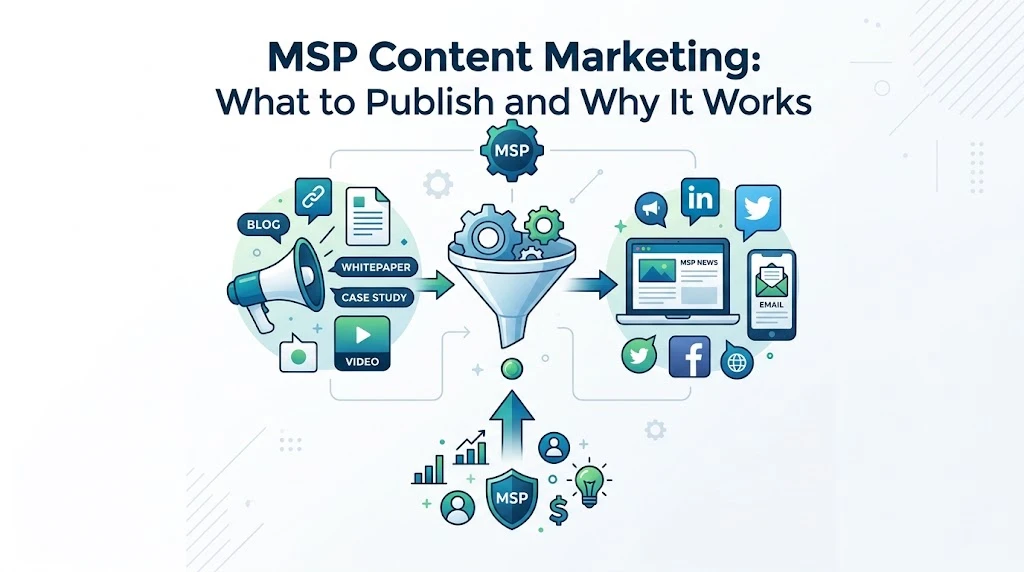
MSP content marketing works best when content answers the questions prospects ask before they hire an IT provider. The strongest MSP content isn’t created simply to increase traffic,it helps a potential client understand a problem, evaluate solutions, compare providers, and eventually take the next step.
The framework behind all of it is simple: a real customer question leads to search intent, search intent leads to useful content, useful content connects to a relevant MSP service, that builds trust, and trust leads to conversion.
What Is MSP Content Marketing?
Direct answer: MSP content marketing means creating useful resources around the problems, decisions, and questions your prospects actually face,not publishing a new blog post every week for its own sake.
That includes content around:
- IT problems
- Business risks
- Technology decisions
- Service questions
- Costs
- Comparisons
- Security concerns
- Provider-selection questions
The goal is never volume. Every piece should support a specific buyer need and a specific business objective,if it doesn’t, it’s not really content marketing, it’s just filler on a blog.
Why Does Content Marketing Work for MSPs?
Direct answer: it works because it meets buyers earlier in their decision, before they’ve even picked up the phone,and it gives your sales team something useful to point to once they do call.
- Prospects research before contacting an MSP. By the time someone reaches out, they’ve usually already searched the problem, the cost, and the options.
- Content answers questions sales calls usually have to explain. That means less time spent educating and more time spent qualifying.
- Useful content builds expertise before the first conversation. A prospect who’s already read a clear, honest guide from you starts the call trusting you more.
- Service content captures commercial search intent. People actively searching for a service are close to a decision,service-focused content meets them there.
- Educational content helps create future demand. Not every reader is ready today, but a useful answer now can bring them back later.
- Good content gives sales something useful to send prospects. A well-written comparison or FAQ page can do part of the selling for them.
What Should an MSP Publish?
Direct answer: a strong MSP content mix covers the full range of buyer questions, not just blog posts,from problem-solving guides to service pages to real case studies.
| Content Type | Why It Exists |
| Problem-solving guides | Capture people searching for a fix, not a provider |
| Service pages | Convert people already looking for that specific service |
| Cost and pricing content | Answer the question most prospects have before they’ll even call |
| Comparison articles | Support people actively evaluating their options |
| Security content | Address the risk concerns driving many MSP searches |
| Industry-specific content | Speak directly to the problems a given industry actually has |
| How-to resources | Build trust with genuinely useful, practical help |
| Case studies | Show real, verifiable results |
| Checklists | Give readers something immediately usable |
| Buyer guides | Help prospects evaluate providers, including you |
| FAQs | Capture direct, specific questions efficiently |
| Original research or data | Build authority that generic content can’t match |
Publish Content About Problems Your MSP Actually Solves
Direct answer: this should be the core of your MSP content marketing, because it meets people at the exact moment they’re searching for help,before they know which provider to call.
Examples worth building content around:
- Why is business Wi-Fi constantly dropping?
- How can a company reduce IT downtime?
- What causes recurring Microsoft 365 problems?
- How do businesses recover from ransomware?
- Why are employees experiencing slow network performance?
Each piece should follow the same shape: start with the business problem, explain the possible causes, show what the business should check first, explain when professional help actually makes sense, and connect the problem naturally to your service,without turning the article into a disguised sales pitch.
Create Content Around MSP Services
Direct answer: service-focused content carries stronger commercial intent than general educational content, because the reader is already closer to a buying decision.
For each major service, cover what the service does, who needs it, what problems it solves, what’s included, what isn’t included, when to consider it, how providers typically deliver it, and what questions to ask before buying.
- Managed IT services → “What Does Managed IT Support Include?”
- Cybersecurity → “What Should a Small Business Cybersecurity Plan Include?”
- Microsoft 365 → “When Does a Business Need Managed Microsoft 365 Support?”
Publish Comparison Content for Buyers Evaluating Options
Direct answer: comparison content targets people much closer to a decision, and it works best when it’s genuinely balanced instead of rigging the outcome in your favor.
Strong comparison topics include:
- MSP vs in-house IT
- Managed IT vs break-fix
- Co-managed IT vs fully managed IT
- Microsoft 365 vs Google Workspace
- MDR vs traditional antivirus
- Outsourced IT vs hiring an IT manager
Each comparison should explain the real difference, show when each option actually makes sense, discuss costs and trade-offs honestly, and help the reader decide,without forcing your own service to “win” every single comparison. Balanced content builds more trust than a one-sided pitch ever will.
Create MSP Content About Cost and Pricing
Direct answer: cost questions come up long before most prospects contact an MSP, so this content needs to exist even though pricing is rarely one-size-fits-all.
Useful topics include:
- How much does managed IT support cost?
- What affects MSP pricing?
- Per-user vs per-device MSP pricing
- What should be included in an MSP contract?
- What makes one MSP more expensive than another?
Explain what actually changes the price, what the customer gets for it, the common pricing models, and what a suspiciously low quote might be leaving out. Avoid inventing universal pricing figures unless you have real data behind them,vague or made-up numbers hurt credibility fast.
Publish Industry-Specific MSP Content
Direct answer: industry-specific content works when it addresses genuinely different problems for each industry,not when it’s the same article with the industry name swapped in.
Consider industries like:
- Accounting
- Legal
- Healthcare
- Construction
- Financial services
- Manufacturing
- Professional services
For example: “Cybersecurity Considerations for Accounting Firms,” “Microsoft 365 Management for Professional-Service Companies,” or “IT Risks Growing Construction Companies Should Review.” The key is adding real, industry-specific problems each time, not just relabeling the same generic content.
Create Content Based on Questions Your Sales Team Keeps Hearing
Direct answer: your sales team already knows exactly what your next piece of content should be,ask them before you brainstorm anything from scratch.
Ask sales what every prospect asks, what objections come up repeatedly, what makes prospects hesitate, why they choose other providers, what they misunderstand, and what information they request before a proposal.
For example, if sales keeps hearing “why should we pay for managed IT when we already have an employee who handles IT?”,that’s a direct content brief for “In-House IT vs MSP: When Does Outsourcing Make Sense?” This creates a real bridge between your content and your sales team, instead of two departments working from separate priorities.
Use Search Data to Find What MSP Buyers Want to Know
Direct answer: combine three free data sources,Google Search Console, keyword research tools, and your own sales or CRM data,to find topics that are both searched for and genuinely useful to your business.
- Google Search Console shows existing and unexpected queries, pages already getting impressions, and queries with high impressions but low click-through,often a sign the current page or title isn’t answering the question well.
- Keyword research tools help you find commercial topics, problem searches, comparison searches, cost searches, and industry-specific searches.
- Sales and CRM data surfaces repeated questions, objections, and the services prospects ask about most often.
The strongest topics sit where search demand, business relevance, and real buyer need overlap,not just wherever the search volume happens to be highest.
Match Each Content Topic to a Search Intent
Direct answer: the type of content you create should match what the searcher actually wants at that moment,a troubleshooting guide and a service page aren’t interchangeable, even for a related topic.
| Search Intent | Content Type | Business Purpose |
| Problem | Troubleshooting guide | Build awareness |
| Informational | Educational article | Build expertise |
| Commercial | Service guide | Generate interest |
| Comparison | Comparison article | Help evaluation |
| Cost | Pricing guide | Reduce uncertainty |
| Local | Local or service page | Capture local demand |
| Decision | Buyer guide or case study | Support conversion |
Don’t Send Every Content Reader Straight to “Contact Us”
Direct answer: match the call to action to how ready the reader actually is,someone reading “What is ransomware?” isn’t in the same place as someone reading “managed IT services for small business.”
- Match the CTA to buying intent. An educational reader should be offered another useful resource, not a hard sales pitch.
- Use internal links to move readers toward relevant services gradually, as their interest becomes more specific.
- Give early-stage readers a useful next step, like a related guide or a checklist, instead of a form that feels premature.
An early-stage path might look like: educational article → related guide → security service page → assessment offer. A late-stage path, like someone reading “managed IT services for small business,” can go straight to the service page and a consultation offer.
Turn One MSP Topic Into Multiple Useful Assets
Direct answer: a well-researched topic can support several formats,but each one needs to add real value, not just repeat the same paragraph in a different shape.
For example, “common cybersecurity gaps found in small businesses” can become a blog article, a checklist, a LinkedIn post, a sales resource, an email, a short video, or a client discussion guide,as long as each format is genuinely useful on its own, not a copy-paste of the same three sentences.
How Case Studies Make MSP Content More Credible
Direct answer: a strong case study answers specific questions with real detail,vague claims like “we helped a client improve their IT” convince no one.
A useful case study covers:
- What was the client’s problem?
- What was happening before?
- What did the MSP investigate?
- What solution was implemented?
- What changed?
- What measurable result was achieved?
- What did the MSP learn?
Specific evidence,real numbers, real timelines, real before-and-after,is far more persuasive than general praise.
How Often Should an MSP Publish Content?
Direct answer: there’s no magic number,publishing quality should be driven by what buyers actually need answered, not an arbitrary quota.
- Prioritize important buyer questions over hitting a publishing target.
- Improve existing content before creating more,a rewrite of a weak page often beats a brand-new one.
- Publish when you have something useful to add, not on a fixed schedule regardless of quality.
- Build a sustainable publishing schedule you can actually maintain long-term.
A smaller number of genuinely useful resources is worth more than a large library of repetitive articles nobody reads twice.
How to Decide Which MSP Content to Publish First
Direct answer: prioritize by business value, buyer intent, search opportunity, and existing authority together,not by whichever topic sounds most interesting to write.
| Priority | When It Applies |
| Publish first | High-value service with clear buyer demand |
| Improve existing content | Already getting impressions or traffic but underperforming |
| Create later | Useful, but low commercial priority right now |
| Don’t create | Duplicate or near-duplicate topic with no added value |
How to Measure Whether MSP Content Marketing Is Working
Direct answer: pageviews alone tell you almost nothing,track content performance all the way through to leads, sales conversations, and revenue.
- Organic impressions
- Organic clicks
- Search queries
- Rankings
- Engaged visits
- Service-page visits
- Content-assisted conversions
- Leads
- Qualified opportunities
- Sales conversations
- Pipeline
- Revenue influenced by content
Break it down by asking which content generates traffic, which content generates qualified leads, and which content actually helps sales close deals,that’s the real difference between content performance and business performance.
Common MSP Content Marketing Mistakes
Direct answer: most weak MSP content marketing fails for the same handful of avoidable reasons.
- Publishing just to hit a monthly content quota
- Writing about topics that have nothing to do with your services
- Rewriting the same information already available everywhere
- Creating multiple articles with the same search intent
- Making every article a sales pitch
- Ignoring existing content that already has search visibility
- Measuring traffic without checking lead quality
- Publishing without internal links to relevant services
- Using generic AI-style content with no original experience or evidence
Worth noting: using AI to help draft content isn’t itself the problem,low-value, repetitive, unoriginal content is the actual issue, regardless of how it was written.
Build an MSP Content Marketing System, Not a Blog Calendar
Direct answer: content works best as a system, not a to-do list,customer question leads to intent, intent leads to a topic, a topic leads to a content type, that connects to a relevant service, a call to action, an internal link, a lead, and sales feedback.
That last step matters most: sales feedback should feed the next round of content. So the loop looks like this,sales questions shape content, content brings in visitors, visitors become leads, leads generate sales feedback, and that feedback improves the next batch of content. That’s a far stronger approach than simply deciding to “blog consistently.”
A 90-Day MSP Content Marketing Plan
Direct answer: use the first 90 days to find real opportunities, build the core content around them, then optimize based on actual performance.
Days 1–30,find the opportunities: review existing content, review Search Console data, talk to sales, identify priority services, find content gaps, and identify high-intent questions.
Days 31–60,build the core content: improve important service pages, publish problem-solving resources, create comparison and cost content, add internal links, and create one strong case study.
Days 61–90,optimize and expand: review search performance, improve underperforming pages, expand topics showing real demand, consolidate overlapping content, measure content-assisted leads, and feed sales feedback into the next content cycle.
If you’d like this built out as part of a broader plan, our MSP marketing plan service covers exactly how content fits alongside your other channels.
MSP Content Marketing Framework at a Glance
Find real buyer questions, identify the intent behind them, choose the right content type, answer it completely, connect it to the relevant MSP service, add the appropriate next step, measure the business results, and improve based on real data,not a content calendar built on guesswork.
What Should an MSP Publish First?
Direct answer: start with what’s closest to revenue, then work outward toward broader education.
- Your highest-value service pages
- The biggest problems those services solve
- Questions your sales team hears repeatedly
- Comparison questions prospects ask
- Cost and pricing questions
- Industry-specific problems
- Case studies with real outcomes
- Buyer guides that help prospects evaluate providers
- Content opportunities revealed by Search Console
- Existing pages that already have visibility but need improvement
If you’re not sure where your content currently stands, this overview of MSP marketing services explains how a content review typically fits into a broader engagement.
Frequently Asked Questions About MSP Content Marketing
How Much Does MSP Content Marketing Cost?
It depends on volume and depth,a handful of well-researched service pages costs far less than an ongoing program covering multiple topic clusters, but both can work depending on your goals.
Should an MSP Write Its Own Content or Hire a Writer?
Either can work, as long as whoever writes it understands the business well enough to avoid generic, surface-level advice,technical accuracy and real experience matter more than who holds the pen.
How Long Does MSP Content Marketing Take to Produce Leads?
Service-focused content can produce interest within weeks, while broader organic content marketing usually takes a few months to build real momentum.
Can Content Marketing Work for a Local MSP?
Yes,local, industry-specific, and problem-based content often performs especially well for a local MSP, since the competition for those exact searches is usually lower than national terms.
Should Every MSP Service Have Its Own Content Strategy?
Your core, revenue-driving services should each have dedicated content; smaller or rarely-requested services can usually share broader, less frequent coverage.
What Should an MSP Do With Old Blog Posts?
Review them against current search performance,update the ones getting impressions but underperforming, and consolidate or remove ones that no longer add value.
How Can an MSP Tell if a Content Topic Is Too Competitive?
Check who’s currently ranking for it,if it’s dominated by large, well-established sites with no local or niche angle available, a narrower or more specific version of the topic is usually a better bet.
Should MSP Content Include Technical Details or Stay Beginner-Friendly?
Match the depth to the reader’s stage, early-stage buyer content should stay accessible and plain-spoken, while service and comparison pages can include more technical specifics for readers further along.
For a wider look at how content fits into full MSP growth, see this guide on MSP growth and online optimization, or this overview of marketing for MSP and general MSP marketing support for the bigger picture.