
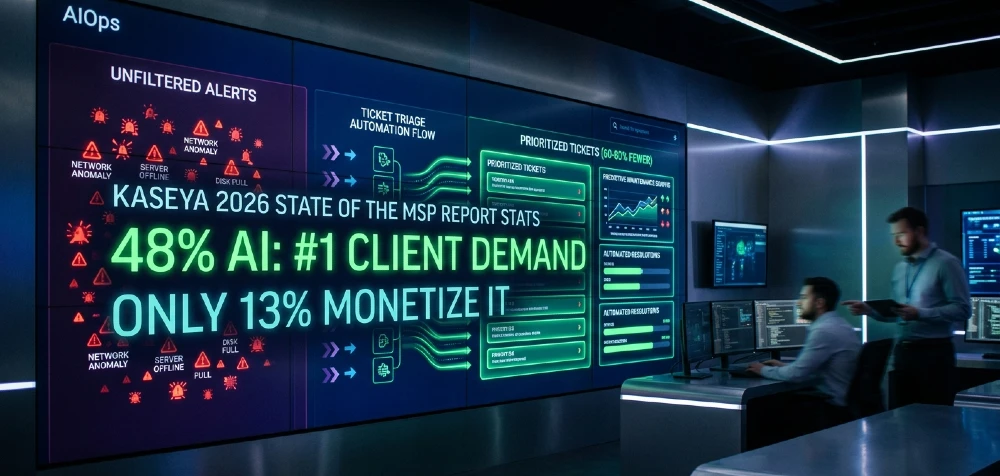
Kaseya 2026 State of the MSP Report: 48% of Clients Want AI But Only 13% of MSPs Are Making Money From It
The biggest gap in managed services right now isn’t talent. It isn’t even budget pressure. It’s the space between what clients are asking for and what MSPs are actually delivering. The numbers from Kaseya’s 2026 report make that painfully clear.
On April 14, 2026, Kaseya one of the largest providers of IT management and cybersecurity software globally released its 2026 State of the MSP Report. It surveyed more than 1,000 managed service providers across the world. And the headline finding isn’t subtle.
Nearly half of all MSP clients now rank AI and automation as their top IT priority for 2026. That’s ahead of cybersecurity. Ahead of cloud backup. Ahead of everything. Yet when you flip to the revenue side of the equation, just 13% of MSPs are currently earning meaningful income from those same AI services.
That gap 48% demand versus 13% delivery is the story of the MSP industry in 2026. And it runs much deeper than just one metric.
48%
MSPs rank AI as #1 client need for 2026
13%
Currently generating meaningful AI revenue
71%
Say customer acquisition is top challenge
53%
Already using AI internally for operations
41%
Clients still spending over $25K/year (down from 75%)
Growth Is Getting Harder. The Numbers Don’t Lie.
Let’s start with the business environment MSPs are operating in right now. It’s rough. Not impossible — but noticeably harder than a year ago.
According to the Kaseya report, 71% of MSPs now say acquiring new customers is their single biggest challenge. That’s a significant jump. And it’s not just a perception issue — one-third of respondents specifically cited slower new-client acquisition as a key economic factor affecting their growth trajectory.
Deal sizes are shrinking too. This one stings. The share of MSPs reporting typical customer spending above $25,000 per year collapsed from 75% to just 41% in a single year. That’s not a gradual decline — that’s a cliff. Meanwhile, 24% of MSPs said clients are actively reducing IT spend.
📉 Market Pressure at a Glance
- Deal sizes above $25K/year dropped from 75% to 41% year over year
- 24% of MSPs say their clients are cutting IT budgets
- 33% of new client wins are MSP-to-MSP switchers — the market is cannibalizing itself
- Difficulty hiring skilled technicians nearly doubled — from 9% to 16%
That last point about hiring deserves a pause. Difficulty finding skilled technicians almost doubled in one year. That’s a workforce crisis quietly happening inside an already squeezed industry. You can’t grow headcount when talent isn’t available — and you can’t grow revenue when deals are getting smaller. That’s the pressure cooker MSPs are sitting in right now.
“The MSP market is maturing, and rising competition is forcing providers to rethink how they grow.”— Dan Tomaszewski, Executive Vice President of Channel, Kaseya
AI Is the #1 Client Demand — And MSPs Know It
So what do clients actually want in 2026? According to Kaseya’s survey, the answer is clear. 48% of MSPs say their clients rank AI and automation as the top IT service need for the year. That places it above cybersecurity — which, for years, has been the go-to answer when you asked clients what keeps them up at night.
This isn’t hype anymore. Clients are seeing AI used in other parts of their business — in marketing tools, in customer service automation, in finance — and they’re now asking their MSPs: “What can you do with AI for our IT infrastructure?”
What specifically are clients asking for? Things like predictive maintenance (catching infrastructure problems before they cause downtime), intelligent ticket triage, anomaly detection in network behavior, and autonomous patching workflows. These aren’t futuristic concepts — they’re table-stakes expectations from clients who’ve already seen AI deliver value elsewhere.
The Demand Signal Is Loud. The Revenue Response Is Quiet.
Here’s where the report gets uncomfortable. Despite that massive client-side demand, only 13% of MSPs are currently generating meaningful revenue from AI services. That means 87% of MSPs are essentially leaving money on the table — or more accurately, they’re struggling to package, price, and deliver AI as a premium offering clients will actually pay for.
The AI Gap: Demand vs. Revenue Reality
Client AI demand (MSPs)
48%
MSPs monetizing AI today
13%
Source: Kaseya 2026 State of the MSP Report, April 14, 2026
This gap isn’t a technology problem. Most MSPs have access to AI tools. The real barrier is packaging — turning technical capability into a billable, client-facing service with clear pricing and measurable outcomes. That’s a product and go-to-market challenge, not an engineering one.
MSPs Are Using AI Internally — Just Not Selling It Yet
Here’s the thing that’s easy to miss in the headline numbers. MSPs are using AI. Quite a lot, actually. The report shows that 53% of MSPs are already deploying AI internally — automating ticketing workflows, patch management, infrastructure monitoring, and reporting.
The results? Measurable. Kaseya reports providers are seeing improvements in first-response times, stronger technician efficiency, and reduced employee burnout. For an industry fighting a talent shortage, that last one matters more than people admit. Burned-out technicians leave. AI that absorbs routine work keeps teams focused — and employed.
Internal AI Wins Reported by MSPs
- Faster first-response times on support tickets
- Technicians handling more complex work (less Level 1 noise)
- Reduced employee burnout on repetitive monitoring tasks
- Automated patching reducing manual intervention cycles
- AI-generated reporting cutting admin hours per week
But here’s the catch: more than half of those MSPs using AI internally have only automated about a quarter of their workload. The gains are real, but they’re early-stage. The runway is long. MSPs that accelerate automation now will compound those efficiency gains — those that wait will find their margins shrinking as competitors do more with smaller teams.
Cybersecurity and Backup: Still the Revenue Backbone
Not everything in the report is a warning sign. Two service categories are holding up exceptionally well — and MSPs should pay attention.
According to Kaseya’s data, 71% of MSPs reported year-over-year revenue growth in cybersecurity — the highest of any service category in the survey. Backup and disaster recovery followed close behind, with 50% of MSPs reporting growth in business continuity services.
These aren’t shrinking markets. If anything, the economic pressure on clients is making them more risk-aware — not less. Cyberattacks don’t stop because budgets tighten. In fact, leaner IT environments often become more vulnerable. MSPs that anchor their offering in security and resilience have a defensible position even as other categories face margin compression.
The smart play? Use cybersecurity and backup as your stable revenue floor, and build AI services on top of it. One protects margins. The other grows them.
The Real Opportunity: Closing the AI Monetization Gap
If you’re an MSP reading this, the Kaseya 2026 State of the MSP Report is essentially a roadmap with the destination already marked. Clients want AI. They’re asking for it by name. And 87% of your competitors aren’t delivering it in a way that generates revenue. That is the opening.
But closing the monetization gap requires three things that MSPs often struggle to build internally: client-facing AI tools (not just back-end automation), packaging and pricing models that make AI tangible and billable, and fast development capacity to build or white-label those tools without breaking the budget.
What MSPs Can Do Right Now: A Practical Checklist
- Audit your current AI tool usage — what’s internal-only vs. what could be client-facing?
- Create a simple AI service tier — even one offering — that clients can subscribe to monthly
- Build or white-label a client dashboard showing AI-driven insights (uptime, threat alerts, ticket trends)
- Train your sales team to talk about AI outcomes, not features — clients buy results
- Partner with development teams who can build AIOps portals at 40–60% lower cost than in-house
- Use internal AI wins (faster response times, fewer incidents) as proof points in client conversations
- Benchmark your automation progress — aim to automate more than 25% of workflows this year
The MSPs that will lead in the next business cycle aren’t the ones adding the most services. They’re the ones that package AI into clear, measurable outcomes — and make it simple for clients to buy.
What This Report Really Tells Us About the MSP Market
Step back for a moment and look at what the Kaseya 2026 State of the MSP Report is actually describing. It’s a market in transition — not in collapse, but in a genuine structural shift.
The old MSP growth model — win clients, lock them into recurring contracts, slowly expand scope — is under pressure. Deal sizes are falling. Clients are more cost-conscious. Acquisition is harder. And the talent needed to scale traditional service delivery is increasingly expensive and scarce.
The new model that’s emerging? Leaner teams backed by AI automation, delivering AI-powered services as a premium tier to clients who are actively asking for exactly that. The MSPs who thread that needle first — efficiency on the inside, AI services on the outside — will set the benchmark that everyone else chases.
As MySecurity Marketplace noted in their analysis of the report: the providers that will lead the next cycle are the ones that simplify their stacks, automate intelligently, and package AI into measurable outcomes. That’s not opinion. The data says the same thing.
Why This Matters
The Kaseya 2026 State of the MSP Report is one of the largest surveys of managed service providers globally — over 1,000 respondents — making its findings statistically significant for the industry. The 48% vs. 13% AI gap isn’t just an interesting data point. It’s a market inefficiency that represents real revenue waiting to be captured by MSPs who move quickly.
For any business that supports MSPs — through development, staffing, marketing, or tooling — this report signals where client attention and budget will flow in 2026. Understanding it now is a competitive advantage.
The full report is available directly from Kaseya’s website.