
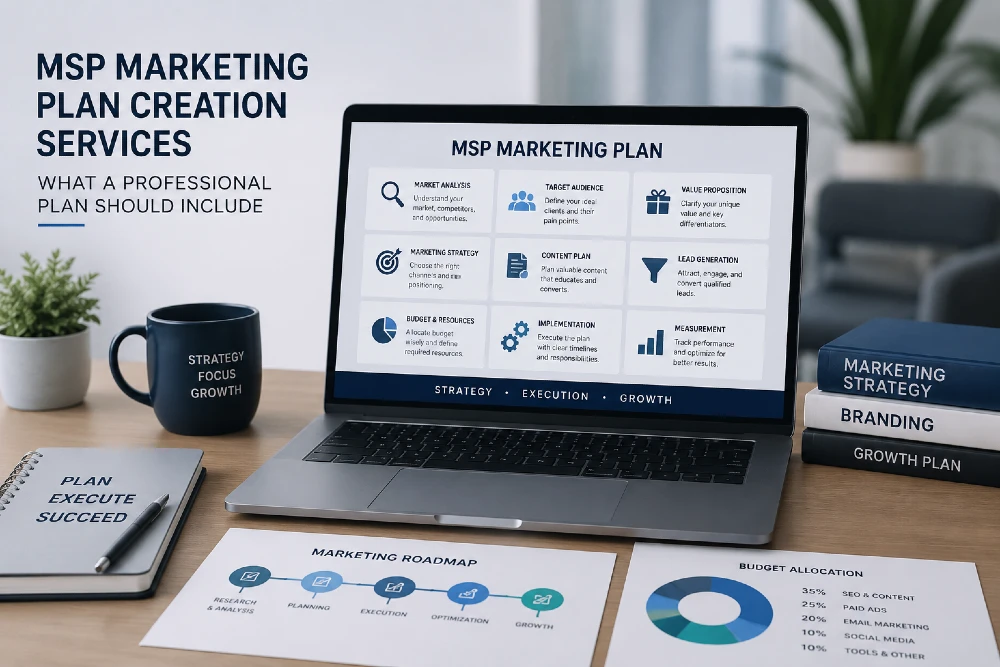
A professional MSP marketing plan should include a market and business assessment, a defined ideal customer, clear positioning, measurable goals, a prioritized channel strategy, an offer and conversion process, a budget, and a way to measure everything against revenue, not just a list of tactics to try.
Most “marketing plans” sold to MSPs are recycled templates with a new logo on the cover. This guide breaks down what real MSP Marketing Plan Creation Services should actually deliver, and how to spot the ones that won’t.
What an MSP Marketing Plan Actually Does
Direct answer: a real marketing plan is a decision document, it tells you what to do, in what order, and why, not a checklist of tactics copied from a blog post. This is exactly the gap that properly built MSP Marketing Plan Creation Services are meant to close.
A Marketing Plan Is a Decision Document, Not a List of Tactics
Tactics without reasoning don’t tell you what to prioritize when budget or time is limited, a plan should make that call for you, based on your actual situation.
How a Good Plan Connects Marketing Activity to MSP Revenue
Every activity in the plan should trace back to a business outcome, leads, opportunities, or closed revenue, not just traffic or visibility.
Why Every MSP Needs a Different Marketing Plan
Two MSPs with different client bases, budgets, and growth goals need different plans, even if they’re in the same city offering similar services.
Start the Plan With an MSP Business and Market Assessment
Direct answer: a plan built without first reviewing the MSP’s current revenue, clients, and marketing performance is a generic template, not a real strategy.
- Review the MSP’s current revenue model to understand which services actually drive profit today.
- Identify the services that should drive growth based on margin, demand, and delivery capacity.
- Analyze the current client base to see who’s already succeeding with the business.
- Identify the most valuable customer segments by revenue, retention, and referral behavior.
- Assess current marketing performance before recommending changes, you can’t fix what you haven’t measured.
- Identify existing assets that can be reused, so the plan doesn’t start from zero unnecessarily.
Define the Ideal MSP Customer Before Choosing Marketing Channels
Direct answer: channel decisions made before the ideal customer is defined are just guesses, this step has to come first.
| Define This | Why It Matters |
| Company size, industry, and location | Shapes messaging, channel choice, and service area |
| Shared IT problems among best clients | Reveals the real pain points to market against |
| Who actually makes the buying decision | Determines tone and content depth needed |
| What makes a prospect a good or bad fit | Prevents wasted effort on the wrong leads |
A practical ideal client profile should be specific enough that anyone on the team could recognize a good-fit prospect on sight, not a vague description like “small businesses that need IT.”
Build the MSP’s Market Positioning
Direct answer: positioning answers one question, why should this specific business pick your MSP over the one down the street, and a real plan should answer it clearly.
- Decide what the MSP should be known for, rather than trying to be known for everything.
- Identify the difference between your MSP and local competitors honestly, not with generic claims like “great service.”
- Turn technical capabilities into a clear business proposition that a non-technical buyer can understand instantly.
- Create messaging for different buyer concerns, cost, security, reliability, and support all need their own angle.
- Define what the MSP should stop trying to sell, since narrowing focus is often what makes positioning work.
A professional plan shouldn’t simply say “target small businesses.” It should explain which businesses, why they’re valuable, what problem they share, and why this MSP is the right fit for them specifically.
Set Marketing Goals That Can Actually Be Measured
Direct answer: goals without numbers and timeframes aren’t goals, they’re intentions, and a real plan replaces intentions with targets.
- Separate business goals from marketing goals so each is measured on its own terms.
- Set lead and qualified-opportunity targets, not just a vague “generate more leads.”
- Define revenue targets from marketing specifically, separate from overall company revenue goals.
- Establish a realistic customer acquisition target based on sales capacity, not wishful thinking.
- Set timeframes for each objective, since a goal with no deadline never gets prioritized.
Identify the Best Growth Opportunities Before Choosing Channels
Direct answer: the best channel is the one that fits an already-identified opportunity, not the one that’s trending or easiest to sell internally.
- Find existing sources of qualified leads that may already be working but underused.
- Identify gaps in the current customer journey where prospects are likely dropping off.
- Find services with untapped demand that aren’t being marketed at all yet.
- Identify markets the MSP can realistically enter, given current capacity and proof.
- Prioritize opportunities by impact and effort, so the highest-value work comes first.
This step prevents the common mistake of putting every marketing channel into the plan simply because it exists.
Build a Channel Strategy Around the MSP’s Actual Situation
Direct answer: channels should be chosen based on the MSP’s current stage and resources, not a generic “SEO plus ads plus social” package sold to everyone.
- Decide which channels deserve investment first, based on the opportunities already identified.
- Define the job each channel must perform, awareness, leads, or retention are not interchangeable goals.
- Separate short-term lead generation from long-term visibility, since they’re funded and judged differently.
- Decide which channels should be tested before scaling, rather than committing budget upfront.
- Document what the MSP should not spend money on yet, which is just as important as what it should.
Create the Offer and Conversion Strategy
Direct answer: a plan that jumps straight from “audience” to “channels” without defining the offer skips the step that actually turns interest into leads.
- Define the offer you want prospects to respond to, a free assessment, a consultation, or a specific service package.
- Create a logical entry point for new prospects, so there’s one clear place the marketing points to.
- Decide what happens after someone enquires, including who follows up and how fast.
- Remove friction from the conversion process, since every extra step loses a percentage of interested prospects.
- Align landing pages, CTAs, and follow-up with the offer, so the experience feels consistent from click to conversation.
Build a Customer Journey for MSP Buyers
Direct answer: MSP buyers move through stages, and a real plan maps content and messaging to each one instead of treating every visitor the same way.
- Map the journey from first discovery to sales conversation.
- Identify what information the prospect needs at each stage of that journey.
- Create different messages for different buying stages, early research looks nothing like a final comparison.
- Define when marketing should hand a lead to sales, based on clear readiness signals.
- Create follow-up for prospects who aren’t ready yet, so early interest isn’t wasted.
Turn the Strategy Into an Executable Marketing Calendar
Direct answer: a strategy without a calendar rarely gets executed, a real plan turns priorities into scheduled, assigned work.
- Define monthly marketing priorities tied directly to the plan’s goals.
- Assign each activity to a specific business objective, so nothing gets done just to stay busy.
- Set publishing, campaign, and outreach frequencies that are realistic to sustain.
- Assign responsibility for each task, so nothing falls through the cracks.
- Set deadlines and dependencies between related activities.
- Leave room for optimization instead of locking every activity in months in advance.
Define the Budget Before the Marketing Plan Goes Live
Direct answer: budget should follow priority, not an equal split across every channel, otherwise the highest-impact work is underfunded from the start.
- Separate strategy costs from execution costs, since they’re often billed and planned differently.
- Allocate budget by priority rather than spreading it evenly across everything.
- Set testing budgets for unproven channels before committing to full scale.
- Define when spending should increase or stop, based on measured results.
- Include tools, advertising, content, and other operational costs so the real total is visible upfront.
Build Measurement Into the Plan From Day One
Direct answer: measurement bolted on after launch is always weaker than measurement built into the plan from the start.
- Define the metrics that matter to the MSP specifically, not a generic dashboard.
- Track lead source and campaign attribution, so you know what’s actually working.
- Measure qualified leads instead of raw enquiries, since not every form fill is a real opportunity.
- Track opportunity and customer conversion, all the way through to a closed deal.
- Connect marketing activity to revenue wherever possible.
- Create a monthly performance review so the plan gets adjusted based on real data, not assumptions.
Include a Testing and Optimization Process
Direct answer: a professional plan should assume the first version of the strategy won’t be perfect, and should include a built-in way to adjust it.
- Define what will be tested before launch, not after something underperforms.
- Set a minimum evaluation period so decisions aren’t made on too little data.
- Decide what data will trigger a change ahead of time, to remove guesswork later.
- Keep winning activities and remove weak ones on a regular schedule.
- Update the plan when market conditions change, rather than treating it as fixed for the year.
What Deliverables Should MSP Marketing Plan Creation Services Provide?
Direct answer: a completed engagement should hand you a full, usable document, not a slide deck of generic advice.
| Deliverable | What It Covers |
| Business and market analysis | Current position, competitors, and opportunity |
| Ideal customer profile | Who to target and why |
| Competitor and market opportunity analysis | Where gaps exist in your market |
| Positioning and messaging framework | How to talk about your MSP consistently |
| Marketing goals and KPIs | Specific, measurable targets |
| Channel prioritization | Which channels come first, and why |
| Offer and conversion strategy | What prospects are asked to do, and how it’s optimized |
| Marketing calendar | Scheduled, assigned activities |
| Budget framework | Spend allocated by priority |
| Measurement and reporting framework | How results get tracked and reviewed |
| 30-, 60-, or 90-day implementation roadmap | The first concrete steps to execute |
If you want to see how these deliverables connect to the services actually used to execute them, this breakdown of MSP marketing services covers what typically comes next after the plan is built.
How to Tell If an MSP Marketing Plan Is Actually Customized
Direct answer: ask these six questions before you trust any plan is genuinely built for your business, not repurposed from another client’s file. This is the fastest way to separate real MSP Marketing Plan Creation Services from a recycled template.
- Does it reference your actual services, by name?
- Does it identify your specific customer segments?
- Does it use your existing performance data?
- Does it explain why each channel was selected?
- Does it include priorities instead of a long list of tactics?
- Does it tell you what to do first?
If most of these come back vague, the plan probably wasn’t built specifically for your MSP.
Warning Signs of a Weak MSP Marketing Plan
Direct answer: these signs show up consistently in low-quality plans, and any one of them is worth pausing over before you pay for MSP Marketing Plan Creation Services.
| Warning Sign | Why It’s a Problem |
| The same strategy is given to every MSP | It wasn’t built from your actual data |
| Tactics are listed without explaining their purpose | You’re left guessing what each one is supposed to achieve |
| There are no specific KPIs | Success can’t actually be measured |
| There’s no budget logic | Spending decisions aren’t tied to priority |
| It promises rankings or leads without a testing process | No legitimate provider can guarantee this |
| It focuses on traffic instead of business outcomes | Traffic alone doesn’t pay the bills |
| It has no implementation timeline | Good ideas with no execution plan rarely happen |
| It doesn’t explain what happens if the strategy fails | A real plan accounts for this upfront |
How a Professional MSP Marketing Plan Becomes an Execution Roadmap
Direct answer: a plan only creates value once it’s turned into weekly, owned, trackable work, otherwise it stays a document nobody opens again.
- Turn priorities into weekly actions, broken down from the monthly calendar.
- Assign owners and deadlines to every task.
- Track completed vs. planned activities to catch slippage early.
- Review performance at the end of each sprint, not just once a quarter.
- Adjust the next month based on actual results, not the original assumptions.
MSP Marketing Plan Example: From Strategy to Action
Direct answer: here’s what a real, specific plan section looks like, not a generic 50-tactic list.
| Element | Example |
| Business situation | Established MSP, flat growth, over-reliant on referrals |
| Growth objective | 15 new qualified opportunities per month within two quarters |
| Target customer | 20–100 employee professional services firms in one metro area |
| Priority offer | Free network and security assessment |
| Selected marketing activities | Local SEO, service page rebuild, referral system, targeted content |
| Budget allocation | Weighted toward website and SEO first, paid ads tested after month two |
| KPIs | Qualified leads, cost per opportunity, closed revenue by source |
| First 90-day actions | Website fixes, local listings, first content batch, referral process launch |
What to Ask Before Hiring an MSP Marketing Plan Creation Service
Direct answer: use these questions to confirm you’re getting a real strategy from genuine MSP Marketing Plan Creation Services, not a templated document with your logo on it.
- Will you build the plan from our existing data?
- How do you decide which channels to prioritize?
- What deliverables will we receive?
- Who will execute the plan?
- How will results be measured?
- How often will the strategy be reviewed?
If you’d rather see this applied directly to your business, our MSP marketing plan service walks through this exact process, and our broader MSP marketing work covers execution once the plan is set.
FAQs About MSP Marketing Plan Creation Services
How Much Do MSP Marketing Plan Creation Services Cost?
It varies by scope and depth, a narrow strategy document costs less than a full plan with market research, competitor analysis, and an execution roadmap included.
How Long Does It Take to Create an MSP Marketing Plan?
Most thorough plans take a few weeks to complete properly, since they require reviewing real data before making recommendations.
Should an MSP Update Its Marketing Plan Every Year?
At minimum, yes, markets, competitors, and internal priorities change enough that a plan older than a year usually needs revisiting.
Can an MSP Marketing Plan Be Created for a New MSP With No Marketing History?
Yes, without historical data, the plan leans more on market and competitor research and positioning work upfront, with measurement built in from day one.
Who Should Own the Marketing Plan Inside an MSP?
Ideally one specific person, even in a small business, a plan with no clear owner tends to get deprioritized when things get busy.
What Is the Difference Between an MSP Marketing Plan and a Marketing Strategy?
A strategy is the overall direction and reasoning; a plan turns that strategy into specific goals, channels, budgets, and a calendar you can actually execute.
Can a Marketing Plan Work Without a Dedicated Marketing Team?
Yes, as long as someone is clearly responsible for executing and reviewing it, the plan just needs to be realistic about the resources actually available.
Should an MSP Have Separate Marketing Plans for Different Industries?
If you’re actively targeting more than one distinct industry with different messaging, separate plans usually perform better than one blended document trying to cover both. For a wider view of how this fits into overall growth, this guide on MSP growth and online optimization and this overview of marketing for MSP are worth reading alongside your plan.