
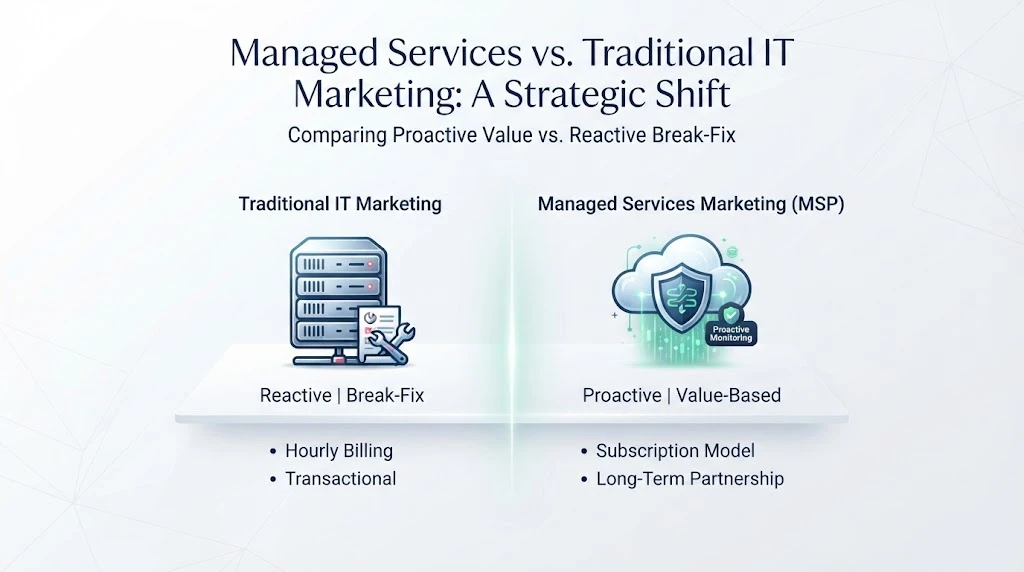
Managed services marketing sells an ongoing relationship, while traditional IT marketing sells a one-time fix, and that single difference changes your messaging, your website, your content, your sales process, and how you measure results.
Most MSPs still market themselves the way an old break-fix shop would: list the tools, list the services, wait for someone with a broken system to call. That approach undersells what a recurring, proactive relationship is actually worth. Below is exactly what changes when you market a relationship instead of a repair.
The Fundamental Difference: You’re Marketing a Relationship, Not a One-Time Service
Direct answer: traditional IT marketing responds to a problem that already happened; managed services marketing sells the prevention of problems that haven’t happened yet. That’s a completely different conversation.
Traditional IT Marketing Often Starts With a Specific Project
A server needs replacing, a network needs setting up, an office is moving, the buyer already knows the scope before they search.
Managed Services Marketing Starts With Ongoing Business Responsibility
The buyer isn’t asking for one job done, they’re asking who’s going to be accountable for their systems every day going forward.
Why Recurring Services Need a Different Buyer Conversation
A one-time buyer wants a price and a timeline. A recurring buyer wants to know they can trust you for the next several years, which means the conversation has to earn that trust, not just quote a job.
Change the Message From “Fix the Problem” to “Prevent the Problem”
“We fix IT issues fast” speaks to project buyers. “We keep issues from happening in the first place” speaks to the managed services buyer, and it’s the message most MSP websites are missing.
Compare the Buyer Journey Before Choosing Your Marketing Strategy
Direct answer: a traditional IT buyer moves fast because the pain is already obvious; a managed services buyer moves slower because they’re evaluating a long-term commitment, not a quick fix.
How a Traditional IT Buyer Usually Enters the Market
Something broke, or a specific project came up, they’re searching with urgency and a clear scope in mind.
How a Managed Services Buyer Recognizes the Need
It’s usually a slower realization: repeated small issues, an internal hire that isn’t working out, or growing risk they can’t manage alone anymore.
Identify Whether the Prospect Has an Urgent or Long-Term Problem
Ask directly. Urgent problems need fast, confident responses; long-term problems need proof, patience, and a clear process.
Match Your Marketing Message to the Buyer’s Stage
Sending a “sign a 12-month contract” message to someone with an urgent outage, or a “call now for emergency support” message to someone doing quiet, long-term research, loses both of them.
Stop Marketing MSP Services Like Individual IT Tasks
Direct answer: listing tools and tasks (patching, monitoring, backups) tells a prospect what you do, but not why it matters to their business, and that’s the gap managed services marketing needs to close.
- Don’t lead with technical features alone. RMM, EDR, and SIEM mean nothing to a business owner without a business reason attached.
- Connect each service to a business outcome. Patching prevents downtime; monitoring prevents small issues from becoming expensive ones.
- Explain what ongoing management actually covers. Most buyers genuinely don’t know what happens behind the scenes, spell it out.
- Show what happens between support requests. The quiet, preventive work is exactly what makes managed services different, and it’s usually invisible in current marketing.
- Make the recurring value visible. A monthly fee needs monthly value attached to it, clearly stated, not implied.
Build Your Marketing Around the Cost of IT Problems
Direct answer: the strongest case for managed services marketing is the cost of doing nothing, show that clearly, and the value of a recurring relationship becomes obvious on its own.
Show the Business Cost of Downtime
Lost hours, missed deadlines, and frustrated staff all have a real cost, put a number or a scenario next to it.
Explain the Cost of Reactive IT Support
Emergency callouts and rushed fixes are almost always more expensive than the same work done proactively.
Show What Unmanaged Risks Can Create Over Time
Security gaps and outdated systems don’t cause problems immediately, they accumulate risk that eventually becomes a much bigger bill.
Compare Reactive Spending With Predictable IT Management
A simple side-by-side of unpredictable emergency costs versus a flat monthly fee makes the value easy to understand at a glance.
Use Business Impact Instead of Fear-Based Marketing
Facts and real scenarios build trust; scare tactics make prospects defensive and skeptical of everything else you say.
Your MSP Website Needs to Sell Predictability
Direct answer: a managed services buyer is paying for certainty, so your website needs to remove uncertainty at every step, not just describe your services.
- Explain what clients can expect every month, specific deliverables, not a vague “ongoing support.”
- Make your support model easy to understand, how to reach you, what counts as covered, what doesn’t.
- Show response and escalation processes, what happens in the first five minutes of a real issue.
- Explain onboarding before the prospect becomes a client, the unknown of “what happens after I sign” is a real hesitation point.
- Remove uncertainty from the buying decision, every unanswered question on your site is a reason to keep shopping around.
Change the Content You Publish for Managed Services Buyers
Direct answer: content built for a one-time IT buyer answers “how do I fix this,” while content for a managed services buyer answers “who should be responsible for this ongoing.”
Create Content Around Ongoing IT Management Problems
Topics like recurring downtime, staff turnover in IT, or growing compliance pressure speak directly to the managed services buyer’s real concerns.
Answer Questions About MSP Contracts and Service Models
Buyers researching MSPs want to understand what they’re actually signing up for, contract length, scope, and pricing structure.
Explain When Outsourcing Makes More Sense Than Hiring
This is a genuine decision many businesses are weighing, and a fair, honest comparison earns more trust than a one-sided pitch.
Create Content That Helps Buyers Evaluate Providers
Buyer guides and comparison content position you as the trustworthy source, even before a prospect talks to you directly.
Use Existing Client Questions to Find New Content Opportunities
The questions your own clients asked before signing are the exact questions your next prospect is asking right now.
Market the MSP Business Model, Not Just the Technology
Direct answer: prospects aren’t just buying tools, they’re buying a way of working, so explain the model, not only the tech stack behind it.
- Explain your service delivery model, how work actually gets done day to day.
- Show how monitoring and maintenance work, in plain language, not acronyms.
- Demonstrate how issues are detected before they become disruptions, this is the core promise of managed services.
- Explain how your team handles recurring IT responsibilities, ownership and accountability matter more here than tool names.
- Show what makes your managed service different from break-fix support, this comparison is often the deciding factor for a hesitant buyer.
Build Trust Before Asking a Prospect to Sign a Recurring Contract
Direct answer: a recurring contract is a bigger ask than a one-time job, so trust needs to be built before the sales conversation, not during it.
- Show evidence you can manage IT long-term, tenure, retention, or years in business all help here.
- Use case studies that demonstrate ongoing improvements, not just a single fixed problem.
- Explain your client onboarding process clearly, so the first step feels safe, not uncertain.
- Show your team’s technical capabilities through specifics, not general claims of expertise.
- Make your service commitments specific, vague promises don’t hold up against a multi-year decision.
Traditional IT Leads and MSP Leads Should Not Be Qualified the Same Way
Direct answer: a project lead and a managed services lead need different qualifying questions, because they’re solving completely different problems.
- Identify the prospect’s current IT support model.
- Ask why they’re considering an MSP now, that “why now” reveals urgency and readiness.
- Find out whether they have internal IT staff, since that changes the entire pitch.
- Identify recurring problems instead of one-time issues.
- Determine whether the business is genuinely ready for a long-term service relationship, not just a quick fix.
Build a Marketing-to-Sales Process for Recurring Revenue
Direct answer: managed services marketing needs a handoff process built for a longer decision, not a fast quote-and-close motion.
- Capture the prospect’s main IT challenge early, so sales isn’t starting from zero.
- Educate before pushing for a sales call, a rushed pitch on an unfamiliar model tends to backfire.
- Use discovery questions to uncover ongoing needs, not just the one issue that brought them to you.
- Connect the marketing message to the sales proposal so the story stays consistent from first click to signed contract.
- Keep prospects engaged during longer buying cycles with useful follow-up, not repeated sales pressure.
Measure MSP Marketing Differently From Project-Based IT Marketing
Direct answer: lead volume alone tells you almost nothing about managed services marketing, track the numbers tied to recurring revenue instead.
| Metric | Why It Matters for Managed Services |
| Qualified recurring-revenue opportunities | Shows real fit, not just interest |
| Customer acquisition cost vs. contract value | Confirms the deal is actually profitable over time |
| Lead-to-client conversion by service type | Reveals which offers are actually converting |
| Client retention and expansion opportunities | Recurring revenue depends on keeping and growing clients, not just signing them |
Don’t judge managed services marketing by lead volume alone, a smaller number of well-qualified, long-term-fit leads is worth more than a large number of one-time inquiries.
When Traditional IT Marketing Tactics Still Make Sense for an MSP
Direct answer: this isn’t an either/or decision, some prospects genuinely need project-based marketing, and pretending otherwise creates a false choice.
- Use project-based marketing for specific IT opportunities, like a network overhaul or a one-time migration.
- Use managed services marketing for recurring needs, where ongoing responsibility is the real ask.
- Combine both when a project can lead to a long-term relationship, many managed clients start as a one-time job.
- Decide which offer should lead the conversation based on how the prospect first describes their problem.
A Practical Managed Services Marketing Framework
Direct answer: use this seven-step order to build or rebuild your managed services marketing from the ground up.
| Step | Action |
| 1 | Identify the recurring business problem |
| 2 | Define the managed outcome you’re promising |
| 3 | Build the offer around ongoing responsibility, not a task list |
| 4 | Create proof that supports the promise |
| 5 | Build content around real buyer concerns |
| 6 | Qualify leads for long-term fit |
| 7 | Measure recurring revenue instead of just lead count |
If you want help putting this framework into an actual plan, this guide to building an MSP marketing plan walks through the process in more detail.
Managed Services Marketing vs Traditional IT Marketing: Quick Decision Guide
| If the Prospect Needs… | Lead With… |
| A one-time technology project | Project-focused IT marketing |
| Emergency technical help | Immediate problem-solving |
| Ongoing IT responsibility | Managed services positioning |
| Predictable IT costs | Recurring service value |
| Proactive monitoring | Managed service outcome |
| Strategic long-term IT support | MSP relationship |
For a broader look at how these pieces fit together across a full strategy, this overview of marketing for MSP covers the process end to end, and this breakdown of MSP marketing services explains what a full engagement typically includes.
FAQs About Managed Services Marketing
Not inherently, the difference is in strategy and patience, not budget. Managed services marketing often needs more content and trust-building, but not necessarily a bigger spend.
Yes, but the messaging has to shift from reactive fixes to ongoing prevention, and that usually means rebuilding the website and content, not just relabeling the same services.
It depends on your market, showing a starting range can filter out poor-fit leads, while some MSPs prefer to qualify pricing conversations directly on a call.
Industries with compliance requirements, sensitive data, or heavy technology dependence, like healthcare, legal, and finance, tend to value predictable IT management the most.
Compare the flat monthly fee against the real, unpredictable cost of downtime and emergency repairs, the contrast usually makes the value clear on its own.
Position your MSP as support for the team, not a replacement, covering overflow, specialized security work, or after-hours coverage often lands better than a full takeover pitch.
Often, yes, a completed project is a natural moment to introduce ongoing management, especially if the client already trusts the quality of your work.
Start with the website and core messaging, if it still reads like a project-based repair shop, everything else in your managed services marketing will struggle to land. For a full audit of what to prioritize, this look at MSP growth and online optimization or general MSP marketing support are good starting points.