
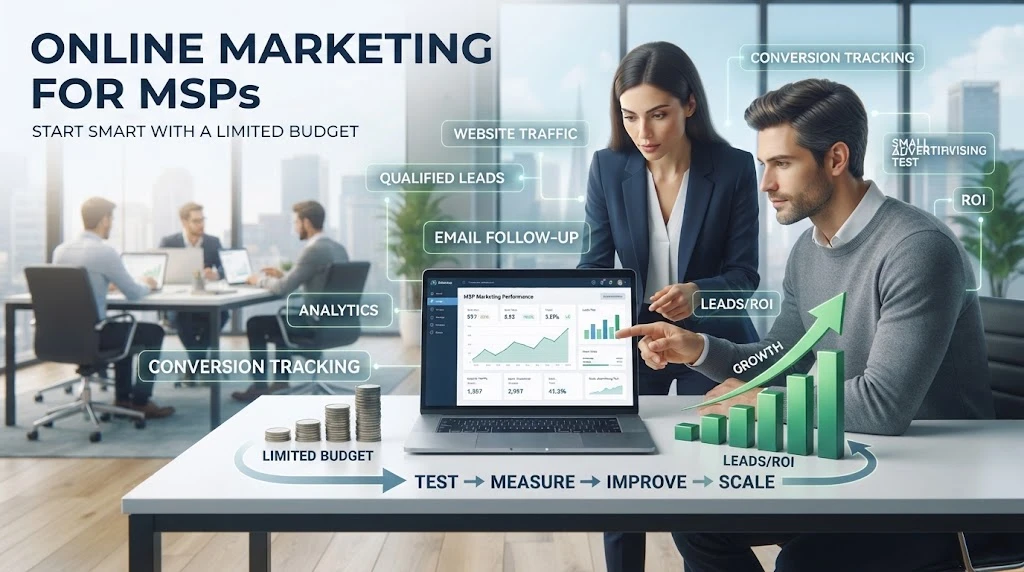
A small budget doesn’t stop online marketing for MSPs from working, it just changes the order you do things in. Fix your website and your data first, test one channel at a time with a fixed budget, and only spend more once something is proven to bring in real leads.
Most advice for new providers assumes you already have money to burn on ads and a big content team. This guide skips that. It’s built for an MSP with a tight budget that needs every dollar to earn its place. If you want the fuller picture beyond budget constraints, this guide on marketing for MSP covers the complete starting process.
First Decide What Your Small Marketing Budget Must Achieve
Direct answer: pick one measurable goal before you spend a single dollar, a small budget spread across five goals will produce nothing worth measuring.
Choose One Measurable Business Goal
Pick leads, meetings booked, or a specific number of new clients, not a vague aim like “more visibility.”
Set a Maximum Monthly Marketing Spend
Decide a firm number you can afford to lose while testing, so early experiments don’t put pressure on cash flow.
Decide What a Qualified MSP Lead Is Worth
Know roughly what one new client is worth to you over a year, so you can judge later whether a channel is actually worth the spend.
Separate Marketing Costs From Sales and Software Costs
Keep your ad spend, tools, and content costs in one bucket so you can see the real cost of getting a lead, not a blended number that hides the truth.
Find Your Lowest-Cost Route to Your Ideal MSP Buyer
Direct answer: go where your buyers are already looking for help, instead of trying to build an audience from nothing. This one decision shapes almost everything else about how your online marketing for MSPs will perform in the first 90 days.
Identify Where Your Prospects Already Spend Time Online
Business owners in your target market are already searching Google, asking peers, or reading specific industry forums, find out which one, don’t guess.
Find the Digital Platforms Your Specific Industry Uses
A healthcare-focused MSP and a legal-focused MSP won’t get the same value from the same platforms, match the channel to the industry, not the other way around.
Prioritize Existing Demand Over Audience Building
Someone actively searching for IT support today is far cheaper to convert than someone you need to convince over months of content.
Choose One Primary Acquisition Route Before Adding More
Get one channel working before splitting a small budget across three or four at once, a thin spend across many channels rarely produces enough signal to learn anything.
Build a Minimum Viable Online Presence Before Spending Money
Direct answer: fix your website’s basics first, spending on traffic before this just wastes the budget you’re trying to protect.
Make Your Website Ready to Receive Traffic
A visitor should understand what you do and who you serve within a few seconds, with no confusing jargon in the way.
Create One Conversion Path Instead of Many CTAs
Too many competing buttons and offers confuse visitors, pick one clear next step and repeat it consistently.
Make Your Contact Process Fast and Easy
A short form or a direct phone number converts better than a long, multi-step contact process.
Add Trust Signals Before Paying for Visibility
Reviews, client logos, or a short case study should be visible before you send paid traffic to the page.
Test the Complete Lead Journey Yourself
Fill out your own form, book your own call, and time every step, you’ll find friction points a spreadsheet never shows you.
Don’t spend money sending traffic to a website where the visitor can’t quickly understand what happens next. If your site needs deeper work first, this overview of MSP marketing services explains what a proper fix usually involves.
Use Free Data to Decide Where Your MSP Budget Goes
Direct answer: check the free data you already have before spending anything, it usually points straight at your best opportunity for online marketing for MSPs on a small budget.
- Google Search Console shows what people are already searching for on your site, even if you’re not ranking well yet.
- Website analytics shows which pages and paths actually lead to an enquiry, not just which get traffic.
- CRM data shows which past leads turned into real clients, and where they originally came from.
- Existing enquiry sources tell you which pages or channels are already producing interest for free.
Turn these four things into a short priority list before you spend a single dollar on a new channel.
Start With Small Tests Instead of Long Marketing Commitments
Direct answer: test one channel, one budget, and one metric at a time, this is how a small MSP learns fast without losing money on guesses.
| Test Rule | Why It Matters |
| Test one channel with a fixed budget | Keeps the risk small and the result easy to read |
| Give every test one success metric | Prevents you from moving the goalposts mid-test |
| Set a stop-loss before you spend | Protects the budget from a channel that clearly isn’t working |
| Don’t change five variables at once | Makes it possible to know what actually caused the result |
| Keep a record of every experiment | Builds a real playbook instead of relying on memory |
| Scale only after a repeatable result | Avoids over-investing in a lucky one-off |
Make Your Existing Online Assets Work Harder
Direct answer: improve what you already have before creating anything new, it’s almost always cheaper and faster.
Improve Pages That Already Receive Attention
A page with some traffic but a weak call to action is often an easier win than a brand-new page starting from zero.
Repurpose Your Best Existing Material Into New Formats
One good case study can become a page, a social post, and an email, no need to create three separate pieces from scratch.
Turn Client Questions Into Reusable Marketing Assets
Questions you already answer on sales calls make some of the most useful content, and they cost nothing but time to write down.
Update Underperforming Assets Before Creating Replacements
A page that’s close to working often needs a small fix, not a full rebuild.
Connect High-Intent Visitors to a Clear Next Action
Anyone reading a service page is close to a decision, make sure there’s an obvious next step waiting for them.
Use Email as a Low-Cost Follow-Up System
Direct answer: email works best as a follow-up tool, not a cold outreach blast, it costs almost nothing and keeps interested prospects warm until they’re ready.
Capture Permission From Relevant Prospects
Only collect emails from people genuinely relevant to your services, not from every visitor regardless of fit.
Separate Active Buyers From Long-Term Prospects
Someone requesting a quote needs a different follow-up than someone who just downloaded a guide.
Create Follow-Up Based on the Problem They Showed Interest In
A prospect who looked at cybersecurity content should get cybersecurity follow-up, not a generic newsletter.
Use Useful Follow-Ups Instead of Constant Sales Messages
Helpful, specific emails get opened; constant “buy now” messages get ignored or unsubscribed.
Know When a Lead Is Ready for a Sales Conversation
Watch for signals like repeat visits to pricing pages or direct replies, that’s when a human should step in.
Use Automation to Reduce the Cost of Manual Marketing
Direct answer: automate the repetitive parts of follow-up, not the parts that actually need a human touch, this is where online marketing for MSPs on a tight budget quietly saves the most hours.
- Automate lead acknowledgment so no one waits hours for a reply.
- Create simple follow-up sequences for leads who go quiet after the first contact.
- Automate lead source tracking so you always know where a lead came from without manual entry.
- Use scheduling tools to cut down the back-and-forth of booking a call.
- Don’t automate personalized sales conversations, a templated reply to a serious buyer can lose the deal.
Turn Online Questions Into Free Marketing Opportunities
Direct answer: answering real questions in public spaces builds trust for free, it just takes consistency, not a budget.
Find Questions Your Prospects Ask in Public Communities
Forums, local business groups, and industry communities are full of the exact questions your future clients are asking right now.
Answer the Specific Problem Before Mentioning Your MSP
Give a genuinely useful answer first, a pitch attached to every reply gets ignored or removed.
Identify Recurring Questions Worth Turning Into Resources
If you see the same question three or four times, it’s worth turning into a proper page on your site.
Build Authority Through Useful Participation
Consistent, honest answers over time build a reputation that a single ad campaign can’t buy.
Avoid Spammy Self-Promotion and Promotional Replies
Communities notice and penalize accounts that only show up to pitch, it damages trust faster than it builds it.
Protect a Limited Budget From Low-Quality Marketing
Direct answer: a tight budget can’t survive being wasted on packages that promise more than they can deliver.
- Avoid buying guaranteed rankings or leads, no legitimate provider can control this outcome.
- Check what’s actually included in cheap marketing packages, vague bundles often hide thin, templated work.
- Don’t pay for traffic you can’t attribute, if you can’t trace it to a lead, you can’t judge if it worked.
- Watch for vanity metrics like impressions or likes that never turn into real opportunities.
- Don’t lock your MSP into a channel you haven’t tested, long contracts before proof is backwards.
Know When Your MSP Is Ready to Spend More
Direct answer: increase spend only after one channel proves it can repeatedly produce qualified opportunities, not because a quarter has ended.
Identify Your First Repeatable Acquisition Channel
Look for the channel that’s produced results more than once, not a single lucky win.
Calculate Cost Per Qualified Opportunity
This number tells you far more than total leads or total spend on its own.
Check Whether Your Sales Process Can Handle More Leads
More leads without capacity to follow up quickly just creates a backlog, not more clients.
Increase Budget Gradually Instead of Doubling It
Small, steady increases let you catch problems before they get expensive.
Reinvest in What Produces Business Outcomes
Put new budget behind what’s already proven, not the newest idea you’ve come across.
A Lean 90-Day Online Marketing Plan for MSPs
Direct answer: use the first 90 days to test, not to scale, scaling too early is one of the most common ways small budgets get wasted.
Days 1–30: audit your website and existing data, fix obvious conversion gaps, and choose one channel to test with a fixed budget.
Days 31–60: improve the route that’s showing the strongest early signal and pull back from anything clearly underperforming.
Days 61–90: measure results properly, refine your messaging or targeting, and decide what to scale based on real numbers, not gut feeling.
| After 90 Days | Action |
| Clearly working | Keep and gradually increase spend |
| Mixed but promising | Refine one variable and retest |
| Clearly not working | Stop and redirect the budget |
How to Allocate a Limited MSP Marketing Budget
Direct answer: your best next move for online marketing for MSPs depends on where you are right now, not on a generic percentage split.
| Your Situation | What to Do Next |
| Almost no budget | Focus on free channels, website fixes, community answers, and existing client referrals |
| A small monthly amount | Put it behind one tested organic or local SEO effort |
| Budget for one paid channel | Choose the channel matching your highest-intent searches, not the trendiest one |
| Already have website traffic | Spend on conversion fixes before spending on more traffic |
| Already have leads but poor conversion | Fix your sales follow-up process before adding more marketing spend |
The Online Marketing Metrics a Small MSP Should Actually Track
Direct answer: track numbers tied to revenue, not activity, activity metrics feel productive but don’t tell you if your online marketing for MSPs spend is actually working.
| Metric | What It Tells You |
| Cost per qualified lead | How efficiently a channel produces real opportunities |
| Lead-to-opportunity rate | Whether leads are actually a good fit |
| Opportunity-to-client rate | How well your sales process closes what marketing sends it |
| Customer acquisition cost | The true cost of winning one new client |
| Marketing-sourced revenue | The real financial return on your spend |
| Time from first contact to closed deal | How long your budget takes to pay back |
What to Do When Your First Marketing Test Fails
Direct answer: a failed test is data, not a dead end, figure out exactly what broke before writing off the whole channel.
Determine Whether the Problem Was Traffic, Offer, or Conversion
Low traffic, weak messaging, and a broken conversion path all look like “failure” but need completely different fixes.
Check Lead Quality Before Calling the Channel a Failure
A channel producing the wrong type of lead isn’t broken, it may just need better targeting.
Change One Element Before Abandoning the Strategy
Adjust one thing, the offer, the audience, or the landing page, before deciding the whole approach doesn’t work.
Know When the Data Is Too Small to Make a Decision
A handful of clicks or leads usually isn’t enough to draw a real conclusion, give a fair test enough volume before judging it.
If you want a fuller framework for planning this out, a documented MSP marketing plan can help you avoid repeating the same failed test twice. And if you’re ready to build toward a bigger, structured approach to online marketing for MSPs once your budget grows, that’s the natural next step.
FAQs About Online Marketing for MSPs
Yes, many of the steps in this guide, like fixing your website, using free data, and answering questions in communities, cost nothing but time.
There’s no fixed number, what matters more is starting with a small, defined test budget rather than a large, unfocused one.
Yes, especially compared to relying only on referrals, since it builds a repeatable pipeline instead of one dependent on chance.
Focus on free data, website fixes, community participation, and email follow-up before spending on ads at all.
Simple fixes and direct outreach can show early signs within weeks, while organic channels usually take a few months to build momentum.
A freelancer can work well for a single, narrow task; an agency is usually better once you need multiple channels working together, such as full MSP marketing support.
Spending across too many channels at once instead of proving one works first.
Once a channel has produced qualified opportunities more than once and your sales process can actually handle more volume.