
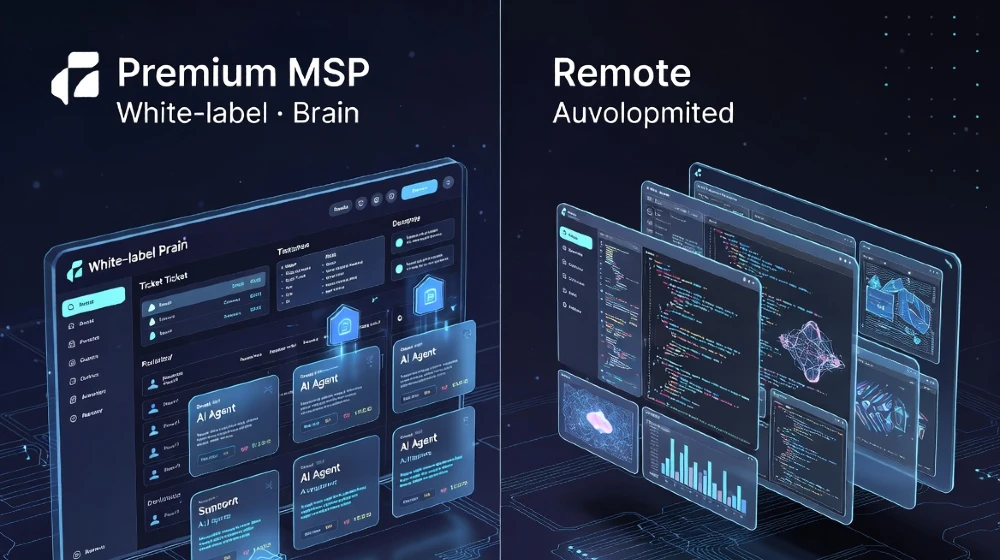
MSPs are under serious pressure right now. Clients want AI-powered services automation, intelligent ticketing, predictive monitoring, AI chatbots but building that from scratch takes engineers most MSPs simply don’t have. Hiring in-house is expensive and slow. Off-the-shelf tools don’t fit your brand or your clients’ workflows.
White-label AI development and staff augmentation solve both problems simultaneously. You get the product, the engineers, and the delivery capacity under your brand, at a fraction of the build cost.
Here’s exactly how it works, what to watch out for, and how to execute it without wasting months or budget.
| Question | Answer |
|---|---|
| What is white-label AI development for MSPs? | You resell or embed AI-built tools (chatbots, automation engines, monitoring AIs) under your own brand, built by a third-party dev team |
| What is staff augmentation in this context? | Hiring external AI engineers who work as part of your team, billed to your clients or internal projects |
| Who is this right for? | MSPs with 20+ clients, wanting to add AI services without full-time AI engineering hires |
| Biggest risk? | IP ownership confusion and client-facing quality gaps — both solvable with the right contract structure |
| Cost range? | White-label AI platforms: $500–$5,000/month. Staff augmentation: $40–$120/hour depending on location and seniority |
| Time to deploy first AI product? | 4–12 weeks for a scoped white-label build; 1–2 weeks to onboard an augmented engineer |
What White-Label AI Development Actually Means for MSPs (And What It Doesn’t)
White-label AI development means a vendor or dev team builds an AI-powered product — a monitoring dashboard, a helpdesk bot, a client reporting tool — and you put your logo on it, sell it, and support it as your own. Your client never knows (or needs to know) who built the engine underneath.
What it’s not: it’s not simply reselling a SaaS tool. Real white-label AI development gives you configurable logic, custom workflows, and the ability to tailor the AI’s behavior to each client’s environment. That’s the difference between slapping your logo on ConnectWise and actually owning a product that differentiates your MSP.
The practical outcome: MSPs that do this well add $3,000–$15,000 per month in recurring AI service revenue per mid-market client, according to channel-focused research from CompTIA’s 2025 MSP benchmark data. The margin is high because the core development cost is shared or fixed, and delivery scales.
Why MSPs Specifically Need This Model in 2026
Most MSPs grew on break-fix and managed support contracts. AI is disrupting that model fast — not because it replaces MSPs, but because it raises the floor of what clients expect.
By 2026, clients are actively asking: “Can you give us an AI that monitors our systems before something breaks?” or “Can you automate our onboarding workflows?” If your answer is “we can set up someone else’s platform,” you sound like a reseller. If your answer is “yes, here’s our AI platform built for businesses like yours,” you sound like a strategic partner.
The gap between those two answers is white-label AI development.
Staff augmentation fills the delivery side. You win the client, you scope the AI project, then you bring in augmented AI engineers to build and deploy it. You manage the relationship. They do the technical execution. You bill the client at your margin.
This isn’t theory — it’s how mid-sized MSPs are already scaling into AI services without ballooning their payroll. Related to this delivery challenge, if your MSP is also navigating AI-powered threat risks in 2026, you’ll see why having AI-capable staff on demand matters beyond just product development.
The 4 White-Label AI Products MSPs Are Actually Building Right Now
Don’t get vague about “AI products.” Here are the specific use cases generating real MSP revenue in 2026:
1. AI-Powered RMM Overlays
These sit on top of tools like NinjaRMM or Datto RMM and add predictive analytics — flagging devices likely to fail in the next 7 days, auto-prioritizing tickets by business impact, or sending clients executive-level health summaries automatically. White-labeled under your brand, clients see this as your intelligence layer.
Build time: 6–10 weeks with a staff-augmented AI engineer familiar with RMM APIs.
2. White-Label AI Helpdesk Bots
Not a generic chatbot — a trained model that knows your client’s software stack, escalation rules, and common issues. It resolves tier-1 tickets without human touch and hands off to your team with full context. Clients see this as “your AI support system.”
Build time: 4–8 weeks depending on integration depth.
3. AI-Driven Client Reporting Dashboards
Monthly reports are dead. Clients want real-time dashboards with natural language summaries — “Your network had 3 incidents this month, all resolved within SLA, here’s why they happened and what we’ve done to prevent recurrence.” White-label this with your branding and it becomes a retention tool, not just a report.
Build time: 3–6 weeks with a frontend AI developer.
4. Compliance & Security Posture AI
For MSPs serving healthcare, finance, or legal clients — an AI that continuously scans, scores, and narrates compliance posture. This overlaps directly with the AI cybersecurity capabilities MSPs are building in 2026. White-labeled, this becomes a premium service tier that commands $1,500–$4,000/month per client.
Build time: 8–14 weeks; requires specialized AI security engineers — exactly the profile to bring in via staff augmentation rather than hire full-time.
How Staff Augmentation Works in an MSP AI Context
Staff augmentation for MSPs isn’t new — IT staff augmentation has existed for years. What’s changed is the skill set you need. You’re no longer augmenting for helpdesk coverage. You’re augmenting for:
- AI/ML engineers who can build and fine-tune models
- AI integration developers who connect LLMs to existing MSP tools (PSA, RMM, documentation platforms)
- Prompt engineers who specialize in enterprise-grade AI behavior design
- AI QA specialists who test model outputs for accuracy, bias, and edge cases
The engagement model has three common structures:
Project-based augmentation: You bring in 2–3 engineers for a defined build — say, 10 weeks to launch a white-label helpdesk AI. They’re scoped, deliverable-focused, and exit clean.
Retainer augmentation: You keep 1–2 AI engineers on a monthly retainer (typically 40–80 hours/month) for ongoing development, model updates, and new feature requests across your client portfolio.
Embedded augmentation: The augmented engineer works inside your team’s Slack, attends your standups, and is indistinguishable from an internal hire to your clients. They carry your email signature. This is the premium model — and it commands the highest client confidence.
The embedded model is the most powerful for MSPs positioning AI as a core competency rather than a third-party add-on. It’s also what allows you to move toward agentic AI and autonomous MSP operations — because you have internal AI capability that builds institutional knowledge over time.
Pricing Models: What You’ll Actually Pay (And What You Can Charge)
Let’s be direct about numbers, because most articles on this topic are vague.
What You Pay
| Engagement Type | Cost |
|---|---|
| White-label AI platform license (existing) | $500–$5,000/month |
| Custom white-label build (project) | $15,000–$80,000 one-time |
| Staff augmented AI engineer (offshore, mid-level) | $40–$65/hour |
| Staff augmented AI engineer (nearshore, senior) | $65–$95/hour |
| Staff augmented AI engineer (US-based, senior) | $100–$140/hour |
| Embedded AI engineer retainer (40 hrs/month) | $3,000–$6,000/month |
What You Charge Clients
| AI Service Tier | Monthly Recurring |
|---|---|
| AI reporting dashboard | $800–$1,500/client |
| AI helpdesk bot (tier-1 automation) | $1,200–$2,500/client |
| Predictive RMM overlay | $1,500–$3,500/client |
| Compliance AI posture monitoring | $2,000–$5,000/client |
| Full AI-managed service layer | $5,000–$15,000/client |
With 10 clients on even a mid-tier AI service at $1,500/month, that’s $180,000 in annual recurring revenue from a delivery model that costs you $3,000–$6,000/month in augmented engineer capacity. That math works.
The Vendor Selection Criteria Most MSPs Get Wrong
When evaluating white-label AI development partners or staff augmentation firms, MSPs typically focus on hourly rate and portfolio. Those matter — but here’s what actually predicts whether the engagement succeeds:
1. MSP-Specific AI Experience
AI development for a law firm looks nothing like AI development for an MSP. You need engineers who understand PSA integrations, RMM data structures, multi-tenant architectures, and MSP billing models. A generalist AI firm will cost you weeks in education.
Test this: Ask them to walk you through how they’d integrate an LLM with ConnectWise Manage’s ticket API to auto-triage by SLA impact. If they hesitate, they don’t know MSP environments.
2. IP Ownership Clarity
This is the biggest contract mistake MSPs make. The default in many staff augmentation contracts is that IP created during the engagement belongs to the development firm unless explicitly transferred. You need a work-for-hire clause that assigns all developed code, models, and training data to you on delivery.
Get your legal counsel to review this before signing. Seriously — losing IP rights on an AI product you’ve sold to 20 clients is a catastrophic business problem.
3. Model Retraining and Maintenance SLAs
AI models degrade. The underlying LLM gets updated by the provider. Your clients’ data patterns shift. You need a partner who commits to model monitoring and retraining on a defined schedule — quarterly at minimum for client-facing AI products.
If a vendor doesn’t mention this proactively, ask directly: “What’s your process for model drift detection and retraining?” The answer tells you everything.
4. Multi-Tenant Architecture Capability
MSPs serve multiple clients from one operational base. Your white-label AI must support multi-tenant isolation — each client’s data stays separate, each client’s AI behavior can be configured independently. This is non-negotiable. A single-tenant AI system built for enterprise will break your operational model.
5. Security and Compliance Posture
Any AI system touching client data needs SOC 2 Type II, and depending on your client base, HIPAA or FedRAMP consideration. Confirm the development partner’s security certifications before they touch a single piece of client data. This directly connects to the broader AI monetization for MSPs framework — where compliance-ready AI products command premium pricing.
Structuring the Commercial Model: How to Bill This Without Confusion
MSPs get tangled up on this. You’ve got a white-label AI product, an augmented engineer delivering it, and a client paying for it. Here’s the cleanest billing structure:
Option A: Fixed AI Service Fee Client pays a flat monthly fee for the AI service (e.g., $2,000/month for AI helpdesk automation). Your augmented engineer cost is embedded in your COGS. Simple, clean, MRR-friendly.
Option B: AI Service + Implementation Project Client pays a one-time implementation fee ($5,000–$15,000) plus monthly recurring. Implementation covers the custom build, integration, and training. This recoups your upfront augmented engineer cost and sets the recurring clean.
Option C: AI Success Pricing For AI tools that produce measurable outcomes (e.g., reduced ticket volume, faster resolution times), some MSPs charge a base fee plus a success component. Example: $1,000/month base + $50 per ticket deflected by the AI. This is compelling for clients and creates alignment — but requires solid reporting to make it work.
Option A is the easiest to operationalize. Option C is the most powerful for closing skeptical clients but takes more setup.
Critical Things to Avoid (That No One Tells You)
Don’t start with the most complex AI product. MSPs eager to monetize AI fast will attempt to build a full agentic AI stack on the first engagement. That’s a 6-month project with high delivery risk. Start with AI reporting or a basic triage bot. Prove the model, then scale up.
Don’t skip the pilot phase. Always run a 4–6 week paid pilot with your first white-label AI client before committing to full-scale deployment. This protects your reputation if the model needs significant tuning. Pilots also build client confidence — they’re paying for something small and seeing results, not betting their operations on an unproven system.
Don’t let augmented engineers own client relationships. Your augmented staff should be operationally embedded but commercially invisible. The client relationship — pricing, scope, escalation — stays with your MSP team. The moment an augmented engineer starts directly negotiating with your client, your margin and control are at risk.
Don’t use generic LLM APIs without fine-tuning for your clients’ environments. An off-the-shelf GPT-4 integration will hallucinate on your clients’ proprietary systems, internal nomenclature, and escalation policies. Every client-facing AI product needs at least minimal fine-tuning or retrieval-augmented generation (RAG) setup using that client’s actual documentation and ticket history.
Don’t sign multi-year augmentation contracts upfront. Start with 3-month rolling contracts. This gives you leverage to adjust scope, swap engineers if there’s a fit problem, or renegotiate rates as the market moves. Locking in 24 months with an augmentation firm year one is how MSPs get stuck paying above-market rates with underperforming staff.
Step-by-Step Execution Roadmap
Here’s the exact sequence that works, based on what successful MSP AI deployments actually look like:
Step 1: Define Your First AI Product (Week 1)
Don’t start broad. Pick one specific AI product to launch first — the one your top 3 clients are most likely to pay for. Survey them directly: “If we gave you a system that automatically resolved tier-1 tickets without you logging a support request, what’s that worth to you monthly?” Their answer shapes your product and your pricing simultaneously.
Step 2: Scope the Build (Week 2)
Write a one-page product specification: what the AI does, what integrations it needs, what the client-facing interface looks like, what success metrics are. This document drives your augmented engineer search and gives candidates something concrete to respond to.
Step 3: Evaluate Augmentation Partners (Weeks 2–3)
Send your spec to 3–5 staff augmentation firms. Ask for:
- Relevant MSP AI experience
- Sample engineer profiles (anonymized)
- Contract terms including IP assignment
- References from MSP clients specifically
Score them on MSP fit, not just technical capability.
Step 4: Pilot with One Client (Weeks 4–14)
Pick your most technically sophisticated and most forgiving client for the pilot. They should be invested in the outcome and willing to give honest feedback. Set expectations: “We’re rolling out our new AI platform. You’ll be the first client. There will be tuning required in the first few weeks — that’s normal and expected.”
Run the pilot for 6–8 weeks. Measure deflection rates, resolution times, client satisfaction. Document everything.
Step 5: Productize and Package (Week 14–16)
Take everything you learned in the pilot — the edge cases, the tuning requirements, the client training process, the reporting cadence — and turn it into a repeatable delivery playbook. This is what lets you scale from 1 client to 20 without each deployment feeling like a new project.
Step 6: Sell to Your Next 5 Clients (Week 16+)
Now you have a proven product, a case study (your pilot client), and a delivery system. Go to your next 5 best-fit clients with a specific offer. You’re not pitching AI in general — you’re showing them results from a real client and offering the same outcome.
Alternatives to Full Custom White-Label Development
Full custom builds aren’t always the right starting point. Depending on your client base and available capital, consider these faster paths:
White-label AI platform licensing: Companies like Gradient MSP, Rewst, and Workato offer platforms MSPs can white-label. You get faster time-to-market at the cost of some customization flexibility. Good for getting to market in 4–6 weeks.
AI module add-ons to existing RMM/PSA tools: Many major MSP platforms are shipping native AI capabilities. Enabling and customizing these — then presenting them as your AI layer — is the lowest-friction entry point. The trade-off: every competitor using the same platform has access to the same capability, so differentiation is limited.
Hybrid model: License a white-label base platform, then use staff augmentation to build custom modules on top of it. You get speed-to-market from the platform and differentiation from the custom layer. This is the model most high-growth MSPs use in 2026.
Measuring ROI: Metrics That Matter
Don’t let white-label AI development sit in a revenue vacuum. Track these specific metrics quarterly:
- AI service MRR: Total monthly recurring revenue from AI-specific line items across your client base
- Ticket deflection rate: What percentage of tier-1 tickets is the AI resolving without human intervention? Target: 40–65% within 90 days of deployment
- Time-to-value per client: How many weeks from contract to first AI-driven client outcome?
- Augmented engineer utilization rate: Are you getting full value from your augmented staff hours? Below 70% utilization means you’re paying for idle capacity
- Client churn impact: Are AI-service clients churning at a lower rate than non-AI clients? (They almost always are — AI creates stickiness because switching means losing trained models and integrations)
The Competitive Differentiation Argument
Here’s the honest reality: most MSPs in 2026 are still in the “we offer AI-powered tools” phase — meaning they’ve checked a box on their website. Very few have an actual white-label AI product they’ve built, trained, and deployed for clients.
That gap is your window. MSPs that invest in white-label AI development now — even on a modest scale — will be the ones that close enterprise contracts in 2027 and 2028. Because by then, clients will be asking for proof of AI capability, not promises.
The combination of a proprietary (even if partially custom) AI product plus in-house AI delivery capacity (via augmentation) is what separates MSPs that grow from MSPs that get commoditized.
Ready to Build Your First White-Label AI Product?
Miracle Concepts works directly with MSPs to design, build, and deploy white-label AI products using an experienced augmented development team. From scoping your first AI service offering to delivering a fully branded client-facing AI platform — the process is straightforward, timeline-realistic, and built to generate recurring revenue for your MSP.
If you’re ready to stop talking about AI and start selling it, contact the Miracle Concepts team here to get a no-cost scope review of your first AI product build.
Explore More MSP AI Resources
- AI Cybersecurity for MSPs: Build Your Security AI Layer
- AI Monetization for MSPs in 2026: Service Packages That Sell
- MSP AI-Powered Threats & Risks in 2026
- Agentic AI for MSPs: Moving to Autonomous Operations
Miracle Concepts does more than AI development for MSPs. If your MSP needs to dominate search rankings, our SEO services drive qualified B2B traffic that converts. Our UX design team builds client portals and service interfaces clients actually want to use. Need a scalable platform? Our web development services deliver custom SaaS and CRM solutions. Polishing your proposals and decks? Our document formatting services make your MSP look enterprise-ready instantly. And for ongoing delivery capacity, our IT staff augmentation connects you with vetted engineers fast. One team. Every growth need.
Published by Miracle Concepts | miracleconcepts.net