
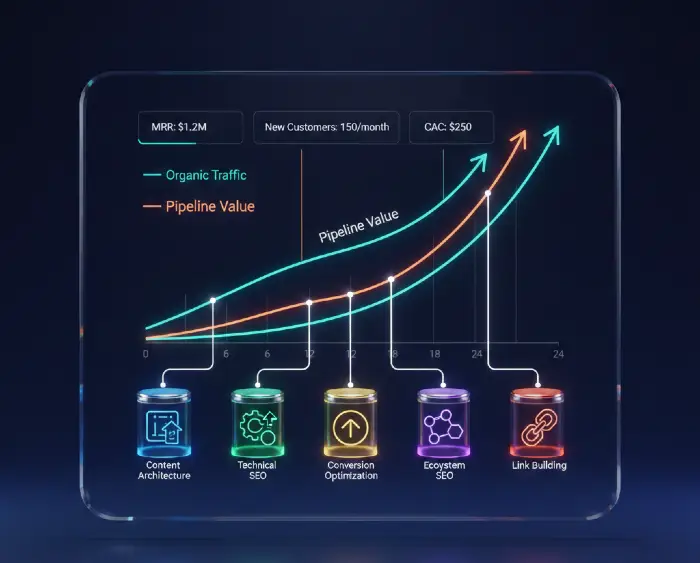
You hired an SEO agency. Traffic went up. Demos did not. Your team spent months celebrating rankings that never turned into revenue and now you are questioning whether SEO works for SaaS at all.
It works. The agency did not.
Most SEO agencies apply the same playbook regardless of who they are working with. E-commerce tactics, content volume strategies, and keyword volume chasing none of it is built for how B2B software buyers actually search, evaluate, and buy. The result is organic traffic that looks good in a monthly report and does nothing for your pipeline.
This is exactly the problem Miracle Concepts was built to solve. SaaS-only. Product-led. Revenue-focused. Here is the complete picture of what genuine SaaS SEO looks like and how to know whether your current approach is actually working.
Explore full-stack web dev for SaaS at Miracle Concepts. React/Next.js + SEO-optimized builds. 40% traffic boost in 90 days. Lightning CWV scores, mobile-first. Partner for high-conversion apps driving MRR!
Why Your SaaS SEO Investment Isn’t Delivering Scalable Growth (The 4 Critical Failures)
Most SaaS companies do not have an SEO problem. They have an agency-fit problem. The traffic is real. The content exists. The technical work was done. But somewhere between “organic visitor” and “qualified demo request,” everything falls apart.
Four failures cause this and most companies are experiencing at least two of them right now.
Failure #1: The “Generic Agency” Trap Applying E-commerce Tactics to B2B Software
Generic agencies are not bad at SEO. They are bad at your SEO. There is a meaningful difference.
Why Keyword Volume Chasing Kills SaaS Lead Quality (10,000 Visitors, Zero Demos)
High search volume keywords feel like wins. They are not at least not automatically. A keyword with 50,000 monthly searches in the SaaS space often carries informational intent from students, researchers, and professionals who will never buy your software. Ranking #1 for it brings traffic. It does not bring pipeline.
The damage is insidious because traffic growth masks the problem. Your agency reports record visitors. Your board sees green charts. Your sales team sees zero increase in qualified demos. By the time everyone agrees something is wrong, six months and significant budget have been spent building rankings that deliver nothing.
Real SaaS keyword strategy targets search intent that maps to buying behavior not search volume that maps to a big number in a report.
The B2C vs. B2B Search Intent Gap: Informational Blog Traffic That Never Converts
An e-commerce company publishes a “top 10 products” post and converts 2% of readers directly on a product page. A SaaS company publishes the same style of post and converts 0.1% because software buying involves multiple stakeholders, a 30–90 day evaluation cycle, and a sales conversation that no blog post can shortcut.
Generic agencies do not think through this. They optimize for clicks. SaaS SEO must optimize for the first step in a long buying journey capturing someone early, nurturing through content, and converting when intent is high enough.
Case Study: How a CRM Startup Wasted $40K on Traffic That Didn’t Buy
A Series A CRM startup hired a full-service digital agency with strong SEO credentials. In eight months, monthly organic visitors grew from 3,000 to 28,000. Demo requests from organic: unchanged at 12–15 per month.
The agency had targeted high-volume informational keywords “what is CRM software,” “CRM benefits,” “how to manage customer relationships” and built 45 blog posts around them. Every post ranked. None of the visitors were evaluating CRM software. They were learning what CRM meant.
The $40,000 spend bought 25,000 extra monthly visitors who were not buyers. The fix required rebuilding the entire content strategy around buyer-stage keywords comparison pages, use-case pages, and integration content. That work took another six months.
Failure #2: The “Content Mill” Problem Publishing Volume Without Product-Led Strategy
Volume is not strategy. Publishing 30 articles per month without a coherent product-led content architecture produces a blog that ranks for random topics and converts nothing.
50 Articles/Month, Zero Product-Market Fit: When Content Strategy Ignores User Pain Points
Content mills optimize for output. A SaaS content strategy must optimize for alignment every piece of content should connect a searcher’s specific pain point to a specific product feature or outcome your software delivers.
When that connection is missing, you get a massive content library that Google indexes and users leave. High impressions. Low clicks. Lower conversions.
The test: can you map every published article to a stage in your buyer journey and a specific product feature it leads to? If you cannot, you have a content volume problem dressed up as a content strategy.
The Feature Announcement Trap: Why “We Launched X” Posts Don’t Rank (Or Convert)
Feature announcement posts feel productive. Your team worked hard on the feature. Writing about it feels like marketing momentum. The problem: nobody searches “CompanyName launches enterprise SSO feature.” They search “enterprise SSO for project management software” which is a completely different keyword with commercial intent.
Feature launches earn rankings when they are structured around what the buyer searches for, not what the company is proud of. “We added SSO” becomes “How enterprise teams manage secure single sign-on in [your software]” — same feature, structured around search behavior.
Editorial Calendar Chaos: How Lack of Topical Authority Dilutes Domain Strength
Google’s topic authority model rewards sites that cover a subject comprehensively. Publishing broadly across 20 unrelated topics produces a site that ranks moderately well for many things and dominates nothing.
SaaS companies that build deep topical clusters covering one software category thoroughly before expanding build the kind of domain authority that produces durable rankings. Random editorial calendars built around “what can we write about this month” produce the opposite.
Failure #3: The “Technical SEO Blindspot” Ignoring SaaS-Specific Architecture Issues
SaaS products run on modern tech stacks. Most SEO agencies do not know how to handle them.
Single-Page Application (SPA) SEO Disasters: When React/Next.js Sites Become Invisible
A React or Next.js application that is not properly configured for server-side rendering can be essentially invisible to Google. Googlebot renders JavaScript differently from browsers content that appears correctly on screen may not be indexed at all.
This is not a rare edge case. It is a common situation for SaaS products built on modern JavaScript frameworks. Agencies without deep technical SaaS experience often miss it entirely, producing months of “content strategy” on a site that Google is partially or fully unable to index.
The symptom: pages that look fine to users show blank or minimal content in Google’s URL inspection tool. Content published months ago with zero impressions in Search Console. This is the SPA rendering problem, and it requires an engineer to fix not just an SEO recommendation.
Dynamic Pricing Page Problems: How URL Parameters Cannibalize Your Rankings
SaaS pricing pages frequently use URL parameters for dynamic content different pricing tiers, currency switching, feature comparisons. Left unmanaged, these parameters create hundreds of duplicate page variations that confuse Google about which version to index.
The result: your pricing page often your highest-intent page ranks inconsistently and cannibalizes itself in search results. Two different URL variations compete against each other for the same keyword, splitting authority and reducing the ranking performance of both.
Integration Marketplace Chaos: 500+ Partner Pages, Zero Organic Visibility
If your SaaS product integrates with Salesforce, HubSpot, Zapier, Slack, and 50 other platforms, each of those integrations represents a high-intent keyword opportunity. “HubSpot [your software] integration” is searched by people actively evaluating your product against alternatives.
Most SaaS companies have either no integration pages or thin, auto-generated pages that Google treats as low-quality. Leading competitors have optimized, content-rich integration pages that rank in the top 3 and convert evaluation-stage visitors.
Fixing integration SEO consistently produces some of the highest-ROI gains in a SaaS SEO program because the traffic is commercial-intent, the visitor is already partially qualified, and the conversion rate is significantly higher than top-of-funnel blog traffic.
Learn B2B SaaS bounce rate fixes. Miracle Concepts: hero CTAs, value props, popups. Cut 70%→25% bounces. Heatmaps + CRO audits included. Turn landing pages into lead magnets now!
Failure #4: The “Lead Gen Disconnect” SEO and Sales Teams Operating in Silos
SEO drives traffic. Sales closes deals. When these teams do not talk to each other, the gap between them wastes every lead that falls through.
MQLs That SDRs Ignore: Why SEO-Driven Leads Get Disqualified Immediately
If your SDRs are accustomed to paid leads from a specific buyer profile and your SEO content attracts a different profile, organic leads get deprioritized or disqualified not because they are bad leads, but because the SDRs do not understand the intent signal behind them.
A visitor who read your “HubSpot vs. Salesforce” comparison post, then your “best CRM for sales teams under 50 people” post, then landed on a demo request form is a highly qualified lead. They just spent 20 minutes educating themselves on your category. An SDR without that context treats them like a cold outbound contact.
Connecting SEO intent signals to CRM records changes how SDRs open those conversations and conversion rates respond accordingly.
The Attribution Black Hole: Proving SEO ROI When Sales Cycles Take 6+ Months
Last-click attribution destroys SEO’s apparent ROI. A buyer who first discovered your software through an organic blog post six months ago, returned three times via paid retargeting, then converted through a direct-navigation demo request gets attributed 100% to direct. SEO gets zero credit.
This is not a reporting inconvenience. It is a budget allocation crisis. Companies consistently under-invest in SEO because their attribution model cannot see it working.
Multi-touch attribution that tracks the full journey first touch, content touches, intent signals, conversion — typically shows SEO contributing to 40–60% of closed deals in mature programs. Last-click attribution shows 5–10%.
Demo Request Friction: High-Intent Traffic Landing on Broken Conversion Paths
An organic visitor who landed on your “best project management software for remote teams” page searched a high-intent keyword, read your content, and is ready to take a next step. If your CTA sends them to a generic homepage, a broken form, or a three-page form that asks for company size, budget, and use case before letting them talk to anyone you lose them.
Conversion path optimization specifically for organic traffic segments is not optional. It is the difference between SEO that generates pipeline and SEO that generates traffic reports.
What Are SaaS SEO Services That Actually Drive Scalable Growth? (The 6-Pillar Framework)
Here is what a real SaaS SEO program is built on. Six pillars. Each one directly connected to pipeline outcomes, not just rankings.
Pillar #1: Product-Led Content Architecture (PLCA)
Every piece of content in a product-led architecture serves a function: it captures a searcher with a specific problem, educates them on the solution, and creates a natural next step toward your product.
Use-Case Driven Keyword Mapping: Connecting Search Intent to Product Features
Instead of mapping keywords to topics, map them to product use cases. “Project timeline tracking for remote teams” → your Gantt chart feature. “Automated invoice reminders for freelancers” → your billing automation module.
The keyword strategy starts with your product features and asks: what does someone search when they need this capability? That question generates keywords with real purchase intent, not just informational interest.
Jobs-to-be-Done (JTBD) Content Strategy: Ranking for Problems Your Software Solves
JTBD content targets the underlying job a buyer is trying to complete not the software category. People do not search “I need project management software.” They search “how to keep a remote team on deadline” or “tracking project progress without endless status meetings.”
Ranking for the job-to-be-done rather than the software category puts your content in front of buyers earlier in their journey, when they are defining their problem and becoming receptive to solutions. Earlier awareness equals longer relationship before conversion which equals higher-quality, more informed buyers.
Comparison Page Optimization: “Best [Category] Software” Dominance Without Paid Ads
Comparison pages are among the highest-converting organic content types for SaaS. “Best CRM software for small business,” “[Your product] vs. [Competitor],” “HubSpot alternatives” these keywords have clear commercial intent. The searcher is actively evaluating options.
Most companies either skip these pages (worried about naming competitors) or publish thin, clearly self-promotional comparisons that Google deprioritizes. The right approach is honest, detailed comparisons that acknowledge competitor strengths while clearly articulating your specific advantages for your target buyer profile. These pages consistently convert at 3–5x the rate of informational blog content.
Pillar #2: Technical SaaS SEO Infrastructure
Technical SEO for SaaS is not the same as technical SEO for a CMS-based website. The architecture problems are different, and they require different solutions.
SPA/Progressive Web App Optimization: Server-Side Rendering (SSR) for JavaScript Frameworks
If your product or marketing site runs on React, Next.js, Vue, or Angular, server-side rendering is the technically correct solution for SEO. SSR delivers fully rendered HTML to Googlebot rather than requiring it to execute JavaScript which means your content is indexed reliably rather than partially or not at all.
Next.js has SSR built in and is generally the cleanest path for new builds. For existing React SPAs, dynamic rendering (serving pre-rendered HTML specifically to crawlers) is the practical fix without a full rebuild.
The work is engineering work, not just SEO work which is why agencies without developer capability cannot actually fix these issues.
Dynamic Content Handling: How to Index User-Generated Content, Dashboards, and App Data
SaaS platforms often have valuable content inside the product customer-created templates, public dashboards, community resources that could rank organically if made indexable. This is a significant but often overlooked organic growth channel.
Making product-generated content indexable requires thoughtful technical architecture: canonical URL structures, crawl budget management, quality thresholds for which content is exposed to search engines, and clear indexing directives. Done correctly, it creates a content engine that scales with your product’s user base rather than your editorial calendar.
API Documentation SEO: Turning Developer Resources into Top-of-Funnel Assets
If your product has an API, your documentation is a top-of-funnel asset that most companies ignore entirely from an SEO perspective. Developers search for specific API capabilities “webhook integration [software category],” “REST API [specific function]” and well-structured, optimized documentation surfaces in those searches.
Developer-led discovery frequently results in internal champions technical buyers who found your API documentation, built a proof of concept, and then advocated for your product in a broader evaluation. API documentation SEO consistently produces some of the highest-quality, highest-converting traffic in a SaaS SEO program.
Pillar #3: Topical Authority for Complex B2B Topics
SaaS companies compete in complex topic areas. Winning in Google requires demonstrating genuine depth not just publishing content, but owning a topic comprehensively enough that Google treats your domain as the authoritative source.
Entity-Based Content Networks: Building Semantic Relationships Around Your Software Category
Google maps topics as networks of related entities concepts, tools, processes, companies rather than as isolated keywords. A content strategy that covers a topic from multiple angles, connects related concepts, and builds semantic relationships between pages signals genuine expertise to Google’s systems.
For a project management SaaS, this means not just writing about project management but building content that covers resource allocation, project timelines, team communication, agile methodology, remote collaboration, and project reporting in a way that links meaningfully across topics. The content network collectively builds authority that no single page achieves alone.
Pillar-Cluster Architecture for SaaS: Hub Pages That Capture Category Ownership
A pillar page covers a core topic comprehensively your primary use case, your product category, your target buyer’s main job-to-be-done. Cluster pages cover specific subtopics in depth and link back to the pillar. Together, they create a semantic structure that signals topical authority.
The business outcome: when someone searches any variant of your core topic broad or specific, early-stage or late-stage — they encounter your content. This breadth of coverage within a specific category is what produces category dominance, not just individual rankings.
E-E-A-T Acceleration: Leveraging Founder Expertise, Customer Success Stories, and Industry Data
Google’s quality signals prioritize Experience, Expertise, Authoritativeness, and Trustworthiness. For SaaS companies, these signals come from specific, demonstrable sources: founder bylines on strategic content, customer case studies with specific metrics, original research with primary data, and expert contributions from recognized domain practitioners.
Generic blog content published under “Admin” by a content mill fails all four signals. Content authored by your CEO on the specific problem your product solves, featuring a customer who achieved a specific measurable outcome, passes all four. This distinction increasingly determines which content ranks and which sits on page 3.
Pillar #4: Conversion-Optimized User Journeys
Traffic without conversion is an expense. Every organic visitor needs a pathway from their search intent to your product and most SaaS sites do not have that pathway mapped deliberately.
Micro-Conversion Mapping: From “How to X” Blog Post to Free Trial Signup
A visitor who lands on a top-of-funnel “how to” post is not ready for a demo. Pushing a demo CTA at them immediately produces low click rates and misaligned leads. The correct approach is micro-conversion a relevant next step that moves them one stage forward in their buyer journey without asking for too much.
From a “how to manage remote team productivity” post: the micro-conversion might be a free productivity tracking template, a “how leading remote teams use [your product]” case study download, or a “try the feature free” link specific to the relevant product capability. Each of these converts at higher rates than a generic “book a demo” and produces better-qualified leads.
Interactive Tool SEO: Calculators, Assessments, and Generators That Capture Emails
Interactive tools serve two SEO purposes simultaneously: they earn backlinks naturally (other sites link to useful tools), and they capture leads with genuine intent. A CAC calculator for SaaS startups, a team productivity assessment, or a project ROI estimator these tools are both rankable content and lead generation assets.
The email capture happens at the point of highest intent: when a visitor has engaged deeply enough with the tool to want their results. Conversion rates on well-designed interactive tools typically range from 15–40% of engaged users, far above standard content CTA conversion rates.
Demo Request Page Optimization: Removing Friction for High-Intent Visitors
Your demo request page is where SEO meets revenue. A visitor arriving from a high-intent keyword who hits a slow-loading, unclear, or demanding form page abandons and that abandonment represents qualified pipeline lost.
Specific friction points that consistently reduce demo conversion: more than five form fields, no explanation of what the demo looks like or how long it takes, no social proof near the form, generic headline copy that does not connect to the searcher’s specific intent, and no alternative lower-friction option for visitors who are not quite ready for a demo.
Testing these elements specifically for organic traffic segments not all traffic combined regularly produces 20–40% conversion rate improvements on high-intent landing pages.
Discover B2B SEO strategies for agencies. Miracle Concepts: high-intent clusters, DA80+ guest posts, snippet wins. 200% organic leads in 6 months. Scale pipelines with proven systems!
Pillar #5: Integration & Ecosystem SEO
Your integration partners are an underutilized SEO channel. Every tool your product connects with is a keyword set that your target buyers actively search.
Marketplace Optimization: Ranking Your Zapier/HubSpot/Salesforce Integration Pages
Integration searches have extremely high buyer intent. Someone searching “Zapier [your product] integration” already knows your product exists and is evaluating how well it fits into their existing stack. That is a bottom-of-funnel evaluation query that deserves a dedicated, optimized page not a redirect to a generic integrations list.
Well-built integration pages include: specific setup instructions (which improves time-on-page and signals quality to Google), real use cases for the combined tools, customer examples, and clear CTAs for trial or demo. These pages consistently convert at 4–6x the rate of top-of-funnel blog content.
Partner Co-Marketing SEO: Joint Content Strategies With Complementary Tools
When your product and a complementary tool (not a competitor a genuine workflow partner) co-create content targeting shared buyer intent, both domains benefit. A joint “How to build a [workflow] using [Tool A] and [Tool B]” piece earns links from both audiences, ranks for combined workflow keywords, and introduces each product to the other’s customer base.
These partnerships are underused and produce link equity that is very difficult to replicate through traditional link-building approaches. A single well-executed co-marketing piece can outperform 20 traditional guest posts.
API Directory Visibility: Getting Discovered by Developers Building on Your Platform
Developer-focused directories RapidAPI, ProgrammableWeb, specific ecosystem marketplaces carry real search authority and route technical buyers directly to your API documentation. Optimizing your presence in these directories, combined with developer-focused content on your own domain, creates a discovery path specifically for technical evaluators who often become the strongest internal champions for platform adoption.
Pillar #6: Scalable Link Building for B2B SaaS
Authority building for SaaS requires a different approach than bulk outreach link-building. The links that actually move the needle come from relevance and utility, not volume.
Data-Driven Content Marketing: Original Research That Earns Natural Backlinks
Original research surveys, data analyses, proprietary benchmark reports earns natural backlinks from journalists, analysts, and bloggers who cite the data. A “State of Remote Work” report from a project management SaaS, a “SaaS CAC Benchmark Report” from a CRM platform, or an “E-commerce Returns Data Study” from a logistics software company these produce links from authoritative domains that no outreach campaign replicates.
The investment is higher than a standard blog post. The return links from TechCrunch, VentureBeat, Hubspot Blog, and industry publications is also higher by an order of magnitude.
Integration Announcement Strategies: Newsworthy Updates That Drive Coverage
When your product launches a native integration with a major platform, that is legitimately newsworthy in your category’s media ecosystem. A well-executed integration announcement press release to relevant publications, partner co-announcement, social proof from early users earns coverage and links from both your ecosystem’s media and your partner’s media.
Most SaaS companies announce integrations on a blog post that nobody outside their existing audience reads. A proactive media strategy around significant integration launches turns product development into link-building opportunities.
Founder-Led Thought Leadership: Guest Expertise That Builds Domain Authority
Bylined articles from founders and executives on recognized industry publications build both brand authority and domain authority. A guest post from your CEO on Harvard Business Review, Forbes Technology, or your category’s leading trade publication earns a high-authority link and positions your brand as a trusted voice in your space.
This is harder to scale than bulk outreach but produces links and brand associations that bulk outreach never achieves. One thoughtfully placed founder byline on a respected publication outperforms 50 generic guest posts on low-authority blogs.
How SaaS SEO Services Drive Scalable Growth (The Compound Effect Explained)
SEO is not a switch you flip. It is a compounding investment and understanding the timeline makes the commitment rational rather than abstract.
The SaaS SEO Flywheel: Why Organic Growth Accelerates Over Time
The flywheel works because each improvement reinforces the next. Rankings attract links. Links build authority. Authority improves rankings on new content faster. Better rankings attract more qualified traffic. More qualified traffic improves conversion data, which informs better content strategy, which produces more targeted rankings.
This is fundamentally different from paid acquisition, where the moment you stop paying, the traffic stops. Organic rankings built on genuine topical authority persist and compound often long after the content was published.
Month 0–6: Foundation Building (Technical Fixes, Content Architecture, Initial Rankings)
This phase feels slow because it is. Technical issues get fixed. Pillar architecture gets planned and executed. Initial content gets published. Some early rankings appear for lower-competition keywords. The pipeline impact is minimal.
This phase is the temptation-to-quit phase. Most SaaS companies that abandon SEO do so here — before the compounding begins.
Month 6–12: Traction Phase (Top 10 Rankings, First SQLs From Organic, CAC Reduction)
Rankings begin consolidating in the top 10 for priority keywords. The first organic-attributed SQLs appear. Conversion paths have been optimized and are converting at improved rates. The CAC for SEO-driven leads starts measurably below paid acquisition CAC.
This is also the phase where early organic wins start appearing in attribution models that were previously showing nothing from SEO.
Month 12–24: Scale Phase (Category Dominance, Predictable Pipeline, Investor-Grade Metrics)
By Month 18–24 in a well-executed program, organic is delivering predictable monthly SQLs, contribution to pipeline is meaningful and measurable, and CAC from organic is 50–70% below paid channels. This is the phase that makes the board meeting interesting and the phase that makes organic an investor-grade growth metric.
Month 24+: Moat Building (Defensive Rankings, Acquisition Channel Diversification)
Deep topical authority creates competitive moats that are genuinely difficult to dislodge. A competitor entering your category with fresh budget can buy paid traffic immediately. They cannot buy 24 months of topical authority and editorial trust. Your organic position becomes a defensible strategic asset.
Unit Economics of SaaS SEO: CAC, LTV, and Payback Period Analysis
The unit economics of SEO work differently from paid acquisition and more favorably over time.
Why SEO CAC Drops 60% After Month 12 (And Keeps Falling)
In paid acquisition, CAC is roughly constant per cohort. You pay $X per click, convert at Y%, and get a predictable CAC that does not improve without optimization work.
In SEO, the denominator grows while the numerator stays roughly constant. Year one: you invest $120,000 in SEO and generate 40 SQLs. CAC: $3,000. Year two: you invest $120,000 again, but the content from year one is still generating traffic now you get 110 SQLs. CAC: $1,090. Year three: same investment, accumulated content generates 200 SQLs. CAC: $600.
The fixed investment produces growing returns. This is the compounding effect that makes SEO’s unit economics increasingly compelling over multi-year horizons.
The “Organic Multiplier” Effect: How Content Assets Generate Returns for 3+ Years
A well-optimized pillar page or comparison page does not expire. A “best CRM for small business” page published in 2024 and properly maintained continues generating qualified traffic in 2027. The asset keeps working.
Paid acquisition generates a lead while the campaign runs. SEO generates leads continuously, from assets that appreciate rather than depreciate.
Calculating SEO ROI for SaaS: Pipeline Attribution Beyond Last-Click
The correct SEO ROI calculation includes: all organic-influenced pipeline (multi-touch, not last-click), deal velocity improvement from better-qualified inbound leads, reduced SDR time per organic-sourced lead, and saved paid acquisition spend on keywords where organic now ranks.
Most companies calculate only last-click attributed revenue from organic and wonder why the ROI looks underwhelming. The full-journey attribution picture is typically 3–4x the last-click picture.
Explore affordable B2B SEO services PKR 50K/mo. Miracle Concepts: keyword research, technical audits, local/global. Page 1 in 4 months. White-hat ROI without big budgets!
Scalability Indicators: When to Double Down vs. Pivot Your SEO Strategy
Not every metric warrants doubling the SEO budget. Here is how to read the signals correctly.
Product-Market Fit Signals: Are Organic Visitors Actually Using Core Features?
Track what organic visitors do inside the product if they convert to trial. High-value organic leads engage with core product features quickly and have lower churn in the first 30 days. Low-quality organic leads bounce from the app after first login.
If organic trial users are churning at higher rates than paid, the content strategy is attracting the wrong ICP. The fix is keyword and content refinement not a budget increase.
Category Expansion Opportunities: Adjacent Keywords With Lower Competition
When core category keywords are well-covered and ranking stably, adjacent categories often offer expansion opportunities. The same product, positioned for a different use case or buyer persona, may have significantly lower competition. Expanding topical authority into adjacent areas compounds the organic footprint without starting from scratch.
International SEO Readiness: Scaling to New Markets Without Starting From Zero
If 15%+ of your current organic traffic comes from a non-English-speaking market, that is a signal worth acting on. International SEO with hreflang implementation and localized content captures that latent demand rather than serving it poorly with English content.
Evaluating SaaS SEO Services: The 8-Point Vendor Scorecard
Choosing an SEO agency for your SaaS company is a significant decision. Use this scorecard in every vendor conversation.
Criteria #1: B2B SaaS Specialization (Not Just “B2B Experience”)
B2B experience means the agency has worked with law firms, consulting businesses, and industrial suppliers. SaaS specialization means they understand MRR, churn, NRR, CAC payback period, and product-led growth. These are different knowledge sets.
Questions to Ask: “How Many SaaS Clients Have You Scaled From $1M to $10M ARR?”
Specific question. Specific answer required. Vague references to “tech clients” or “software companies” are not the same as documented experience scaling SaaS revenue from a specific growth stage.
Red Flags: Case Studies Showing Traffic Growth Without Revenue Correlation
Any agency that presents traffic charts without revenue attribution is showing you the metric that is easiest to move, not the metric that matters. Ask for case studies that show organic-attributed pipeline, SQL growth, or CAC reduction — not just traffic.
Green Flags: Deep Understanding of SaaS Metrics
When you use terms like NRR, CAC payback, or product-qualified lead in the sales conversation and the agency responds with fluency rather than a Google search expression, that is a real signal of appropriate domain depth.
Criteria #2: Product-Market Fit Alignment
An agency that builds your content strategy without deeply understanding your product is building the wrong thing efficiently.
Do They Interview Your Customers Before Building Content Strategy?
Customer interviews are non-negotiable. The specific language buyers use to describe their problems, the exact pain points that drove evaluation, the words they use in the moment before they search this intelligence cannot be replaced by keyword research tools. It is primary research, and agencies that skip it produce generic content.
Can They Articulate Your ICP’s Jobs-to-be-Done Better Than Your Team?
This is a high bar and worth setting. An agency that has done the ICP research should be able to describe your ideal customer’s top frustrations, evaluation triggers, and success metrics as well as (or better than) your internal team after 60 days. If they cannot, the foundational research was not done properly.
How Do They Validate Content Ideas With Actual Product Usage Data?
The best content strategies connect search intent to product behavior data. What features do your best customers use most? What workflows do they describe in support tickets? Product analytics inform content priorities in ways that keyword research alone cannot.
Criteria #3: Technical SaaS Competency
This criteria separates agencies from specialist partners.
SPA/Modern JavaScript Framework Experience (React, Vue, Angular, Next.js)
Ask directly: “Walk me through how you handle SEO for a React SPA.” The answer should include server-side rendering, dynamic rendering as an alternative, crawl budget implications, and JavaScript SEO best practices. A vague answer about “making sure Google can see the content” is not sufficient.
Dynamic Rendering vs. Prerendering: Which Do They Recommend for Your Stack?
This is a technical question with a context-dependent answer. The right agency explains the tradeoffs: dynamic rendering is faster to implement but adds infrastructure complexity; SSR through Next.js is cleaner for new builds but requires a rebuild for existing React SPAs; prerendering works for largely static content but breaks for highly dynamic pages. The ability to walk through this tradeoff correctly indicates real technical depth.
Developer Collaboration: Can They Work Directly With Your Engineering Team?
Technical recommendations that cannot be translated into implementable engineering tickets have no value. Ask whether the agency writes JIRA tickets, joins engineering standups, reviews pull requests, or works within your development workflow. The difference between recommendations and implementations is the difference between wasted budget and actual technical improvement.
Criteria #4: Content Quality at Scale
Volume without quality is the content mill problem already described. Quality at volume requires specific operational infrastructure.
Writer Vetting Process: Subject Matter Experts vs. Generalist SEO Writers
A generalist SEO writer can produce grammatically correct content about any topic quickly. They cannot write with genuine technical depth about enterprise security architecture, SaaS pricing strategy, or DevOps workflow optimization. For B2B SaaS topics with technical complexity, subject matter expert writers people with genuine domain knowledge produce content that converts at higher rates because it reads credibly.
Ask the agency how they source writers for your specific technical domain and how they verify domain expertise before assigning work.
Content Operations: Editorial Workflows That Maintain Quality With Volume
At 20+ articles per month, quality control requires process, not just good writers. Editorial calendars, fact-checking workflows, technical review by SMEs, SEO QA, and publication checklists the absence of these systems produces inconsistent quality at scale.
Update Cadence: How They Refresh Existing Content for Sustained Rankings
Content decay is real. A piece that ranked #2 in 2023 may rank #8 in 2025 if it has not been updated to reflect market changes, new search patterns, or competitive content improvements. Agencies that only create and never refresh are continuously losing ground on their oldest content while building new.
Criteria #5: Conversion Rate Optimization Integration
SEO that does not connect to conversion is traffic analytics, not pipeline generation.
SEO + CRO Collaboration: Do They Optimize for Traffic or Revenue?
The right answer is revenue. Traffic is a leading indicator. The lagging indicator that matters is the organic-attributed qualified pipeline. Agencies that report primarily on traffic and rankings without connecting to conversion and pipeline are solving the wrong problem.
Landing Page Testing: A/B Testing for Organic Traffic Segments
Organic traffic segments behave differently from paid traffic they come with different intent signals, different information levels, and different conversion propensities. Running A/B tests on pages receiving organic traffic specifically (rather than all traffic combined) produces more accurate CRO data and better-targeted optimizations.
Micro-Conversion Tracking: Measuring Beyond “Demo Request” to “Qualified Pipeline”
Not every demo request is equal. An agency that measures only demo request volume is measuring quantity. The right metric is qualified pipeline from organic demo requests that meet your ICP criteria and progress past the first sales conversation. This requires CRM integration and pipeline-stage reporting.
Criteria #6: Sales Alignment & Attribution
The connection between SEO and sales determines whether organic leads get worked effectively or ignored.
CRM Integration: Connecting HubSpot/Salesforce Data to SEO Efforts
SEO-influenced deals need to be visible in your CRM with the content touchpoints that preceded conversion. Without CRM integration, sales cannot see the intent signals organic leads carry, and attribution is permanently broken.
Multi-Touch Attribution: Understanding SEO’s Role in 6-Month Sales Cycles
In a six-month enterprise sales cycle, the first organic touch may have happened in Month 1 and the closed deal in Month 6. Last-click attribution never shows SEO’s contribution. The right agency helps you implement multi-touch attribution modeling that shows the full influence of organic throughout the buying journey.
SDR Enablement: Providing Organic Lead Context for Better Conversations
When an SDR calls an organic lead, they should know which content that lead consumed, what intent signals it represents, and what questions it implies. “I saw you read our comparison of our product versus [competitor] — what questions do you have about how we differ?” opens a vastly better conversation than a cold-framing opener with no context.
Criteria #7: Scalable Systems & Processes
Growth requires infrastructure, not just output.
Content Production Capacity: Can They Scale From 10 to 50 Articles/Month?
Ask specifically how content production scales. What is their maximum current monthly output without quality degradation? How do they add capacity freelancer networks, internal hires, AI-assisted drafting with human editing? The answer tells you whether their model scales with your growth.
International SEO Infrastructure: Hreflang, Localization, Regional Domain Strategy
International expansion requires technical implementation (hreflang tags, regional URL structures), content localization (not just translation cultural and market adaptation), and regional link-building. Ask for specific international SEO case studies, not just general capability claims.
Automation Without Sacrificing Quality: AI-Assisted, Human-Polished Workflows
AI-assisted content production is a legitimate efficiency tool when the AI handles first draft and research aggregation, and humans provide editorial oversight, expert depth, and quality control. Fully AI-generated content without expert human review produces the kind of generic, surface-level articles that Google is increasingly deprioritizing.
The right approach: AI as a productivity multiplier, not a replacement for genuine expertise.
Criteria #8: Transparent Reporting & Communication
You cannot improve what you cannot see clearly.
Beyond Rankings: Reporting on SQLs, Pipeline, and Revenue Impact
Monthly reporting should include organic-attributed SQLs, pipeline stage progression, and revenue influence not just keyword ranking movement and traffic volume. If an agency cannot report on revenue impact, they cannot prove they are delivering it.
Strategic vs. Tactical Communication: Quarterly Business Reviews, Not Just Monthly Reports
Monthly reports tell you what happened. Quarterly business reviews tell you what it means and what you should do next. The difference is strategic partnership versus task execution. You need the former, not the latter.
Proactive Recommendations: Do They Bring Opportunities or Just Execute Tasks?
The best agency relationships produce proactive opportunities “we noticed your competitor is ranking for this keyword cluster and you are not, here is a six-week plan to address it” not just task completion against the brief. If your agency only does what you ask, you are paying for labor. If they bring strategy, you are paying for partnership.
Learn SEO generating real leads/ROI. Miracle Concepts: 150% traffic guarantee. Full-funnel keywords + attribution. Lahore global SaaS focus. Revenue machine starts now!
Miracle Concepts SaaS SEO Services: Built for B2B Software Scalable Growth
Miracle Concepts exists for one reason: SaaS companies deserve an SEO partner that understands their business model, speaks their language, and measures success in revenue terms not traffic reports.
Why We Specialize in SaaS (And Say No to Other Industries)
Specialization is not a limitation. It is a capability statement.
Our Origin Story: From Generalist Agency to SaaS-Only After 3 Failed E-commerce Projects
Early in Miracle Concepts’ history, we learned the hard lesson that most agencies never admit. We were good at SEO technically solid, content capable, link-building experienced. And we were consistently underperforming for our SaaS clients because we were applying the same frameworks we used for e-commerce and service businesses.
The metrics were wrong. The content strategy was wrong. The attribution model was wrong. Three client relationships ended with traffic growth and no revenue impact. That pattern forced an honest evaluation.
We made a decision: become genuinely great at SaaS SEO, or keep being average at everything. We chose the former. We turned away non-SaaS clients. We hired former SaaS product marketers and developers. We rebuilt our methodology from the ground up around B2B software buying behavior.
That decision is why every SaaS client we work with today gets a program built by people who understand SaaS — not adapted from an e-commerce playbook.
The SaaS Operator Mindset: We Think in CAC, LTV, and Payback Periods Not Just Traffic
When a Miracle Concepts strategist reviews your program performance, they are looking at organic CAC compared to paid CAC, organic lead-to-SQL conversion rate compared to other channels, pipeline velocity for organic-sourced deals, and LTV of organic-acquired customers versus paid-acquired customers.
Traffic is a leading indicator we use to predict these outcomes. It is not the outcome itself. This orientation changes how we make decisions and it changes what we report on.
Technical DNA: Our Team Includes Former SaaS Developers and Product Marketers
Writing SEO recommendations for a Next.js site requires knowing how Next.js works. Understanding why a product-led content strategy succeeds requires knowing what product-led growth looks like from the inside. Our team has both former developers who understand modern JavaScript framework SEO at a code level, and former SaaS product marketers who have built ICP frameworks and buyer journey maps from the inside.
This background is not decorative. It is what makes our technical recommendations implementable and our content strategies genuinely product-connected.
Master technical SEO for React/Next.js. Miracle Concepts fixes SSR, lazy loading, Lighthouse 95+. Crawl budget SPA mastery. Free audit your site today!
Our SaaS SEO Methodology: The “Growth Architecture” Approach
Growth Architecture is not a marketing phrase. It is a sequenced methodology that addresses the right problems in the right order.
Phase 1: Product-Market Fit SEO (Months 1–3) Validating Messaging With Organic Traffic
Before scaling content production, we validate that your messaging connects to search behavior. This phase includes customer interviews, ICP definition with exact language documentation, technical audit and fix prioritization, and initial content architecture planning.
The output is a content strategy that is grounded in how your actual buyers describe their actual problems not how your product team describes your features.
Phase 2: Category Entry (Months 4–9) Capturing High-Intent Comparison and Use-Case Traffic
Content production ramps. Priority focus: comparison pages, use-case pages, integration pages, and JTBD-targeted blog content. These page types capture buyers in active evaluation mode when they are most receptive and most likely to convert.
Technical infrastructure is fully deployed in this phase. Conversion paths are optimized. CRM integration is live. SDR enablement is in place.
Phase 3: Market Leadership (Months 10–18) Owning Your Category Through Topical Authority
Full pillar-cluster architecture is built and ranking. Original research content is earning natural links. Organic is contributing measurably to pipeline. The program shifts toward deepening topical authority across the full buyer journey and expanding into adjacent keyword clusters.
Phase 4: Ecosystem Expansion (Months 18+) Integration, Partner, and Developer SEO
With category leadership established, growth comes from ecosystem expansion. Integration SEO, partner co-marketing content, developer-focused API documentation optimization, and international market entry each extends the organic footprint into high-intent adjacent audiences.
SaaS-Specific Capabilities That Generalist Agencies Lack
Technical Stack Expertise: Next.js, React, Ruby on Rails, Python/Django Optimization
We work directly with your engineering team. We write implementation tickets. We review PRs for SEO impact. We flag rendering issues before they go to production. Our technical work is real engineering collaboration, not recommendation documents that sit in a shared folder.
Product-Led Content: Feature Announcements That Rank and Convert
We know how to turn feature launches into organic traffic events structured around what buyers search for, not what product teams are proud of. Feature pages that rank. Release notes that convert. Product updates that earn links.
Developer Marketing: API Documentation and Technical Content That Drives Adoption
Developer audiences find your product through technical search. We optimize the documentation, tutorials, and developer blog content that surfaces your product in developer-specific searches producing technical evaluators who become strong internal champions.
Integration SEO: Marketplace Optimization for Zapier, HubSpot, Salesforce Ecosystems
Integration pages built to rank, not just to exist. Each major integration partner represents a keyword cluster with commercial intent. We build and optimize these pages as conversion assets, not just technical documentation.
Engagement Models: Flexible for Your Growth Stage
“Foundation” Early-Stage SaaS (Seed to Series A) Establishing SEO Infrastructure
For companies establishing their organic foundation technical SEO, initial pillar architecture, ICP-informed content strategy, and the first 3–6 months of content production. Built for teams that need to move deliberately and show early proof points.
“Scale” Growth-Stage SaaS (Series A to C) Capturing Category Demand
Full-program execution: content at volume, comparison and use-case page dominance, integration SEO, link-building, CRO integration, and pipeline attribution reporting. Built for companies ready to make organic a primary growth channel.
“Dominate” Market Leaders Defending Position and Expanding Internationally
Custom program design for companies with established organic presence seeking category defense, international expansion, and ecosystem SEO at scale. Built for companies where organic is already a significant revenue channel and needs to become a competitive moat.
Proof Points: SaaS Growth Stories
Case Study: How [SaaS Client] Reduced CAC by 47% in 8 Months Through Organic
A Series B project management SaaS was paying $2,400 CAC on paid acquisition and struggling to justify the spend against a 24-month average payback period. Eight months after launching a Miracle Concepts organic program focused on comparison pages and use-case content, organic CAC was $1,270, a 47% reduction with comparable SQL quality scores to paid.
The lever: comparison pages targeting “[competitor] alternative” keywords converted at 6.2% to demo request, compared to 1.8% on blog content and 3.1% on paid landing pages.
Case Study: From 0 to 50,000 Monthly Organic Visitors for [Vertical SaaS] in 12 Months
A vertical SaaS in the construction management space entered SEO with zero domain authority and a highly competitive keyword landscape. Twelve months of focused topical authority building, starting with low-competition long-tail use-case keywords and building toward category head terms produced 50,000 monthly organic visitors with an average conversion rate of 2.4% to free trial.
The key was the JTBD content strategy: ranking for specific construction workflow problems rather than generic “construction software” keywords, where competition was untenable for a domain-authority-zero starting position.
Case Study: Integration Marketplace SEO Driving 30% of New User Acquisition
A SaaS API platform with 80+ integrations had zero optimized integration pages each was a thin auto-generated page with a logo and a button. After building and optimizing 25 priority integration pages (covering the platforms their ICP used most), organic integration-search traffic accounted for 30% of new user acquisition within 9 months.
The integration pages converted at 7.1% to free trial the highest conversion rate of any content type in the program because visitors arriving from integration-search keywords were already using the partner tool and actively evaluating connectivity options.
Explore how web dev impacts SEO. Miracle Concepts builds SEO-first: semantic HTML, fast TTFB, structured data. 2x crawl efficiency. Upgrade architecture now!
Implementing SaaS SEO Services: Your 90-Day Quick Start Plan
Month 1: Foundation & Audit
Technical SEO Audit: Full crawl, rendering analysis for SPA/JavaScript issues, site speed analysis, crawl budget evaluation, and canonical and indexing audit. Output: prioritized fix list with implementation tickets ready for engineering.
Competitive Intelligence: Map the top 10 organic competitors in your category. Identify their content structure, top-ranking pages, keyword coverage, and domain authority profile. Find the gaps keywords they rank for that you do not, content types they have built that you have not.
ICP Research: Three to five customer interviews minimum. Goal: exact language your best customers use to describe the problem your product solves, the trigger that started their evaluation, and the criteria that determined their choice. This language becomes the foundation of your content strategy.
Baseline Establishment: Current rankings for target keywords, organic traffic volume and quality, conversion rates on organic traffic, demo request volume from organic, and any existing pipeline attribution data. Document everything you cannot measure improvement without a clear baseline.
Month 2: Architecture & Initial Content
Pillar Page Strategy: Design three to five hub pages for your core use cases. These are comprehensive, long-form pages targeting your primary category keywords the foundation of your topical authority structure.
Content Calendar: Eight to twelve articles mapped to buyer journey stages. Not “what can we write about” specifically mapped to pain points your ICP expressed in customer interviews, structured to lead to specific product features or comparison content.
Technical Fixes: Implement the critical rendering path optimizations from the Month 1 audit. This is engineering work tickets written, reviewed, and deployed. Canonical structure finalized. Schema markup implemented on priority pages.
Conversion Path Mapping: For each pillar page and each blog post cluster, document the micro-conversion path what CTA, the offer, what next step. Every piece of content gets an intentional conversion architecture, not a generic “book a demo” sidebar.
Month 3: Launch & Optimization
Content Publication: Initial cluster goes live. Internal linking structure implemented according to plan pillar pages linked from cluster pages, cluster pages linked to each other where relevant, all linking back to pillar.
Link Building Kickoff: Identify the original research piece or data-driven content that will anchor Month 4–6 link outreach. Brief written. Production begins.
CRO Integration: A/B tests launched on priority organic landing pages. Initial conversion data collection.
Reporting Dashboard: Pipeline-connected reporting live. Organic-attributed SQLs visible in CRM. Real-time dashboard accessible to both marketing and sales leadership.
Month 4–6: Scale & Refine
Content Velocity Increase: Ramp to 20+ articles per month with quality maintained through editorial workflow. Priority: comparison pages, integration pages, and JTBD-targeted content in high-intent clusters.
International Expansion: If organic traffic data from Month 1–3 shows meaningful international demand (15%+ from a non-English market), begin hreflang implementation and first localized content for the priority market.
Integration SEO: Priority integration pages built for top 10 partner platforms. Co-marketing content brief developed with key partner contacts.
Sales Alignment: SDR training on organic lead context. CRM view configured to surface organic content touchpoints in lead records. Feedback loop from SDR to marketing on lead quality by content source.
Is Your SaaS Ready for Scalable SEO Growth? (The 5-Point Readiness Assessment)
Before investing in a serious SEO program, these five factors determine whether you will see returns or frustration.
Readiness Factor #1: Product-Market Fit Confirmation
Do You Have 10+ Paying Customers Who’d Be “Very Disappointed” If You Shut Down?
This is Sean Ellis’s product-market fit benchmark, adapted to SaaS context. If fewer than 40% of your paying customers would be very disappointed by the product’s discontinuation, you have a product-market fit question to answer before an organic growth question.
SEO scales what is working. It does not fix what is not.
Is Your Churn Under 5% Monthly (or Under 10% for Annual Contracts)?
High churn means the organic traffic you attract converts to customers who leave. Scaling acquisition into high churn is an expensive way to stand still. Fix retention before scaling acquisition.
Can You Articulate Your ICP’s Top 3 Pain Points in Their Exact Language?
If your team cannot answer this without vague generalities (“they want to be more efficient”), customer research is the prerequisite. Content strategy built on vague ICP understanding produces generic content that ranks for generic keywords and converts no one.
Readiness Factor #2: Technical Infrastructure
Is Your Site Speed Under 3 Seconds for Core Pages?
Google’s Core Web Vitals are ranking signals. A site that loads in 5+ seconds loses rankings before content quality is even evaluated. Speed issues need to be fixed alongside or before content investment otherwise, you are building content on a technically penalized foundation.
Can Your Engineering Team Implement SEO Recommendations Within 2 Weeks?
If technical recommendations take three months to get into the development queue, technical SEO investments deliver returns on a three-month delay per recommendation. This significantly slows program progress. Establish an SEO implementation pathway with engineering before the program begins.
Do You Have Clean Analytics Tracking (No Data Gaps, Proper UTM Structure)?
You cannot attribute organic pipeline to SEO without clean tracking. If your Google Analytics has gaps, your UTM structure is inconsistent, or your CRM is not properly connected to your web analytics, invest in tracking infrastructure first. Attribution without clean data is fiction.
Readiness Factor #3: Content Operations Capacity
Can You Dedicate 10+ Hours/Week of Subject Matter Expert Time?
Generic content is SEO’s enemy. B2B SaaS content that converts requires genuine expertise specific product knowledge, customer pain point fluency, and industry context that content generalists cannot fake. That expertise comes from your team. Someone needs to provide it whether through interviews, content reviews, or direct writing contribution.
Do You Have (or Can You Build) a Content Approval Workflow?
Content without review cycles produces inconsistent quality, factual errors, and brand voice problems at scale. A simple workflow writer draft → SME review → editorial polish → SEO QA → publication is the minimum viable content operation.
Are You Willing to Publish 2–4 High-Quality Articles/Week Consistently?
Consistency matters in SEO. A burst of 20 articles followed by three months of silence produces weaker results than steady publication of 8–16 articles per month over the same period. If the organizational commitment to consistent publication is uncertain, discuss this candidly before committing to a scaled content program.
Readiness Factor #4: Sales Process Maturity
Do You Have a Defined Sales Process for Inbound Leads?
Organic traffic that converts to demo requests hits your sales process. If that process is undefined or inconsistent, the conversion work SEO does is wasted at the sales handoff. A basic inbound sales process lead routing rules, SLA for response time, qualification criteria, first-call framework is the minimum viable foundation.
Can Your SDRs/AEs Handle 20%+ Increase in Demo Requests?
Successful SEO programs increase organic demo requests materially within 6–12 months. If your current sales team is already at capacity, the incremental organic demand cannot be worked effectively. Plan for capacity ahead of the demand not after it arrives.
Is Your CRM Configured to Track Multi-Touch Attribution?
This connects to the attribution discussion throughout this guide. Multi-touch CRM configuration requires: UTM tracking on all forms, first-touch source capture, content interaction logging, and pipeline stage tagging that allows filtering by acquisition source. This is a one-time technical investment that makes SEO ROI visible for the life of the program.
Readiness Factor #5: Financial Commitment
Can You Invest $5K–$15K/Month for 12+ Months Without Expecting Immediate ROI?
SEO is a 12-month investment before it becomes a pipeline channel. Commitment that wavers at Month 4 because organic is not yet contributing to pipeline produces sunk cost with no return. Leadership alignment on the timeline and the investment is a prerequisite — not something to establish after the program starts.
Is Leadership Aligned on SEO as a 12-Month Strategy, Not a 3-Month Tactic?
This conversation needs to happen at CEO, CMO, and board level for companies where SEO is being positioned as a significant channel investment. Misaligned expectations at leadership level are the most common cause of prematurely cancelled SEO programs that would have performed well with six more months of patience.
Scoring Your Readiness: Next Steps Based on Your Assessment
5/5 Ready: Book a SaaS SEO Strategy Session
Your SaaS is positioned to capture real returns from a properly executed organic program. Visit miracleconcepts.net to schedule a strategy session with our SaaS SEO team. We will review your current organic position, identify the highest-impact opportunities, and outline a program structure matched to your growth stage and goals.
No boilerplate proposals. No recycled SEO audits. A specific, honest assessment of what is possible for your SaaS and what it will take to get there.
3–4/5 Ready: Address the Gaps First
You are close. One or two readiness gaps are separating you from a program that will produce returns. The most common gaps at this stage: technical tracking infrastructure, content operations capacity, or sales process definition. Address these specifically most are solvable in 30–60 days then revisit.
1–2/5 Ready: Foundation Before Scale
Product-market fit, technical infrastructure, or organizational alignment needs attention before SEO investment makes sense. The good news: these are solvable problems, and solving them makes every marketing investment more effective not just SEO. Focus there first.
SaaS SEO Services: Frequently Asked Questions
How Is SaaS SEO Different From Regular B2B SEO?
The core difference: SaaS has a product-led growth component that service-based B2B does not. Content must connect not just to a sales conversation but to a free trial, a product-qualified lead pathway, or a self-serve purchase depending on your motion.
The Product-Led vs. Service-Led Distinction: Why SaaS Content Must Connect to Features
A consulting firm’s SEO content leads to a service inquiry. A SaaS company’s SEO content should lead to a product experience free trial signup, interactive demo, or product tour. The conversion goal is different, and the content strategy must account for it.
Trial-to-Paid Conversion: SEO Traffic That Enters Your Product Funnel, Not Just Sales
The best SaaS SEO programs do not just generate demo requests they generate trial signups that convert to paid users through product experience. Content that explains how your product solves a specific problem, leading directly to a “try it for free” CTA, creates a self-serve conversion path that scales beyond what a sales team alone can service.
Self-Serve vs. Sales-Assist: Optimizing for Both User Journeys
Many SaaS products serve both self-serve users (who buy without sales involvement) and enterprise buyers (who require a sales process). The SEO and content architecture must serve both journeys — different CTAs, different content depth, different conversion paths without confusing either audience.
How Long Until We See SQLs From SEO?
Realistic answer: first qualified leads in Month 4–6 for programs with a strong technical foundation and immediate content execution. Predictable, consistent pipeline in Month 9–12.
Realistic Timeline: First Qualified Leads in Month 4–6
Month 4–6 first SQLs assume: Month 1 technical fixes implemented, content architecture planned and initial content live, comparison and high-intent pages published and indexed by Month 3. The first rankings appear around Month 3–4 for lower-competition keywords and begin converting by Month 4–6.
Acceleration Factors: Existing Domain Authority, Content Budget, Competitive Landscape
Programs with existing domain authority above DA 40, content budgets above $10,000/month, and moderate keyword competition can see first SQLs earlier sometimes Month 3. Programs starting from zero domain authority in highly competitive categories see first SQLs closer to Month 6–8.
Early Indicators: Ranking Improvements, Traffic Quality, Micro-Conversions
Month 1–3, watch: technical health score improvements, initial ranking movement for long-tail target keywords, traffic quality metrics (session duration, pages per session, bounce rate for organic specifically), and micro-conversion rates on early content. These leading indicators predict pipeline performance before the pipeline numbers are large enough to be statistically meaningful.
Can You Work With Our [React/Next.js/Vue] Stack?
Yes. Modern JavaScript framework SEO is a core competency, not an edge case we handle awkwardly.
SSR vs. Dynamic Rendering: We’ll Recommend the Right Approach for Your Setup
For Next.js: SSR or Static Site Generation (SSG) for marketing pages, with product pages handled through incremental static regeneration or dynamic rendering as appropriate. For React SPAs without SSR: dynamic rendering as an interim solution while longer-term SSR migration is planned. For Vue/Nuxt: Nuxt.js SSR configuration that parallels the Next.js approach.
The recommendation is always specific to your stack and your resources not a generic “use SSR.”
Developer Collaboration: We Write Tickets, Review PRs, and Join Standups
Our technical SEO work integrates into your engineering workflow. We do not deliver recommendations in Word documents. We write JIRA tickets, join weekly standups where SEO implementation is on the agenda, review relevant PRs for SEO impact, and flag issues proactively as your product evolves.
How Do You Measure SEO Success for SaaS?
Primary: organic-attributed SQLs, pipeline contribution, and revenue impact. These are the metrics that justify the investment.
Primary: SQLs, Pipeline, and Revenue From Organic (Not Just Traffic)
Monthly reporting includes: organic-attributed SQLs (by content type and keyword cluster), organic-sourced pipeline by stage, average deal size for organic-sourced deals versus other channels, and organic CAC compared to paid CAC.
Secondary: Keyword Rankings, Organic Traffic Growth, Conversion Rates
Supporting metrics that lead to the primary outcomes: keyword ranking movement on priority terms, organic traffic volume and quality (by segment), and conversion rates from organic by page type and CTA.
Operational: Content Velocity, Technical Health Score, Backlink Acquisition
Program health metrics: articles published per month versus plan, technical SEO health score trend, and quality backlinks acquired per month. These indicate whether the program is executing correctly not whether it is producing business outcomes yet.
What If We Don’t Have Content Resources In-House?
Full-service content production is available. Your team provides subject matter expertise; Miracle Concepts handles everything else.
Full-Service Option: We Handle Strategy, Writing, Editing, and Publishing
Strategy, keyword research, content briefs, SME interviews, writing, editing, SEO optimization, and publication the entire content production workflow managed by our team. Your team provides: access to product experts for interviews, approval on content before publication, and guidance on accuracy for technical topics.
Hybrid Model: Your SMEs Provide Input, We Handle Production and Optimization
Your product marketers or technical team contributes draft material, customer quotes, or expert input on specific topics. We handle the SEO optimization, editorial polish, content structure, and publication workflow. Efficient use of internal expertise without the full production burden on your team.
Content Refresh: We Update and Expand Existing Content, Not Just Create New
Content refreshes on underperforming existing articles frequently produce faster ranking improvements than publishing new content. For companies with existing content libraries, the first 60 days often involve more refresh work than new creation identifying pieces with strong authority but declining rankings and restoring their performance.
How Does SEO Fit With Our Paid Acquisition Strategy?
Complementary, not competitive. The correct framing: SEO reduces the total CAC of your customer acquisition portfolio over time by building a lower-cost, compound-return channel alongside paid.
Complementary, Not Competitive: SEO Reduces CAC for Bottom-Funnel Paid Campaigns
When organic owns the informational and mid-funnel content, paid can focus entirely on the bottom-funnel commercial keywords where immediate ROI is clearest. This division produces better paid performance (higher-intent targeting) and better organic performance (less wasted budget on bottom-funnel keywords against established paid competitors) simultaneously.
Content Retargeting: Using SEO Content to Warm Audiences for Paid Social
Organic visitors who read your content but did not convert are warm audiences for paid social retargeting. The content engagement signals intent; retargeting converts it. The organic content investment multiplies paid social ROI by producing better-qualified retargeting audiences at no additional cost.
SERP Real Estate: Owning Both Paid and Organic for High-Intent Keywords
For bottom-funnel keywords where your ICP is in active evaluation “[your product] pricing,” “[your product] vs. [competitor],” “best [category] software” owning both the paid placement and the organic result produces click-through rates well above either alone and sends a trust signal that reinforces both positions. The combined SERP dominance is more valuable than the sum of the two parts.
Ready to build organic into a primary growth channel for your SaaS? Miracle Concepts works exclusively with B2B software companies. If you are ready to talk about what a program looks like for your specific growth stage and goals, start the conversation at miracleconcepts.