
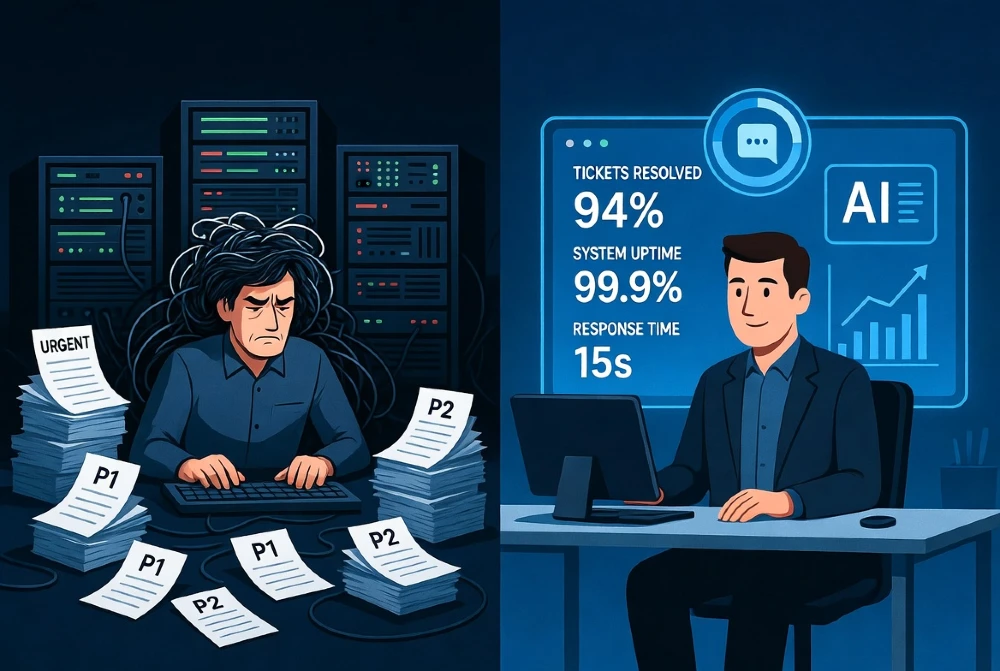
Most SMBs running a managed service provider relationship are leaving serious money on the table — not because they don’t have AI tools, but because nobody told them how to use AI inside an MSP model specifically. This article fixes that.
No background. No history lessons. Just the decisions, the stack, the workflow changes, and the ROI logic you need.
| Question | Direct Answer |
| Should SMBs use AI through their MSP? | Yes — it’s cheaper and faster than building in-house |
| What’s the #1 AI use case for SMBs via MSP? | Automated ticket triage + Level 1 resolution |
| Biggest mistake SMBs make? | Buying AI tools separately instead of integrating into MSP workflows |
| Can AI replace MSP staff? | No — it handles repetitive tasks so techs focus on real problems |
| ROI timeline? | 60–90 days for measurable ticket reduction; 6 months for cost delta |
| Best starting point? | AIOps inside your PSA — ConnectWise, Autotask, or HaloPSA |
What “MSP AI Strategy” Actually Means for an SMB
Let’s be precise. An MSP AI strategy for an SMB is not “use ChatGPT for emails.” It’s a structured set of decisions about where AI enters your managed IT service delivery chain — and which parts your MSP handles vs. which parts you govern directly.
There are three layers:
- AI your MSP deploys on your behalf — AIOps, auto-remediation, anomaly detection
- AI tools your MSP gives you access to — end-user chatbots, AI-assisted helpdesk
- AI you control independently — internal process automation, document AI, CRM intelligence
Most SMBs only think about layer 3. That’s the mistake. The biggest leverage is in layers 1 and 2, because your MSP already has the infrastructure, the alert data, and the technical staff to make those tools actually work.
The 5 AI Capabilities Worth Prioritizing (Ranked by ROI)
1. Automated Ticket Triage and Resolution
This is where you see money back fastest. AI integrated into your MSP’s PSA (Professional Services Automation) tool reads incoming tickets, classifies them by issue type and urgency, routes them to the right tech, and in many cases resolves Level 1 issues without a human touching it.
What this looks like in practice: A staff member submits a ticket — “Outlook not syncing.” AI recognizes it as an Exchange OAuth token issue, cross-references the affected user’s profile, runs the token reset script, sends the user a resolution email, and closes the ticket. That whole flow takes under 3 minutes with zero tech involvement.
ConnectWise Sidekick, Datto Autotask with AI rules, and HaloPSA’s automation engine all support this today. If your MSP isn’t offering this, ask them directly why not.
Avoid: Letting your MSP deploy AI triage without a human escalation path. Miscategorized tickets go into a void. Always define what triggers human review.
2. AIOps — Predictive Monitoring Before Things Break
Traditional MSP monitoring is reactive: something breaks, an alert fires, a tech responds. AIOps shifts that to predictive. It watches patterns — disk I/O trending up, memory utilization creeping, unusual login times — and flags potential failures before they become outages.
For SMBs, this is critical because downtime costs disproportionately more per hour than it does for enterprises. A 2-hour outage for a 25-person professional services firm isn’t an inconvenience — it’s $8,000–$15,000 in lost billable time, depending on the sector.
Real tools doing this well right now: Auvik (network AIOps), NinjaRMM with AI anomaly detection, and Kaseya BMS with predictive alerting. Your MSP likely has access to at least one of these.
The caveat most articles skip: AIOps requires good baseline data. If your MSP has only been monitoring your environment for 30–60 days, the AI doesn’t have enough signal to predict much. Give it 90–120 days before judging its accuracy.
3. AI-Assisted Security Threat Detection
Cybersecurity is the area where AI delivers the clearest SMB value because you can’t afford a 24/7 SOC team — but you can afford an MDR (Managed Detection and Response) service that uses AI to fill that gap.
AI-driven MDR tools like SentinelOne, CrowdStrike Falcon Go, or Huntress (very popular in the SMB MSP space) correlate endpoint signals, email threats, identity anomalies, and network behavior in real time. When something looks like ransomware staging, they don’t just alert — they quarantine the endpoint automatically.
The cost difference is stark: a human SOC analyst costs $85,000–$120,000/year. An AI-powered MDR via your MSP runs $15–$25/endpoint/month. For a 50-endpoint SMB, that’s roughly $15,000/year vs. $100,000+.
What to ask your MSP: “Is our current security stack AI-assisted, and does it include automated response — not just detection?” Detection without response is not enough in 2026.
4. AI Documentation and Knowledge Base Automation
This one gets ignored constantly and it’s a real gap. Every time a tech resolves a complex ticket, that solution should go into a searchable knowledge base — and it almost never does because techs don’t have time to write it up.
AI tools like IT Glue’s GPT-powered documentation, Hudu with AI assist, or even Notion AI inside your MSP’s shared workspace can auto-generate documentation from ticket resolution notes. You end up with a growing library of SMB-specific fixes your entire team can query.
For SMBs, this means faster self-service — staff can search before submitting a ticket — and faster resolution when tickets do come in because techs aren’t starting from scratch.
Practical step: Ask your MSP services provider whether their documentation platform supports AI-assisted knowledge base generation. If they use IT Glue or Hudu, this is available today.
5. AI-Powered Reporting and Business Insights
Most SMBs get monthly or quarterly reports from their MSP that look impressive but don’t drive decisions. AI-powered reporting changes that — it surfaces actionable insights: “Your backup jobs have been failing 3x more this quarter, here’s the root cause,” or “User account access patterns suggest two accounts may be compromised.”
Tools like Liongard (IT stack auditing with AI insights) and BrightGauge (AI-assisted MSP reporting dashboards) turn raw monitoring data into actual business intelligence.
This matters for SMBs because it gives you visibility into your IT environment without needing an internal IT manager. You can walk into a vendor negotiation or board meeting with real data on uptime, security posture, and infrastructure health.
The AI Tools Your MSP Should Already Be Using (2026 Reference)
| Tool | Category | SMB Relevance |
| ConnectWise Sidekick | AI-PSA integration | Ticket auto-triage, resolution suggestions |
| NinjaRMM AI Alerts | AIOps / RMM | Predictive endpoint health monitoring |
| Huntress | AI-MDR | SMB-specific threat detection + response |
| IT Glue + GPT | Documentation AI | Auto-generated runbooks and KB articles |
| SentinelOne Singularity | Endpoint AI | Behavioral threat detection |
| Auvik | Network AIOps | Network topology + anomaly detection |
| BrightGauge | AI Reporting | Business-readable IT dashboards |
| Liongard | Stack Auditing AI | Configuration drift and compliance tracking |
If your current MSP isn’t using at least 3–4 of these (or functional equivalents), that’s a problem worth addressing. See how MSP growth strategies are evolving to include AI-native tooling as a baseline expectation.
How to Structure Your MSP AI Conversation (What to Actually Ask)
Most SMBs don’t know what questions to ask their MSP about AI. Here’s the exact framework:
Question 1: “What percentage of our Level 1 tickets are resolved without human intervention right now?”
If the answer is below 30%, your MSP is underutilizing automation. A well-configured AI triage system should handle 30–50% of L1 tickets autonomously for a typical SMB.
Question 2: “Do you have predictive alerting or only reactive alerting on our environment?”
This tells you immediately whether they’re using AIOps or just traditional monitoring. The difference in outcomes is significant — predictive systems catch 40–60% of outages before users are affected, based on typical AIOps deployment results.
Question 3: “What’s our current MTTR (Mean Time to Resolution) for P1 and P2 incidents?”
If they can’t answer this instantly, they’re not measuring it — which means they’re not optimizing it. AI-assisted MSPs track this as a primary KPI.
Question 4: “Is our security stack detection-only or does it include automated response?”
Non-negotiable in 2026. Detection without automated quarantine means a ransomware event can spread for hours before a human responds.
Question 5: “How is our documentation maintained, and is it AI-assisted?”
Poor documentation = slow resolution = higher cost per ticket. AI-assisted documentation directly reduces your per-ticket cost.
The SMB AI Readiness Gap: What No One Talks About
Here’s the honest reality most articles skip: many MSPs are selling AI but not actually deploying it in a way that benefits SMBs. There are a few common patterns:
The “AI washing” problem: An MSP adds “AI-powered” to their marketing but their actual workflow is unchanged. They bought a tool that has AI features but never configured them for your environment.
The data quality problem: AI tools are only as good as the data feeding them. If your MSP’s PSA has messy ticket categorization, inconsistent asset tagging, and incomplete documentation — AI on top of that produces garbage. Garbage in, garbage out, at machine speed.
The integration problem: Many SMBs use 5–8 different SaaS tools. AI recommendations mean nothing if they can’t integrate with your ERP, CRM, or industry-specific software. Always ask about API connectivity before committing to any AI-driven MSP upgrade.
The accountability problem: Who owns the AI strategy? If your MSP says “we handle it,” make sure there’s a named technical account manager responsible for AI performance metrics, not just a general SLA.
Understanding the real difference between managed IT services and MSP models helps you set the right expectations and ask the right accountability questions.
Real-World AI ROI for SMBs: What the Numbers Look Like
Let’s make this concrete. Here’s what a 40-person professional services firm (legal, accounting, consulting) typically sees after implementing an MSP AI strategy properly:
Before AI integration (baseline):
- Monthly ticket volume: 120–150 tickets
- Average MTTR: 4.2 hours
- L1 auto-resolution rate: 8%
- Monthly MSP cost: $6,500
After 90 days of AI-optimized MSP:
- Monthly ticket volume: 90–110 tickets (users solve more via AI self-service)
- Average MTTR: 1.8 hours
- L1 auto-resolution rate: 38%
- Monthly MSP cost: $6,500 (same contract, better service)
The cost doesn’t drop — but the value delivered per dollar goes up dramatically. Fewer escalations, less downtime, faster resolution, and more proactive issue prevention.
The security ROI is harder to quantify but easier to justify: A single ransomware incident for an SMB costs $120,000–$450,000 on average when you factor in downtime, recovery, legal costs, and reputational damage. An AI-powered MDR running at $15/endpoint/month for 40 endpoints is $7,200/year. The math is obvious.
AI Strategy Mistakes SMBs Make (And How to Avoid Them)
Mistake 1: Buying AI tools outside the MSP stack
If you buy Copilot for Microsoft 365 but your MSP doesn’t integrate it into their monitoring and documentation workflow, you get a fragmented experience. AI tools work best when they share data. Keep your stack unified.
Mistake 2: Expecting AI to replace strategic IT thinking
AI handles execution — not strategy. Someone still needs to decide what your infrastructure should look like in 3 years, how to handle compliance requirements, and when to upgrade legacy systems. That’s human work.
Mistake 3: Skipping the governance conversation
Who decides what the AI can and can’t do on your network? What data does it have access to? What gets logged? These are governance questions that must be answered before deployment — not after an incident.
Mistake 4: Measuring AI by tool count instead of outcomes
“We have 6 AI tools” is meaningless. Measure MTTR reduction, auto-resolution rate, security incident response time, and infrastructure uptime. Those are the metrics that determine whether your MSP AI strategy is working.
Mistake 5: Not revisiting the strategy quarterly
AI in IT is evolving fast. What was a leading capability in Q1 2026 may be table stakes by Q4. Build a quarterly review cadence into your MSP agreement where AI performance and tooling are explicitly discussed.
For a broader view of how to evolve your MSP relationship over time, the MSP growth 2026 optimization roadmap is worth reviewing.
Building Your MSP AI Strategy: The 90-Day Action Plan
Days 1–15: Audit
- Pull last 6 months of ticket data from your MSP
- Identify top 10 recurring issue types
- Ask your MSP for current auto-resolution rate and MTTR by priority level
- Document all current AI tools in use (theirs and yours)
Days 16–30: Gap Analysis
- Map recurring issues against potential AI resolution (which can be automated vs. which need humans)
- Identify data quality gaps — inconsistent ticket categories, missing asset tags, outdated documentation
- Get your MSP to demo their AI triage and AIOps capabilities specifically for your environment (not a generic demo)
Days 31–60: Configuration
- Work with your MSP to configure AI triage rules for your top 10 ticket types
- Set up predictive alerting thresholds based on your baseline data
- Ensure AI-assisted documentation is capturing resolutions from new tickets forward
Days 61–90: Measure and Adjust
- Compare MTTR and auto-resolution rate against baseline
- Identify which AI rules are working and which are miscategorizing
- Set formal KPIs for the next quarter: target auto-resolution rate, MTTR target, uptime target
This isn’t a one-time project. It’s an ongoing optimization loop. The SMBs getting the most from their MSP AI strategy review it quarterly and treat it like a product — not a setup.
Choosing the Right MSP Partner for AI Delivery
Not all MSPs are AI-ready. Here’s what separates the ones worth working with:
Green flags:
- Named technical account manager with AI specialty
- PSA with native AI integration (not bolt-on)
- MDR with automated response (not just alerting)
- Quarterly business reviews that include AI performance metrics
- Transparent SLAs on auto-resolution rate and MTTR
Red flags:
- “AI-powered” in marketing but can’t name specific tools in your stack
- Reactive-only monitoring with no predictive capability
- Security = antivirus + firewall (no MDR)
- No documentation platform or knowledge base
- Can’t tell you your current MTTR when asked
The right MSP partner isn’t selling you AI — they’re operationalizing it inside your environment and proving it with numbers.
SMB-Specific AI Use Cases by Industry
AI strategy isn’t one-size-fits-all. Here’s how it shifts by vertical:
Legal firms: Document management AI (contract review, e-discovery prep), strict access control AI, compliance monitoring for data residency requirements.
Healthcare SMBs: HIPAA-compliant AI monitoring, PHI access anomaly detection, AI-assisted backup verification for EHR systems.
Accounting and finance: Fraud pattern detection on financial systems, AI-assisted audit trail monitoring, automated backup testing for client data.
Manufacturing SMBs: OT/IT network segmentation monitoring, predictive maintenance alerts for connected equipment, AI-driven vendor access control.
Retail and hospitality: POS system monitoring with AI anomaly detection, PCI-DSS compliance automation, AI-assisted endpoint security for distributed locations.
If your MSP doesn’t understand your industry’s specific AI use cases, they’re delivering a generic service — which is a ceiling on what you can achieve.
The Honest Limitations of MSP AI in 2026
AI doesn’t solve everything. Be realistic about these limits:
AI can’t replace strategic planning. Your infrastructure roadmap, budget decisions, vendor negotiations — these require human judgment with business context.
AI struggles with novel issues. Automated triage works well on known issue patterns. A genuinely new, complex, or environment-specific problem still needs an experienced tech.
AI requires clean data to work well. If your asset inventory is incomplete, your ticket categories are inconsistent, or your documentation is sparse — AI amplifies those problems, not hides them.
AI isn’t a substitute for SLA accountability. If your MSP is underperforming, AI is a layer on top of that underperformance. Fix the fundamentals first.
AI tools have cost. Many AI-enhanced MSP capabilities come at an additional per-seat or per-endpoint cost. Be clear on what’s included in your agreement vs. what’s an upsell.
Why This Matters More in 2026 Than It Did in 2024
Two things changed in the last 18 months that make this conversation urgent for SMBs:
First: AI-native ransomware and phishing attacks are now the baseline threat. Attackers are using AI to craft personalized spear-phishing emails, identify unpatched vulnerabilities faster, and move laterally through networks before traditional detection fires. You need AI-speed defense to match AI-speed offense.
Second: The cost of AI-powered MSP services dropped dramatically. MDR, AIOps, and AI triage — tools that cost enterprise money 3 years ago — are now accessible at SMB price points through MSP scale. There’s no longer a cost reason to delay.
SMBs that integrate AI into their MSP strategy in 2026 will operate with the security posture and operational efficiency that only enterprises had access to in 2022. That’s a genuine competitive advantage.
Services That Work Alongside Your MSP AI Strategy
If you’re at the point where your IT foundation is stable and AI-assisted, the next layer is optimizing the digital presence and internal operations that sit on top of that infrastructure. At Miracle Concepts, we work with SMBs that have strong MSP foundations and need to maximize ROI across every digital touchpoint. Our SEO services make sure your business is visible when clients search for what you offer — using the same AI-first thinking applied to your content strategy. Our UX design and web development work ensures that when those clients land on your site, they convert. We handle document formatting for professional proposals, reports, and deliverables that reflect the quality of your brand. And our full MSP services practice means we understand IT environments from the inside — so when we build your digital strategy, we’re not guessing at your infrastructure constraints. One team, every layer, zero silos. That’s how SMBs scale in 2026.