
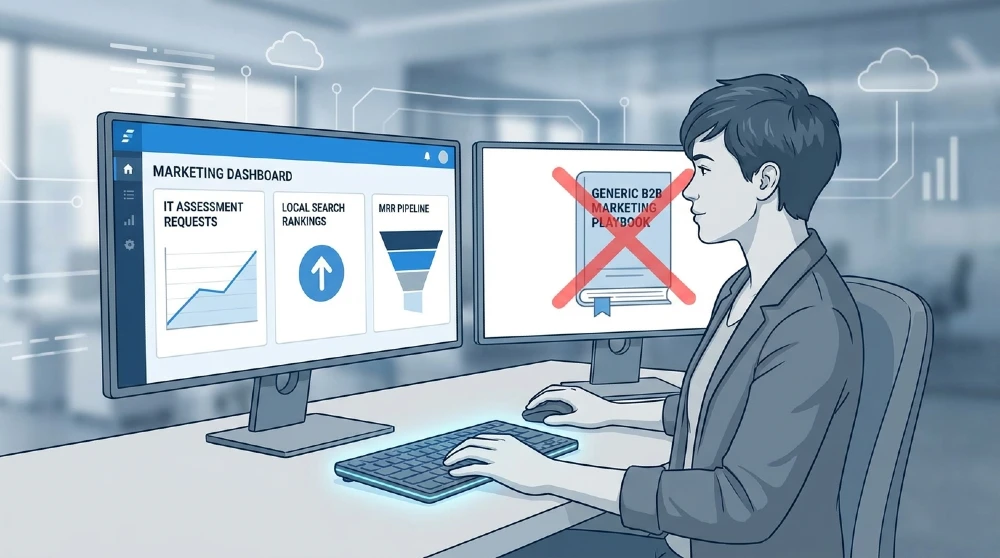
Effective MSP marketing combines local search optimization, problem-aware content, targeted Google Ads, LinkedIn account-based outreach, email nurture sequences, and trust assets like case studies and reviews. Most managed service providers see measurable pipeline improvement within 90 days when these strategies line up with their sales cycle and ideal client profile.
If you run an MSP and your marketing feels like it’s not converting into real leads, you’re not alone. Most MSP marketing fails not because the channels are wrong, but because the foundation underneath them was never built properly. This guide walks through what actually moves the needle, in the order it needs to happen.
For a broader look at what a professional engagement covers, see this breakdown of MSP marketing services and what to expect.
Why Most Generic B2B Marketing Playbooks Fail for MSPs
Generic B2B playbooks fail for MSPs because MSP buyers don’t behave like SaaS buyers. They’re local, risk-averse, and often business owners with little technical knowledge not IT enthusiasts hunting for product features.
An MSP buyer isn’t comparing feature lists. They’re asking a simpler question: can I trust this company to keep my business running?
That changes everything about how marketing should work:
- Thought-leadership blog posts rarely rank for the searches that actually convert, like “my server is down” or “email not working.”
- Reach and impressions mean nothing if that traffic never turns into a request for an IT assessment.
- Buyers want proof of reliability and business continuity, not a list of technologies you support.
This is the core mistake behind most MSP marketing that underperforms: it’s built for awareness, not for urgency.
The Four Foundations to Fix Before You Spend on Advertising
Before you spend a dollar on ads, fix your foundation. Most MSPs burn ad budget because they scale paid media before their website, offer, and tracking are ready to convert that traffic.
Defining Your Ideal Client Profile and Serviceable Market
Narrow your focus instead of trying to serve everyone. Define your ideal client by:
- Industry (healthcare, legal, finance, manufacturing, etc.)
- Company size (employee count or device count)
- Geography (the service area you can realistically support)
- Compliance needs (HIPAA, PCI-DSS, CMMC, and similar requirements)
A tightly defined ideal client profile makes every other marketing decision easier, from keyword research to ad copy.
Building a Unique Selling Proposition Around Business Outcomes
Your positioning should center on outcomes, not services. “We manage IT” tells a prospect nothing about why they should choose you.
Instead, lead with what changes for them: fewer costly outages, a stronger compliance posture, predictable monthly costs, and a team that answers the phone when something breaks.
Creating Conversion Paths for IT Assessments
A dedicated landing page something like “Free Network Health Check” converts far better than a generic “Contact Us” form. It gives visitors a low-commitment next step and a clear reason to hand over their details.
Installing Proper Tracking and CRM Integration
You can’t improve what you can’t measure. Set up:
- Call tracking on every marketing channel
- Form attribution tied to source and campaign
- CRM routing so leads land with the right person immediately
Without this, you’re guessing which channels actually produce marketing-sourced pipeline, and which ones just look busy.
Local SEO and Service-Area Pages: Owning “IT Support Near Me”
Local SEO is the highest-intent, lowest-competition strategy available to most MSPs, and it should be the first channel you invest in.
Ranking for “managed IT services [city]” brings in prospects who are already looking for help a far more qualified lead than someone reading a national thought-leadership article.
To build this out:
- Fully optimize your Google Business Profile, including categories, services, and photos
- Build a dedicated service-area page for each city or county you actively cover
- Keep your business name, address, and phone number consistent across every directory (NAP consistency)
- Run a systematic process for collecting Google reviews after every completed project
This work is detailed further in this guide to MSP SEO and ranking on Google, and paired with proper MSP keyword research to target the exact phrases your buyers are searching for.
Content That Ranks for Problem-Aware Searches
Content only works when it answers a specific, urgent problem not when it explains general IT concepts.
There’s a real difference between writing for algorithms and writing for buyers. MSP content should target searches like:
- “Ransomware recovery steps”
- “HIPAA IT compliance checklist”
- “Why is my internet so slow”
To improve visibility in search generative experience results and AI Overviews:
- Mine “People Also Ask” data for real buyer-risk questions
- Add FAQ schema markup to relevant pages
- Structure answers so the first sentence under each heading directly answers the question
Content built this way builds entity authority over time search engines start recognizing your site as a genuine source on IT support, cybersecurity, and compliance topics, not just another blog publishing generic advice.
Paid Acquisition: Google Ads for Urgent Demand and LinkedIn for Named Accounts
Paid acquisition works best as two separate channels serving two separate purposes: Google Ads captures people searching right now, and LinkedIn builds a pipeline of named accounts over time.
Google Ads for High-Intent Local Keywords
Google Ads is built for capturing existing demand. Set up geo-targeted, service-specific campaigns around searches like “IT support near me” or “business computer help.” These searchers already know they need help your job is just to be the answer they click.
LinkedIn Account-Based Marketing for Target Accounts
LinkedIn ABM works differently. Instead of chasing keywords, you target named decision-makers at specific companies using job title and company size filters, then match your proof assets (case studies, testimonials) to where they are in the buying process.
Budget Allocation Between Paid Channels
A practical starting split for most growing MSPs:
| Channel | Purpose | Suggested Share |
|---|---|---|
| Google Ads | Capture urgent, high-intent demand | 60% |
| LinkedIn ABM | Build pipeline with named target accounts | 40% |
Adjust this once you have real cost-per-acquisition and lifetime-value data from your CRM.
Email Nurture and Retargeting: Staying Visible During Long Sales Cycles
MSP sales cycles often stretch across several months, so staying visible matters as much as the first click.
Build these two systems:
- Automated email sequences triggered when someone downloads an assessment or resource, gradually introducing case studies, FAQs, and proof points
- Retargeting ads aimed at website visitors who didn’t convert, keeping your brand in front of them until they’re ready for a quarterly business review or sales conversation
Without this layer, prospects who visited your site once but weren’t ready to buy simply forget you exist by the time they are.
Video, Case Studies, and Reviews: Building Trust Tokens
Trust matters more than production quality in MSP marketing. Buyers aren’t judging your marketing on polish they’re judging whether you seem reliable.
Focus on three trust assets:
- Simple video content introducing your team and explaining common IT problems in plain language
- Case studies with measurable outcomes downtime reduced, costs saved, incidents prevented
- Consistent review generation on Google and relevant industry platforms
These assets shorten the trust cycle. A prospect who watches a two-minute video of your technician or reads a case study with real numbers moves toward a decision faster than one reading generic service copy.
Vendor Co-Marketing and Strategic Partnerships
Vendor and referral partnerships are an underused channel that often deliver higher-quality leads than cold outreach.
Two directions worth pursuing:
- Vendor co-marketing: Microsoft, Cisco, Datto, and similar vendors often run partner programs with co-branded campaigns and marketing development funds (MDF) that reduce your out-of-pocket cost
- Referral partnerships: Accountants, business consultants, and insurance brokers who already serve your ideal client profile can become a consistent referral source when the relationship is structured properly
These leads typically arrive pre-qualified, since they come with an existing layer of trust from the referring party.
Mapping Marketing to Seasonal Demand and Surge Events
MSP demand isn’t flat throughout the year, so your marketing shouldn’t be either.
Plan around predictable surge points:
- Budget cycles in Q1, when many businesses set their annual IT spend
- Contract renewal periods
- Compliance deadlines specific to your target industries
- Cyber incident spikes, when ransomware and breach news drive urgent searches
The key is preparing useful assets checklists, assessment offers, relevant ad copy before demand rises, not scrambling to create them once it does. This is what separates proactive marketing from reactive marketing.
The Realistic Timeline: What to Expect at 30, 60, and 90 Days
Most MSP owners want fast results, but real progress follows a predictable pattern.
Days 1–30: Discovery, foundation fixes, tracking installation, and initial content planning. Expect very few visible leads during this phase.
Days 31–60: Service-area page launches, local SEO improvements, paid campaign builds, and the first nurture sequences go live.
Days 61–90: Early organic ranking gains, first marketing qualified leads, campaign optimization based on real data, and initial pipeline reporting.
If a marketing partner promises significant lead volume in the first two weeks, treat that as a red flag rather than good news.
Warning Signs Your Marketing Is Off Track
Watch for these signs that budget is being wasted before it compounds:
- Tracking vanity metrics like traffic instead of marketing-sourced monthly recurring revenue
- No alignment between marketing activity and your sales follow-up process
- Publishing generic content that doesn’t address specific buyer pain points
- Scaling paid media spend before fixing conversion paths on your website
- An agency partner who can’t clearly explain the difference between break-fix and managed services
If more than one of these applies to your current setup, it’s worth a full review before spending more. A structured MSP growth and online optimization audit can identify exactly where the gaps are.
Questions MSP Owners Ask Before Investing in Marketing
It depends on team capacity and expertise. In-house works if someone can dedicate real time to SEO, content, and ad management. Most MSPs get better results faster by outsourcing to a team that already understands the sales cycle and buyer psychology of IT services.
Most MSPs see early marketing qualified leads within 60–90 days, with stronger organic and paid results building from month four onward as content and campaigns mature.
Local SEO typically delivers the lowest cost per acquisition over time, since it captures existing search demand without an ongoing cost-per-click.
A common starting benchmark is 7–10% of revenue for MSPs actively pursuing growth, adjusted based on target market size and competition in your service area.
Yes. Local SEO, targeted paid ads, and referral partnerships consistently produce measurable pipeline for MSPs when the foundation tracking, conversion paths, and a clear ideal client profile is in place first.