
Most websites publish dozens of blog posts and still struggle to rank. The content is decent. The keywords are researched. But Google just doesn’t treat the site as an authority. The reason is almost always the same the content is scattered, disconnected, and built around individual keywords instead of topics.
Ben Stace’s topical authority method solves exactly that. Instead of asking “what keyword should I rank for next?”, his framework asks “what topic should my website own?” and then builds a complete, semantically connected content system around that answer.
This guide breaks down the full Ben Stace topical authority framework: what it is, how it works step by step, why Google rewards it, and how you can apply it to build lasting search visibility.
Quick Verdict TL;DR: Ben Stace builds topical authority by creating topical maps structured blueprints of pillar pages and content clusters, all semantically interlinked. His framework combines entity-based optimization, search intent matching, semantic content networks (SCNs), and strategic internal linking to signal to Google that a website is the definitive source on a subject. Sites applying his method report 40–115% increases in organic traffic within 3–6 months. The core principle: own the topic, not the keyword.
Why Traditional Keyword SEO Fails to Build Authority
Before understanding what Ben Stace does, it helps to understand what everyone else was doing wrong.
Traditional SEO was simple: find a keyword with search volume, write a blog post targeting it, build some backlinks, repeat. This worked reasonably well when Google matched pages to queries based on exact word matches. But Google hasn’t worked that way for years.
Since the Hummingbird algorithm update and later BERT and MUM, Google reads meaning not just words. It understands context, relationships between concepts, and whether a website genuinely covers a topic or just mentions keywords. When you publish 30 isolated blog posts each targeting a different keyword, Google sees 30 disconnected pages. It has no reason to trust your site as an authority on anything. No clear structure. No semantic depth. No signal of expertise.
This is where most websites hit a ceiling. Rankings plateau. Traffic flatlines. New content gets indexed but doesn’t gain traction.
Ben Stace identified this gap early and built a system around solving it.
Explore Ben Stace semantic SEO consultancy services review. 184% organic traffic growth, 90+ top-10 keywords via content clusters. LegalTech case studies prove ROI—master intent-driven rankings now!
Who Is Ben Stace? Why Does His Approach Matter?
Ben Stace is a UK-based SEO consultant and semantic search strategist. He is the founder of VAMFungi and is widely recognized as one of the leading voices in topical authority SEO. His website is benstaceseo.com, where he shares frameworks, tools, and case studies.
He’s not an academic he’s a practitioner. His frameworks come from testing content strategies across multiple industries, studying how Google’s algorithms evolved, and documenting what actually produced results.
He even created a popular semantic SEO writing tool that guides writers to include entity recognition, topic clusters, and user intent in their content. Stace is a recognized SEO speaker and trainer whose focus on topics rather than isolated keywords has influenced many agencies.
What separates him from most SEO voices is that he didn’t just advocate for “better content.” He built a repeatable system one that defines exactly how to structure a website’s content, how to interlink it, what topics to cover first, and how to signal expertise to search engines through content architecture rather than just link building.
He is the Founder of VAMFungi, based in the United States. On topical authority courses, his perspective is that semantic SEO is a genuine upgrade for SEO practice
What Is Topical Authority? The Core Concept Behind the Framework
Topical authority is Google’s way of determining which websites are the most trustworthy, comprehensive sources on a specific subject. It’s not just about having a lot of content it’s about having the right content, organized correctly, covering every relevant angle of a topic.
Think of it like this. A medical school graduate who has studied one subject exhaustively for six years is more credible than someone who has read scattered articles on 50 different health topics. Google applies similar logic to websites. A site that deeply covers one subject area with organized, interconnected content ranks higher than a site with random posts on dozens of unrelated topics.
When you build topical authority, you’re essentially telling search engines that your website is the go-to resource for specific subjects. This approach works because search engines have evolved to understand context and relationships between different pieces of content, not just isolated keywords.
Ben Stace didn’t invent the concept of topical authority but he turned it into a practical, step-by-step system that businesses and SEO agencies could actually implement. That’s where the real contribution lies.
What Is a Topical Map? The Blueprint Ben Stace Uses
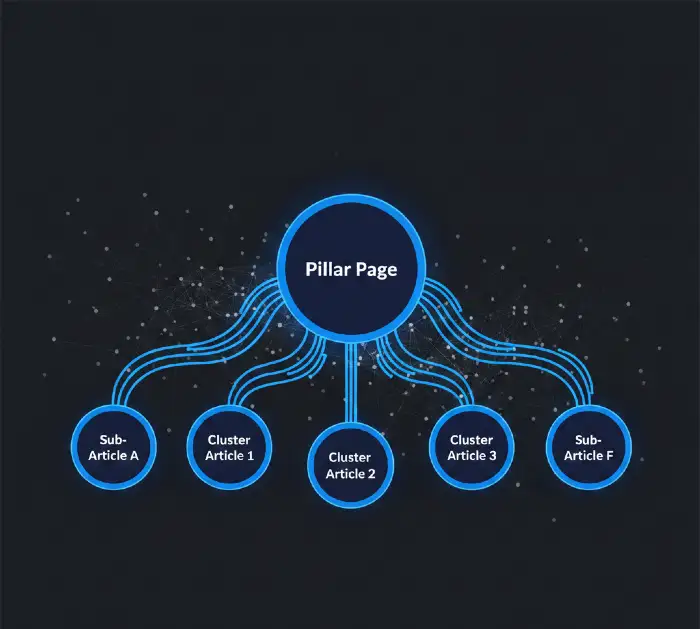
A topical map is a visual and strategic representation of all the content a website needs to establish authority on a given subject. It’s not a spreadsheet of keywords. It’s a structured hierarchy of topics, subtopics, and their relationships essentially a blueprint for building a knowledge graph on your website.
Stace advises marketers to organize content like a curriculum with a central thesis (pillar topic), modules (subtopics), and lesson pages. Each piece interlinks to reinforce relationships.
Here’s how the structure works in practice:
Level 1 — The Pillar Page: This is the broad, comprehensive guide on the main topic. It covers the subject at a high level, defines the scope, and links out to every cluster article. Example: “Complete Guide to Email Marketing.”
Level 2 — Cluster Articles: These are deeper dives into specific subtopics. Each one answers a more focused question. Examples: “How to Write Email Subject Lines,” “Email Marketing Automation Setup,” “Email Segmentation Strategy.” Each cluster article links back to the pillar and to related cluster articles.
Level 3 — Supporting Content: Very specific, narrow pages that answer highly targeted questions. These feed into the cluster level above them. Example: “What Is A/B Testing in Email Subject Lines?”
The whole structure works together. Every page strengthens every other page because they’re semantically related and internally linked. Google crawls this structure and reads it as a coherent knowledge hub, not a collection of random posts.
Ben’s case studies all revolve around one thing: owning the topic, not the keyword. Instead of chasing random phrases, he reverse-engineers Google’s knowledge graph to identify what Google expects from an authority in that niche. He maps out semantic clusters interlinked articles that speak to every angle of the core topic. Each cluster strengthens the domain’s topical depth.
A real example from Ben Stace’s own work: In the wedding speeches niche, his goal was to rank for “best man speech examples.” Rather than publishing one page for that keyword, he built 85+ pages of related content all semantically connected. The core pillar covered how to write a best man speech step by step. The clusters covered speeches for a brother, funny templates, appropriate length, opening lines, toasts, and more. Every piece linked to every relevant other piece. The site didn’t just rank for the target phrase. It owned the entire topic.
Learn how Ben Stace semantic SEO stands different. Entity optimization over keyword stuffing, topical authority clusters. 187% traffic surge proven—ditch old tactics for Google’s knowledge graph!
How Does Ben Stace Build Topical Authority? Step-by-Step Framework
This is the practical core of the article. Here is the complete process.
Step 1: Define the Topic Your Website Will Own
The first step is choosing the right topic not a keyword, a topic. Ben Stace’s guidance is clear: ask yourself “If Google could assign one label to my site, what should it be?” That answer becomes the foundation of everything.
For a digital marketing agency: the topic might be “semantic SEO services for B2B companies.” For a healthcare provider: “chronic pain management in adults.” For a legal firm: “personal injury law in Florida.” For an e-commerce brand: “natural skincare for sensitive skin.”
The topic needs to be broad enough to support a pillar page and 10–20+ cluster articles, but specific enough to be ownable. “Marketing” is too broad. “Content marketing for SaaS startups” is right-sized.
What to do: Pick one topic. Not two. Not five. One. Build depth there before expanding. Stace’s own data shows that scattered authority across multiple topics produces far weaker results than deep authority in one area.
What not to do: Don’t pick a topic because it has high search volume. Pick it because it’s directly connected to what your business does or sells. The goal is to attract the right audience, not just any audience.
Step 2: Map Every Subtopic and Question Within That Space
Once the core topic is defined, the next step is mapping every subtopic, question, angle, and user intent that belongs to it. This is the topical map creation phase.
Ben Stace uses tools like MarketMuse, InLinks, and Google’s NLP API to identify primary, secondary, and latent semantic indexing (LSI) keywords. For a topic like “dog food,” he maps subtopics such as “best organic dog food,” “grain-free diets,” and “puppy nutrition.”
Free tools that work well for this research phase:
- Google’s People Also Ask — shows real questions users are asking
- AlsoAsked — maps question trees from PAA results
- Answer the Public — surfaces long-tail question patterns
- Google Search Console shows what queries your existing content is already appearing for
The output of this step is a list of every possible piece of content your website needs to fully cover the topic. Think of it like a curriculum. If someone enrolled in a course on your topic, what would they need to learn from start to finish? Map that.
Organize the output into three categories:
- Informational content — questions people ask when learning (how does, what is, why does)
- Comparative content — questions people ask when evaluating options (X vs Y, best tools for Z)
- Transactional content — questions people ask when ready to act (hire, buy, use, get started with)
Every category needs coverage. Informational alone gets traffic but not conversions. Transactional alone gets ignored because there’s no trust built first.
Step 3: Build the Pillar Page First
Before writing any cluster content, write the pillar page. This is the most important piece in the entire framework.
A pillar page is a comprehensive, long-form guide that covers the entire topic at a high level. It doesn’t go deep on every subtopic that’s what the clusters are for. But it introduces each subtopic clearly and links out to the relevant cluster article for readers who want more depth.
Length: typically 3,000–5,000 words. Not for the sake of word count for the sake of actually covering the topic scope.
Structure of a strong pillar page:
- Clear H1 that names the topic directly
- Introduction that states the problem and what the page covers
- A table of contents with anchor links
- Each major subtopic addressed in its own H2 section briefly but clearly
- Internal links from each H2 to the relevant cluster article
- Schema markup (Article schema at minimum)
- A strong conclusion with a clear next step
What to do: Write the pillar page before any clusters. It gives you the map. Every section that needs more depth becomes a cluster article. Every cluster article knows which pillar page to link back to.
What not to do: Don’t write a bloated pillar page that tries to be everything. Depth belongs in the clusters. The pillar page is the guide, not the encyclopedia.
Explore is Ben Stace SEO worth it for businesses. 62% lead growth for local services, e-commerce top-3 rankings. Real case studies show 50-70% gains—investment pays 3x in 90 days!
Step 4: Create Content Clusters Around Every Subtopic
With the pillar page live, the next phase is building the cluster content. Each cluster article covers one specific subtopic in depth answering the question fully, practically, and specifically.
Think of a topical map as a city map: the pillar page is downtown, while the cluster articles are neighborhoods connected by roads (internal links). Ben designs pillar content that explains the main idea, then links to cluster content that dives into subtopics. This cluster approach signals topical authority.
Ben Stace’s guidance on cluster articles is specific:
- Each cluster article should answer one focused question completely
- It should link back to the pillar page (parent link)
- It should link to 2–3 related sibling cluster articles (lateral links)
- It should cover all entities related to its specific subtopic
The entity coverage is important. Entities are the specific people, places, tools, concepts, and things that Google associates with a topic. If you’re writing a cluster article about “email marketing automation,” the entities Google expects to see include: Mailchimp, Drip, ConvertKit, autoresponders, trigger sequences, behavioral segmentation, open rate, click-through rate. Including these entities not as keyword spam, but as natural references within the content tells Google’s NLP system that the article genuinely covers the subject.
What to do: Write cluster articles in a logical sequence. Start with the subtopics closest to your pillar page’s core theme. Publish one cluster per week initially. Each new piece strengthens the whole structure retroactively.
What not to do: Don’t publish all clusters at once without checking internal link health. Every new cluster article should be linked from the pillar page and from at least 1–2 existing cluster articles. An orphaned cluster page one with no internal links pointing to it is invisible to Google even if it’s well-written.
Step 5: Build the Internal Linking Structure Like a Knowledge Graph
Internal linking is not a secondary SEO task in Ben Stace’s framework. It’s the architectural layer that makes the entire topical authority system work.
A key part of his strategy is linking pages in a hierarchy parent (broad topic) to child (specific topic) and sibling pages so Google can parse the content structure. In Stace’s view, a well-linked topic cluster tells search engines “this is the structure… this is how it all connects.”
The internal linking rules Stace follows:
- Pillar to Cluster: Every major subtopic section in the pillar page links to the corresponding cluster article
- Cluster to Pillar: Every cluster article links back to the pillar page at least once, using anchor text that references the pillar topic
- Cluster to Cluster: Related cluster articles link to each other using descriptive, contextual anchor text not “click here” or “read more”
- No orphan pages: Every piece of content has at least two internal links pointing to it
The practical result is that PageRank, trust, and topical context flow through the site like water through a pipe system. High-authority pages share their authority with related pages. Google’s crawlers follow the links and understand the hierarchy. The site reads like a structured knowledge base, not a blog.
What to do: Audit your internal links every time you publish new content. Add links from existing cluster articles to the new piece within 48 hours of publication. This helps Google discover and index new pages faster.
What not to do: Don’t use generic anchor text for internal links. “Click here to learn more” tells Google nothing about the destination page’s topic. Use descriptive phrases like “email segmentation strategy” or “how to build a topical map” as anchor text. Specific anchors strengthen the semantic signal.
Master geo and entity-based SEO tactics. Ben Stace methods: LocalBusiness schema, location clusters, named entity recognition. 230% lead boost for plumbers—dominate local search now!
Step 6: Optimize Every Page for Entities, Not Just Keywords
Ben Stace uses a concept called entity-based optimization a framework where content is enriched with the specific people, places, tools, concepts, and relationships that Google associates with a topic through its Knowledge Graph.
At the heart of semantic optimization is the concept of entity authority he idea that a topic gains credibility not from keyword repetition, but from its coherent representation across interconnected content.
In practical terms, entity optimization means:
- Mentioning the relevant brands, tools, and named concepts associated with your topic
- Linking to authoritative external sources that Google already trusts (official documentation, recognized research, government or academic sources)
- Using natural language that mirrors how people actually talk about the subject — not robotic keyword insertion
- Including schema markup (Article, FAQ, HowTo, Product, Organization) to communicate structure directly to Google in a machine-readable format
Tools Ben Stace uses for entity and semantic research:
- InLinks maps entity relationships and content gaps
- MarketMuse scores content for topical depth and identifies missing concepts
- Google’s Natural Language API analyzes how Google reads and classifies content
- Surfer SEO / NeuronWriter compares semantic keyword coverage against top-ranking pages
What to do: After writing any piece of content, paste it into Google’s free Natural Language API demo (cloud.google.com/natural-language). It shows exactly which entities Google extracts from your content and how it classifies the document. If the entities it extracts don’t match your topic, revise.
What not to do: Don’t stuff entity mentions unnaturally. The goal is natural coverage, not keyword density for entities. A paragraph that mentions Mailchimp, ConvertKit, Drip, ActiveCampaign, and HubSpot in three sentences is suspicious. Spread entity references naturally across the full article.
Learn long-tail keyword strategy for digital marketing firms. Ben Stace approach: intent-rich queries replace broad terms. “Legal software solo practitioners” converts 7.1% CTR vs 5.4%!
Step 7: Keep the Content Fresh and Fill Gaps Over Time
Topical authority is not built once and then forgotten. Ben Stace treats it as a living system that requires ongoing maintenance.
Implementing semantic SEO effectively demands more than one-off fixes; it requires a sustained, strategic approach. Ben Stace advocates for a phased implementation that balances foundational work with forward-looking innovation. Conduct content audits to identify semantic gaps topics missing in definition, entities underlinked, or intent misaligned with user behavior.
The ongoing maintenance process looks like this:
Every month: Check Google Search Console for new queries your content is appearing for but not ranking in the top 5. These are content gap signals — questions you’re partially answering but not fully owning.
Every quarter: Run a content audit using a tool like Screaming Frog + Ahrefs. Find pages with declining traffic. Update the statistics, add new subtopics that have emerged, improve internal linking.
Every time Google releases a core update: Review your pillar pages against the Helpful Content guidelines. Make sure every page answers the user’s question completely without requiring them to click elsewhere.
Every time you publish a new cluster article: Go back to the pillar page and existing clusters. Add contextual internal links to the new piece. Never leave new content isolated.
What Makes Ben Stace’s Topical Map Different from Regular Content Planning?
A lot of companies do “content planning.” Very few do topical mapping. The difference matters.
Regular content planning starts with a keyword list. You pick 20 keywords with decent search volume, assign one to each blog post, and publish on a schedule. The articles might be well-written. But they have no relationship to each other. They don’t reinforce each other’s authority. They compete with each other for similar queries (keyword cannibalization). And they don’t tell Google anything about what your site is actually an expert in.
Topical mapping starts with a topic and works outward. Every piece of content is placed deliberately within a hierarchy. Every link is intentional. Every entity is chosen to reinforce the semantic context. The site builds compounding authority each new piece makes every existing piece stronger.
The beauty of topical mapping lies in its ability to create a structured content ecosystem where every article, guide, and page works together to strengthen your overall authority. Rather than having scattered blog posts that compete against each other, you develop a cohesive strategy that builds trust with both users and search engines.
One concrete example of the difference: A digital marketing agency used Ben Stace-inspired topical mapping for their blog. Before the strategy, they had 60+ blog posts scattered across marketing topics with weak internal linking. After restructuring into 3 topic clusters with proper pillar pages, their organic traffic increased by 100% within three months. Their bounce rate dropped by 30%, meaning users were navigating deeper into the site rather than reading one post and leaving.
What Are Semantic Content Networks? The Advanced Layer of the Framework
Semantic Content Networks (SCNs) are the advanced evolution of topic clusters. Ben Stace advocates for SCNs as the next step beyond basic pillar-cluster architecture.
In 2025, the conversation has shifted from raw keyword frequency to topical authority and structured content strategies. At the center of this change is Ben Stace’s concept of Semantic Content Networks (SCNs), a framework that helps websites align with how modern search engines and large language models actually process information. Unlike traditional keyword-driven SEO, Semantic Content Networks treat information as a web of relationships.
In a Semantic Content Network, content isn’t just organized in a hierarchy it’s organized like a knowledge graph. Every piece of content is connected to every other relevant piece through multiple pathways. The structure mirrors how Google’s Knowledge Graph actually models real-world information: as interconnected entities with defined relationships, not as a tree with a single trunk.
The practical difference between a topic cluster and an SCN:
Topic Cluster: Pillar → Clusters. Linear hierarchy. One main path between related content.
Semantic Content Network: Pillar → Clusters → Supporting pages, all connected to each other through multiple link pathways. An article about “email segmentation” links not just up to the pillar but also to articles about “personalization,” “subscriber lifecycle,” “email deliverability,” and “CRM integration” because those concepts genuinely relate to segmentation in the real world.
The more pathways Google can follow between semantically related content on your site, the stronger the topical authority signal. This is why sites built on SCN principles tend to rank for dozens of related queries without targeting them individually.
Why Does Google Reward This Approach?
Understanding the mechanism behind why topical authority works helps you apply it more effectively.
Google’s primary goal is to match users with the most helpful, trustworthy, complete answer to their query. When evaluating which page to rank, Google uses multiple signals — but one of the most important is whether the source demonstrates genuine expertise across a topic area, not just on a single page.
Google’s E-E-A-T framework (Experience, Expertise, Authoritativeness, Trustworthiness) is essentially the evaluation standard for topical authority. A site with deep, structured, interlinked content on a topic demonstrates:
- Experience: It covers the subject from practical, hands-on angles (how-to guides, case studies, specific examples)
- Expertise: It covers the subject comprehensively nothing important is missing
- Authoritativeness: Other trusted sources link to it, and its own internal structure references authoritative external sources
- Trustworthiness: The content is accurate, current, and clearly created to help users rather than just rank
His topical maps “align perfectly with Google’s Helpful Content Update and E-E-A-T.” His methods help sites demonstrate genuine expertise to both users and search engines. As he warns, sites that only publish isolated blog posts with one keyword end up with “holes” in their topical net but layered, semantically linked content fills those holes, and that’s how Google “recognizes you as the authority.”
There’s also a practical mechanical reason this works: Google’s crawlers follow links. A well-interlinked topical map ensures every page on your site gets crawled frequently, gets indexed quickly, and passes authority efficiently between pages. An isolated blog post might take weeks to get indexed and rarely earn authority from the rest of the site. A cluster article connected to a strong pillar page gets indexed faster and inherits authority immediately.
Mistakes That Destroy Topical Authority (Even When You Think You’re Building It)
Understanding the right approach is only half the picture. These are the specific mistakes that waste months of effort.
Mistake 1: Publishing without a topical map first Most teams publish content reactively based on what topic seems interesting this week or what a keyword tool suggests. Without a topical map defining where each piece fits in the hierarchy, the content has no structural relationship to other pieces. The effort doesn’t compound.
Mistake 2: Skipping internal linking because it feels like extra work Ignoring internal linking reduces topical authority. Stace interlinks pillar and cluster content strategically. Internal linking is not optional. It’s the mechanism that makes the topical map function. Without it, you have a pile of content, not a knowledge system.
Mistake 3: Expanding topics too early A common mistake is building a partial topic cluster and then starting a second topic cluster before the first is complete. This splits authority between two half-built structures. Ben Stace’s recommendation is to cover one topic completely every major subtopic, every key question before moving to a second topic area.
Mistake 4: Not updating old content Outdated content loses relevance. Stace refreshes pages regularly to align with algorithm changes. Content that was comprehensive in 2022 may have gaps in 2025 as the subject has evolved. Regular updates maintain authority signals and tell Google the site is actively maintained.
Mistake 5: Writing for keywords instead of entities Teams that understand topical authority at a surface level still write content by inserting keywords into templates. Content written for entities covering all the concepts, tools, people, and relationships that belong to a topic performs better semantically because it mirrors how Google actually classifies information.
How Long Does It Take to Build Topical Authority?
The honest answer: it takes longer than most teams expect, but it compounds faster than traditional SEO.
Most case studies using Ben Stace-inspired topical mapping show meaningful ranking improvements in 3–6 months. Sites that had no existing authority in a topic area typically start seeing top-10 rankings for cluster articles within 3 months, with the pillar page following shortly after.
The factors that affect timeline:
- Domain age and existing authority: Older domains with some existing trust move faster
- Content publishing frequency: Teams publishing 2–4 pieces per week build clusters faster
- Content quality: Thin, generic cluster articles don’t compound authority. Each piece needs to genuinely answer its question
- Internal linking discipline: Teams that link immediately on publication see faster indexation and ranking movement
One clear data point: a financial services firm that built a topical map around wealth management pillar on investment strategies, clusters on retirement planning, tax optimization, portfolio diversification, and specific investment vehicles saw a 340% increase in organic traffic over six months and first-page rankings for dozens of competitive terms. That’s not unusual for a properly executed topical authority strategy.
Can Small Websites Compete with Large Ones Using This Method?
Yes and this is one of the most important practical advantages of Ben Stace’s framework.
A large website with thousands of pages but no topical structure often loses to a smaller site with 40 tightly organized, semantically connected pages on a specific topic. Google doesn’t rank websites by size. It ranks pages by relevance, authority, and helpfulness for a specific query.
A small business website that builds genuine topical authority in a specific niche say, HR software for small construction companies can outrank large HR platforms on the long-tail queries that drive actual conversions. The large platform has breadth. The small site has depth. Google rewards depth when a specific topic is at stake.
Topical mapping is especially powerful for small businesses because it helps them compete with larger sites by establishing authority in specific niches rather than trying to rank for everything.
The practical strategy for a small site: pick the narrowest version of your core topic that still has commercial value. Build a complete topical map for that narrow topic. Own it completely. Then expand outward once authority is established.
How High-Quality Content Is the Engine Behind All of This
Everything described above only works if the content itself is genuinely good. Topical maps, internal linking, entity optimization these are the architecture. High-quality content is the material that fills it.
Bad content organized in a perfect topical map still ranks poorly. Google’s Helpful Content system specifically evaluates whether content was created to help users or to rank. Content written around real user questions, with practical depth, honest insights, and specific examples that’s what passes Google’s quality filters and what keeps users engaged once they arrive.
This is why content quality and SEO architecture are inseparable. The structure tells Google where to look. The quality determines what Google thinks when it looks there.
The most effective topical authority strategies combine both:
- Architecture: Topical map, pillar-cluster hierarchy, internal linking, schema markup, entity coverage
- Content quality: Genuine expertise, specific examples, practical guidance, E-E-A-T signals throughout
At Miracle Concepts, this is exactly how content is approached for clients. Every piece of content starts with a clear topical map, is written to answer real user questions with genuine depth, and is structured to strengthen the site’s overall authority not just to target a single keyword. That combination is what produces compounding organic growth rather than one-time ranking spikes.
If you’re working to build topical authority for your business and want a content partner who understands both the strategic architecture and the quality execution, Miracle Concepts specializes in exactly that.
Topical Authority and Your Website’s Other Systems
Topical authority through content is the core but it works significantly better when the rest of your digital infrastructure supports it. Here’s where the other building blocks connect.
Is Your Website Built to Support Content Authority?
A technically broken website undercuts every content effort. If your pages load slowly, have crawl errors, or aren’t mobile-friendly, Google’s crawlers can’t properly read and index your topical structure no matter how well it’s built.
Web development that supports SEO means clean URL architecture, fast page load times (Core Web Vitals compliance), proper canonical tags, and a site structure that mirrors your topical hierarchy. If your website needs to be rebuilt or restructured to support a content strategy, Miracle Concepts’ web development services can handle that foundation ensuring your topical map has a technical structure that actually works.
Does Your User Experience Match Your Content Quality?
You can rank for a query. But if the landing page is confusing, cluttered, or hard to navigate users leave immediately. High bounce rates and low dwell time are negative signals to Google.
UX design that supports content authority means clear page layouts, intuitive navigation between pillar and cluster content, readable typography, and content structured so users can find the specific information they need without friction. When content and UX work together, session duration increases, bounce rates drop, and the behavioral signals Google collects from users reinforce the authority signals from the content itself.
Miracle Concepts’ UX design services are built around this principle: design that makes content easier to trust and consume, not design for design’s sake.
Are You Getting Found by the Right Searches at All?
Building topical authority solves the long-term ranking problem. But if your SEO technical foundation is broken pages not indexed, incorrect robots.txt settings, missing XML sitemaps, duplicate content issues your topical map content may never rank regardless of quality.
SEO services at the technical and on-page level are the prerequisite for topical authority to function. This includes technical audits, on-page optimization, schema markup implementation, and search console monitoring. Miracle Concepts provides SEO services that address both the technical foundation and the content strategy layer because neither works well without the other.
Is Your Brand Showing Up Across All Digital Touchpoints?
Topical authority is strongest when your brand appears consistently across the web not just on your own site. This includes your Google Business Profile, industry directories, social profiles, and press mentions. Managed Service Provider (MSP) digital strategies that coordinate all these touchpoints amplify the trust signals feeding into your domain authority.
Miracle Concepts’ MSP services help businesses manage and coordinate their complete digital presence ensuring that the authority built through content is reinforced across every channel a potential customer might encounter your brand.
Are Your Documents and Proposals Matching Your Content Authority?
Here’s a connection most businesses miss: if your website signals expertise and authority, but your proposals, reports, and documents look unpolished — there’s a trust gap. The credibility you build in content needs to carry through into every client-facing touchpoint.
Document formatting services from Miracle Concepts ensure that your business documents proposals, reports, white papers, case studies match the professional quality of your website content. Clean, well-structured documents build the same trust as clean, well-structured web content. Both matter.
The Checklist: Apply Ben Stace’s Topical Authority Framework to Your Site
Before building your topical map, verify these foundations are in place:
- [ ] You have chosen ONE core topic your website will build authority on
- [ ] You have researched every subtopic and question within that topic using PAA, AlsoAsked, and Answer the Public
- [ ] You have categorized all content ideas into informational, comparative, and transactional
- [ ] You have written (or planned) the pillar page before any cluster content
- [ ] Every cluster article has a defined relationship to the pillar page
- [ ] Every published cluster article is linked from the pillar page
- [ ] Every published cluster article links back to the pillar page
- [ ] Related cluster articles link to each other with descriptive anchor text
- [ ] You have added schema markup (Article, FAQ, HowTo) to pillar and cluster pages
- [ ] You have a quarterly content audit scheduled
- [ ] You have a process for updating existing content when new subtopics emerge
Final Thought: The System Matters More Than Any Single Piece
The most important insight from Ben Stace’s topical authority framework is this: any one piece of content, no matter how good, has limited impact on its own. The system the topical map, the hierarchy, the internal linking, and the entity coverage is what creates compounding, lasting authority.
Google doesn’t rank individual pages in isolation. It evaluates pages in the context of the entire domain. A cluster article on a domain that has a strong topical map around that subject inherits authority from the system. The same article published on a domain with no topical structure competes alone.
Build the system first. Fill it with quality content. Maintain it over time. That’s the complete Ben Stace approach to topical authority — and it’s the reason sites that follow it don’t just rank temporarily. They own their topics for the long term.