
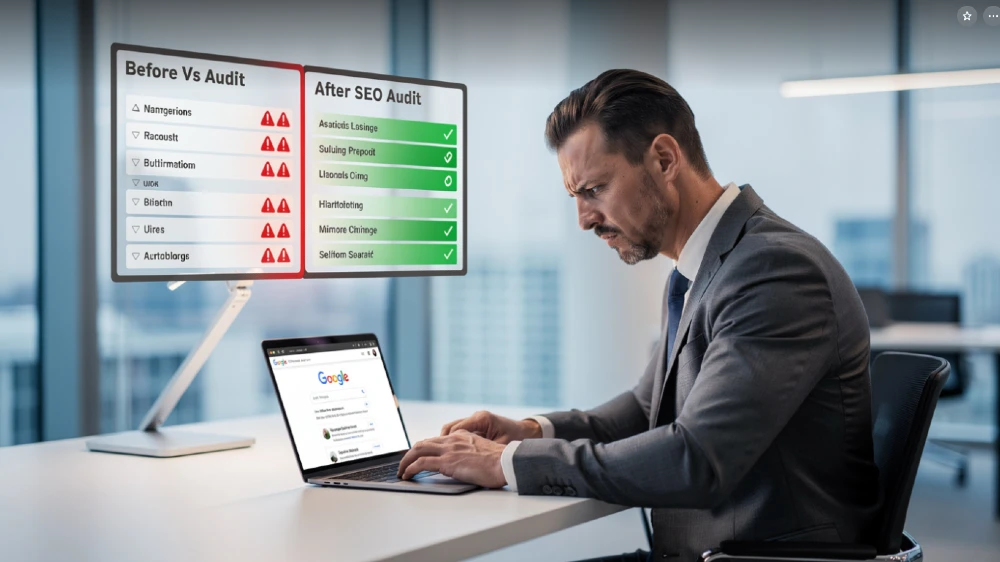
If your service business isn’t showing up on Google — not on page one, not in the map pack, not anywhere useful — something specific is broken. Not vague. Specific. And it’s almost always fixable.
This audit breaks it down exactly: what’s wrong, why it’s wrong, and what to do about it. No theory. No padding.
The #1 reason service businesses don’t rank: Google can’t figure out what you do, who you serve, or where you serve them — because your site doesn’t tell it clearly enough. Fix your on-page signals, your Google Business Profile, your technical foundation, and your content relevance. Do those four things right and rankings follow. Everything else is secondary.
1. Google Doesn’t Know What Your Business Actually Does
This is the most common problem, and it’s brutal because owners don’t see it. They think their site is clear. It’s not — at least not to Google.
The direct answer: If your homepage talks about “delivering exceptional results” and “passion for quality” but never clearly states what service you provide, to whom, and in which city — Google has nothing to rank you for.
Google reads your page like a document. It extracts entities: service type, location, audience, intent signals. If those aren’t explicit, you don’t exist for the searches that matter.
What to fix:
- Your H1 should include your core service + location. Example: “Commercial Plumbing Services in Austin, TX” — not “Welcome to Smith & Sons.”
- Your first paragraph should mention your primary service at least twice naturally.
- Your title tag must lead with the keyword, not your brand name. “SEO Services for Small Businesses | Miracle Concepts” beats “Miracle Concepts | Digital Agency.”
- Every service page needs its own URL, its own H1, its own content. One page listing 10 services is invisible for all 10 of them.
The fix isn’t keyword stuffing. It’s clarity. Write like you’re explaining to a new customer what you do, where, and for whom — and let that language live in your headings and opening copy.
2. Your Google Business Profile Is Either Missing or Half-Done
For service businesses especially, the Google Business Profile (GBP) is not optional. It drives map pack results. Those three local listings at the top of Google results? That’s GBP. And most service businesses either haven’t claimed theirs or haven’t optimized it past the basics.
What kills your GBP ranking:
- No service area set (or set too broad — “United States” means nothing)
- Primary category wrong or too generic
- No photos (businesses with photos get significantly more direction requests and clicks per Google’s own data)
- Zero reviews — or reviews with no responses
- Business description that’s vague marketing copy instead of keyword-relevant services
What actually works:
Set your primary category as specifically as possible. “SEO Agency” beats “Marketing Agency.” “Residential Electrician” beats “Contractor.” Add every secondary category that applies.
Write your GBP description with your actual services and city name included — not just once, but naturally throughout. Keep it under 750 characters because Google truncates beyond that.
Reviews with keywords in them help. Don’t ask customers to “leave a review” — ask them to “mention the specific service they used.” “They handled our complete bathroom renovation in Denver” is more valuable than “Great service, 5 stars.”
Respond to every review. Google sees engagement as a quality signal.
For a deeper breakdown of local vs. global strategy, this guide on local SEO vs. global SEO covers the distinction clearly.
3. Your Website Has Technical Problems That Block Rankings
Technical SEO sounds complicated. In practice, for most service businesses, it comes down to five things. Fixing these removes the ceiling on your rankings.
Core speed: Google’s Core Web Vitals are a real ranking factor. If your site takes more than 3 seconds to load on mobile, you’re losing rankings and customers simultaneously. Run your site through Google PageSpeed Insights right now. If your score is below 70 on mobile, that’s a problem worth fixing before anything else.
Common causes of slow speed: uncompressed images, cheap shared hosting, too many plugins (WordPress especially), no caching, no CDN.
Mobile usability: Over 60% of local service searches happen on phones. If your site isn’t responsive — if buttons are too small, text is too tiny, or the layout breaks on a small screen — Google demotes you. Check Google Search Console under “Mobile Usability” for specific errors.
Indexing issues: Sometimes the problem isn’t rankings — it’s that Google isn’t crawling your pages at all. Check Search Console > Coverage. If pages show as “Discovered but not indexed” or “Crawled but not indexed,” Google is finding them but choosing not to include them. This usually means thin content, duplicate content, or pages blocked by robots.txt accidentally.
HTTPS: Still seeing HTTP on any page? That’s a trust and ranking signal problem. All pages should be HTTPS. No exceptions.
Broken links and redirect chains: These dilute your authority and frustrate users. A free crawl with Screaming Frog (up to 500 URLs free) will surface immediately.
4. You’re Targeting the Wrong Keywords
Most service businesses either target keywords that are impossibly competitive or target keywords nobody searches for. Both are invisible in different ways.
The realistic keyword strategy for service businesses:
Don’t go after “marketing agency.” You won’t rank there in 12 months with a new or mid-authority site. Go after what you can actually win.
- Service + city + modifier: “email marketing for restaurants in Phoenix” instead of “email marketing”
- Problem-based searches: “why isn’t my website showing on Google” instead of “SEO services”
- Comparison and decision searches: “best web designers for small business vs freelancer”
These longer, more specific queries have lower competition and much higher commercial intent. Someone searching “web design agency Dallas” is closer to buying than someone searching “web design.”
Use Google Search Console to see what queries you’re already showing up for — even at positions 20–50. Those are your easiest wins. Add content that targets those exactly and you can move from position 30 to position 5 faster than trying to rank for something new.
For finding the right tools to research this properly, this breakdown of the top 10 SEO tools cuts through the noise quickly.
5. Your Service Pages Have Thin or Generic Content
Here’s the uncomfortable truth: most service business websites have the same five pages — Home, About, Services, Blog, Contact — and the service pages each have 200 words of vague marketing language.
Google values pages that thoroughly answer what a user is looking for. A 200-word service page doesn’t do that.
What a properly built service page needs:
- 800–1,500 words minimum for a competitive service
- Clear definition of the service at the top
- Who it’s for (specific audience, not everyone)
- What’s included (process, deliverables, timeline)
- Why it works (mechanism, not just claims)
- FAQ section addressing real objections — this directly feeds AI Overview citations
- Social proof: specific results, named clients where possible, or case study snippets
- Clear CTA that matches buyer intent (consultation, quote, audit — not just “contact us”)
Thin content doesn’t just fail to rank — it actively hurts your credibility pages that do rank. Google evaluates sites holistically. One authoritative page surrounded by ten thin pages still signals a low-quality site overall.
6. You Have Zero or Weak Backlink Profile
Backlinks are still a significant ranking factor. In 2026, it’s less about quantity and entirely about relevance and authority.
A service business in Phoenix with 20 backlinks from local news outlets, industry directories, and relevant partner sites will outrank a national competitor with 500 backlinks from irrelevant sources.
Realistic backlinks for service businesses:
- Local citations: Get listed in every relevant directory — Yelp, Better Business Bureau, industry-specific directories, local Chamber of Commerce. These are easy and genuinely help local rankings.
- Partner mentions: If you work with other businesses, ask for a mention on their website. A local accountant referring to your bookkeeping services with a link is gold.
- HARO/journalist outreach: Respond to journalist queries in your niche. Even one mention in a relevant publication moves the needle.
- Guest content: Write practical how-to content for industry publications your target clients read.
What doesn’t work and wastes time: buying links from link farms, submitting to hundreds of generic directories, or exchanging links with irrelevant sites. Google identifies and ignores these, and aggressive link schemes can trigger manual penalties.
For a practical breakdown of what actually builds authority, this guide on backlink building techniques is worth reading before you spend any money on link building.
7. Your Site Architecture Is Confusing Search Engines
If Google’s crawler gets lost on your site, your pages don’t rank. It’s that direct.
Common architecture problems:
- Services buried 3+ clicks from the homepage
- No internal linking between related pages
- Blog posts with no links to your service pages
- Duplicate content (same services described on multiple URLs)
- No XML sitemap submitted to Search Console
What to do:
Every service page should be reachable from your homepage in one click — either through the main navigation or a clearly linked “Services” section. Your most important pages should receive the most internal links from other pages on your site.
When you publish a blog post, link to your relevant service page from within it naturally. A post about “how to improve website speed” should link to your web development service page.
Submit your sitemap at Google Search Console. If you’re on WordPress, Yoast or Rank Math generate it automatically. Verify it’s updated and includes all your important pages.
A strong website structure doesn’t just help SEO — it helps conversion. Users who can find what they need quickly stay longer and contact you. This guide on building a professional business website covers the structural foundations in detail.
8. You’re Not Showing Up in AI Overviews and SGE Results
Google’s AI Overviews (formerly Search Generative Experience) now appear above traditional results for many queries. If you’re not being cited there, you’re missing the new top of the page.
What gets cited in AI Overviews:
- Clear, direct answers to specific questions
- FAQ-style content with structured questions and concise answers
- Pages with demonstrable expertise (detailed content, author info, real credentials)
- Schema markup — FAQ schema, LocalBusiness schema, Service schema
Practical implementation:
Add FAQ sections to every service page. Use actual questions your customers ask — “How long does SEO take to show results?” “What’s included in your web design package?” Answer each in 2–4 sentences, directly and completely.
Add LocalBusiness schema markup to your homepage and contact page. This tells Google your name, address, phone, hours, and service area in structured data it can pull directly into AI responses.
For a deeper look at how to position your content for AI search results, this SGE SEO strategy guide and this piece on Generative Engine Optimization break down the mechanics.
9. Your Conversion Path Kills Leads Before They Contact You
This isn’t purely an SEO issue — but it directly affects your SEO. If people land on your page and leave immediately (high bounce rate, low dwell time), Google interprets that as a signal that your page didn’t satisfy the search. Rankings drop.
Where service businesses lose visitors:
- No clear CTA above the fold
- CTA says “Contact Us” with no context (why? for what? how fast do you respond?)
- Phone number not clickable on mobile
- Contact form asks for too much information upfront
- No trust signals: no reviews, no credentials, no recognizable client logos, no clear location
What converts:
A specific CTA works better than a generic one. “Get Your Free SEO Audit” converts better than “Contact Us.” “Book a 20-Minute Strategy Call” converts better than “Schedule a Consultation.”
Put your phone number, a one-line value proposition, and a CTA button in the header — visible before any scrolling. On mobile, make the phone number a tap-to-call link.
Add 3–5 client reviews directly on your homepage and each service page. Real names, real results. Generic testimonials (“Great service!”) provide almost no conversion value.
10. You’re Not Publishing Content That Attracts Your Ideal Clients
Service businesses that rank consistently in 2026 publish content that answers the questions their customers are actually searching for — not generic industry news.
The content that works:
- “How much does [your service] cost in [your city]?” — Pricing transparency pages rank incredibly well and pre-qualify leads.
- “[Your service] vs. [alternative]” — Comparison content captures decision-stage buyers.
- “[Problem your service solves]: causes and fixes” — Pulls in awareness-stage searchers before they know what service they need.
- Case studies with specific numbers and named outcomes
What doesn’t work:
- “10 Reasons Why [Your Industry] Matters in 2026” — Generic, no search intent, no conversion value.
- Content that exists only to fill a blog — thin posts about industry trends nobody’s searching for.
- Repurposed press releases or news pieces with no original insight.
Every piece of content should target a specific search query, answer it completely, and contain a clear next step toward your services.
The Complete SEO Audit Checklist for Service Businesses
Run through this list. Be honest. Every “no” is a ranking opportunity:
On-Page Signals
- [ ] Homepage H1 includes primary service + location
- [ ] Title tags are keyword-first on all pages
- [ ] Each service has its own dedicated page
- [ ] Service pages are 800+ words with FAQ sections
- [ ] Internal links connect blog posts to service pages
Technical Foundation
- [ ] Site loads in under 3 seconds on mobile
- [ ] All pages are HTTPS
- [ ] No mobile usability errors in Search Console
- [ ] XML sitemap submitted and indexed
- [ ] No broken links or redirect chains
Local Presence
- [ ] Google Business Profile claimed and fully completed
- [ ] Primary GBP category is specific (not generic)
- [ ] 10+ Google reviews with keyword mentions
- [ ] All responses to reviews posted
- [ ] Business listed in top local and industry directories
Content Quality
- [ ] No thin pages under 400 words on important topics
- [ ] FAQ schema added to service pages
- [ ] LocalBusiness schema on homepage
- [ ] Pricing or comparison content published
- [ ] Content targets specific search queries, not just topics
Authority Signals
- [ ] Backlinks from at least 10 relevant local or industry sources
- [ ] Citations consistent across all directories (name, address, phone identical)
- [ ] At least one link from a high-authority relevant site
What to Prioritize First
If you’re going to fix one thing this week: fix your Google Business Profile and your homepage H1. These two changes affect local map pack rankings and organic rankings simultaneously, and they take less than an hour to implement correctly.
If your technical issues are severe (site loads in 8 seconds, no HTTPS, broken pages), fix those before anything else — content and links won’t help if Google can’t crawl your site properly.
After that, build out individual service pages with real depth. Then go after backlinks.
The sequence matters. Backlinks to a technically broken site with thin content is money wasted. Get the foundation right, then build on it.
For pricing context on what professional SEO work actually costs in 2026, this SEO pricing breakdown gives realistic numbers without the guesswork.
When to Hire Help vs. DIY
DIY SEO works for the basics — GBP optimization, meta tags, page speed fixes, content publishing. These require time and attention but not deep technical expertise.
Where it breaks down: technical audits, structured data implementation, link building outreach, and competitive analysis for saturated markets. These are time-intensive and require experience to execute correctly.
If your business generates enough revenue that ranking on page one would meaningfully change your pipeline, the ROI on professional SEO is usually fast. The math is simple: one additional client per month from organic search likely pays for a year of professional SEO services.
If you’re in a niche or location where the competition is fierce — legal, medical, financial, construction in large cities — attempting to DIY your way to page one against established competitors with professional SEO teams is unrealistic. Acknowledge that early and allocate accordingly.
Ready to find out exactly what’s holding your service business back? Book a free SEO audit consultation and get a specific, prioritized list of what to fix — not generic advice, but a real analysis of your actual site.
One More Thing Most Audits Miss: Brand Search Volume
Here’s something almost nobody talks about: Google uses branded search volume as a trust signal. If nobody is searching for your business name, that tells Google your brand has low real-world presence.
Building brand recognition — through consistent content, local PR, social presence, and word-of-mouth — creates search demand for your brand name directly. That in turn signals to Google that you’re a real, recognized entity. It’s a slower signal but a durable one.
This is why service businesses that invest in both SEO and brand building consistently outperform those chasing only keyword rankings.
Explore More Resources
If you want to go deeper on specific areas, these resources cover the next level:
- SEO for Interior Designers — service-specific ranking tactics
- Pinterest SEO — visual platforms for service businesses
- How to Cite a Website — for content credibility and E-E-A-T signals
- IT Staff Augmentation Services — if you need technical capacity without full-time hires
- MSP Growth and Online Optimization — for managed service providers specifically
At Miracle Concepts, we don’t just fix rankings — we build the entire digital foundation your service business needs to grow. Our SEO services target real traffic that converts. Our UX design turns visitors into leads. Our custom web design and development builds sites that load fast and rank. Need polished client-facing materials? Our document and deck formatting makes your proposals win. Running a managed service provider? Our MSP growth optimization services are built specifically for you. Explore all our services or contact us today to get started.