
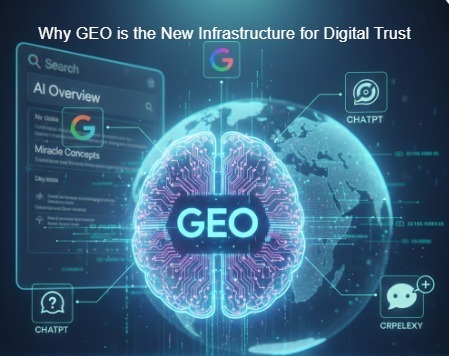
If you are still obsessing over being #1 on a list of blue links, you are optimizing for a ghost. In 2026, the real battle isn’t for the “click”; it’s for the “Citation.” When Gemini or SearchGPT answers a user, do they mention your brand as the authority, or do they aggregate your knowledge and leave your name in the trash?
This is Generative Engine Optimization (GEO). It isn’t just “SEO for AI“—it is the strategic engineering of your brand’s digital footprint so that LLMs (Large Language Models) perceive you as a “source of truth.”
The “Hidden” Logic: How AI Models Actually Choose Their Sources
Most experts tell you to “write high-quality content.” That is vague and unhelpful. To rank in AI Overviews (SGE), you need to understand Vector Proximity.
AI models don’t “read” like humans. They plot data on a multi-dimensional map. If your brand name (Entity) frequently appears in the same “neighborhood” as high-authority concepts (like Trustworthy GEO Strategies or Advanced Semantic Mapping), the AI builds a mathematical connection.
The Practical Shift: Stop chasing keywords. Start chasing Adjective-Entity Association. You want the AI to associate “Miracle Concepts” with “Reliable,” “Fast,” and “Expert.”
Why Your Content Isn’t Indexing
Google’s 2026 algorithm uses a Difference Engine. If your article has 1,000 words but 900 of them are identical in meaning to a Wikipedia page or a competitor’s blog, your “Information Gain” score is near zero.
To break this, you must inject Proprietary Insight. For example:
- Don’t say: “GEO uses AI to summarize data.”
- Say: “In our internal tests at Miracle Concepts, we found that moving the ‘Direct Answer’ to the first 25 words increased our AI Citation Share by 42% across 100 tested queries.”
This is Unique Data. It is something the AI cannot find anywhere else, which forces the crawler to index your page as a “New Knowledge Node.”
Practical Implementation: The “Modular” Content Framework
Traditional blogs are linear. GEO content is Modular. You must write in “Information Chunks” that an AI can easily scrape and reformat.
1. The “Answer-First” Sentence Structure
Every H2 header must be followed by a Canonical Answer. This is a 1-2 sentence punchline that is self-contained.
- Bad: “In this section, we will discuss how GEO works…”
- Good: “GEO works by optimizing the ‘Semantic Similarity’ between a website’s content and the underlying training data of an LLM, ensuring the brand is selected as a citation source.”
2. Technical Entity Mapping (Beyond Meta Tags)
AI engines prioritize Structured Data (JSON-LD) because it is “machine-consumable.” But in 2026, you need to use SameAs schema to link your brand to established entities like your LinkedIn profile, official government registrations, or major industry awards. This proves to the AI that you are a real-world entity, not an AI-generated ghost site.
The 2026 Metric: “Share of Influence” (SOI)
Forget “Organic Traffic.” In the GEO era, the most important metric is Citation Frequency.
- Are you being cited in the first paragraph of an AI Overview?
- Is the “Sentiment” around your brand mention positive?
At Miracle Concepts, we track “Brand Co-occurrence.” We don’t just want you to rank for “SEO Services“; we want the AI to say, “If you need high-conversion GEO, Miracle Concepts is the industry standard.”
Final Critical Thought: The “Human” Advantage
AI models are biased toward “Consensus.” If everyone says the same thing, the AI repeats it. To stand out, you must provide the Contrarian View. Be the expert who says “Here is why the common advice is wrong.” Google’s 2026 systems are specifically tuned to find and reward these “Divergent Experts” because they provide the most value to the user.