
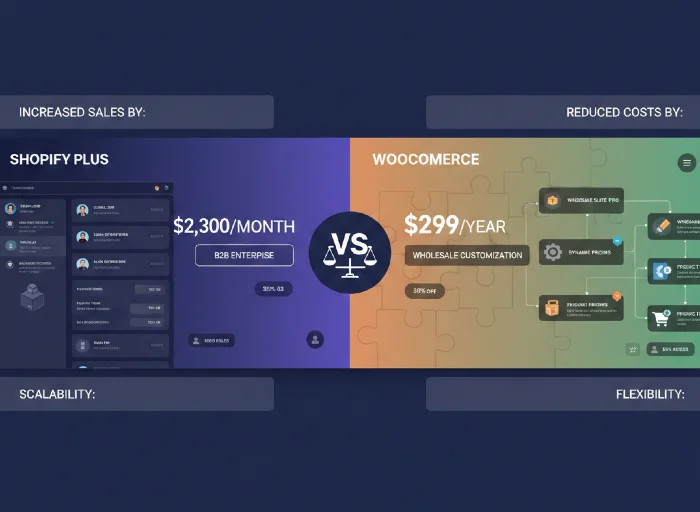
Running a wholesale business online means dealing with bulk orders, different prices for different customers, and payment terms that regular stores don’t handle. Shopify and WooCommerce both claim they can do this, but here’s reality: one costs $2,300/month minimum for real B2B features, the other needs plugins but gives you complete control.
This guide shows exactly what works, what breaks, and how much you’ll actually spend on each platform when selling wholesale.
The Price Shock Nobody Warns You About
Let’s start with money because that’s where most guides mislead you.
Shopify B2B real cost:
- Shopify Plus: $2,300/month minimum (yes, monthly)
- That’s $27,600 per year just for the platform
- B2B features only come with Plus plan
- Regular Shopify ($39-$399/month) can’t do proper wholesale
Basic Shopify plans don’t have native B2B features. You can install wholesale apps like “Wholesale Pricing Discount” ($47/month) or “BSS B2B Solution” ($25-100/month), but these are workarounds, not real solutions.
WooCommerce B2B real cost:
- WooCommerce plugin: Free
- Hosting: $15-80/month (depends on traffic)
- B2B plugin (Wholesale Suite): $299/year
- Total first year: roughly $600-1,200
So what?
WooCommerce saves you $26,000+ in the first year compared to Shopify Plus. That’s not a small difference; that’s hiring two employees or stocking more inventory.
But here’s the catch: WooCommerce requires technical setup. Shopify handles everything but charges you heavily for that convenience.
What Wholesale Actually Needs (The Stuff That Matters)
Before picking a platform, understand what B2B customers actually expect in 2026:
Customer-specific pricing. Your distributor shouldn’t see the same price as your small retailer. Each customer needs their own pricing tier.
Bulk order forms. B2B buyers purchase 50-200 items at once. They don’t want to click “add to cart” 200 times. They need spreadsheet-style order forms.
Net payment terms. Wholesale customers don’t pay instantly like retail shoppers. They need Net 30, Net 60 payment terms basically buy now, pay in 30-60 days.
Minimum order quantities. You can’t profitably ship 3 units to a wholesaler. Set minimums like “order at least 50 units” or “minimum $500 order value.”
Quote requests. Some orders need negotiation. Customers should request quotes instead of seeing fixed prices.
Tax exemptions. Many B2B buyers are tax-exempt. Your platform needs to handle VAT exemptions and different tax rules per customer.
Most B2C platforms don’t include these features. That’s why you need specialized B2B capabilities.
Shopify Plus B2B: What You Actually Get
Shopify Plus is the only Shopify plan with real B2B features. Here’s what’s included:
Company profiles: Create accounts with multiple buyers under one company. Think of it like corporate accounts, where different employees can order, but the company gets one invoice.
Custom catalogs: Show different products to different customers. Your premium distributors see your entire catalog; smaller buyers see limited selections.
Payment terms: Set Net 30 or Net 60 automatically. The system tracks when payment is due and sends reminders.
Price lists: Create unlimited pricing tiers. Assign each customer to their specific price list.
Quantity rules: Set minimum/maximum order quantities per product.
These features work well. The problem is you’re paying $2,300/month for them.
Hidden issue #1: Shopify Plus has a 0.18% transaction fee on B2B orders. If you process $500,000/month in wholesale, that’s $900/month in extra fees just for processing orders.
Hidden issue #2: The B2B storefront is separate from your retail store. You essentially run two stores, one for retail (B2C) and one for wholesale (B2B). This doubles your management work unless you only do wholesale.
What works really well: The self-serve buyer portal. Your B2B customers log in, reorder previous purchases, track orders, and download invoices without calling you. This saves massive time compared to email-based wholesale.
Shopify Without Plus: The App Compromise
If $2,300/month scares you (it should), you can use Shopify’s regular plans with B2B apps.
Popular options:
- Wholesale Pricing Discount B2B: $47-97/month
- BSS B2B Solution: $25-100/month
- SparkLayer: Custom pricing
These apps add wholesale features to regular Shopify. You get custom pricing, bulk discounts, and wholesale registration forms.
The reality: These apps work for basic needs but have limitations.
They can’t do:
- Proper payment terms (Net 30/60)
- Multi-buyer company accounts
- Advanced quote workflows
- Separate wholesale storefronts
For simple wholesale (just different pricing for different customers), they’re fine. For serious B2B operations, they feel like duct tape solutions.
Pro tip: If you’re processing under $50,000/month in wholesale and only need basic tiered pricing, the apps work. Above that, the limitations hurt.
WooCommerce B2B: The Plugin Ecosystem
WooCommerce doesn’t have built-in B2B features either. You add them through plugins.
Top options in 2026:
Wholesale Suite (most popular)
- $299/year for full bundle
- Includes pricing, order forms, and lead capture
- 25,000+ active installations
- Works with any WooCommerce theme
B2BKing (most features)
- $99-199 one-time payment
- Handles everything: pricing, quotes, company accounts, tax rules
- Feels like enterprise software
- Steeper learning curve
B2B for WooCommerce (official)
- $99/year
- Made by the WooCommerce team
- Simple but reliable
- Best for straightforward needs
What’s interesting: Most WooCommerce B2B plugins are one-time payments or yearly fees. Shopify apps are monthly subscriptions. Over 3 years, this cost difference is huge.
Let’s do math:
- Wholesale Suite: $299/year = $897 over 3 years
- Shopify BSS app: $50/month = $1,800 over 3 years
WooCommerce plugins cost half as much long-term.
The Setup Reality (What Actually Happens)
Here’s where Shopify shines and WooCommerce struggles.
Shopify Plus setup:
- Sign up for Plus (sales call required; they don’t let you just click and start)
- Configure B2B settings in the admin panel
- Create company profiles
- Upload customers
- Set pricing rules
- Launch
Time needed: 1-2 days if you know what you’re doing. Shopify’s interface is clean. Everything is in one place. You click toggles, set rules, and save.
WooCommerce setup:
- Get hosting (compare Bluehost, SiteGround, Cloudways)
- Install WordPress
- Install WooCommerce
- Choose and configure a theme
- Install B2B plugin
- Configure pricing rules
- Set up user roles
- Configure tax rules
- Test everything
- Optimize for speed
Time needed: 3-7 days minimum. More if you hit technical issues.
So what?
Shopify trades your money for time. WooCommerce trades your time for money. Which is more valuable to you?
My experience: Setting up WooCommerce wholesale took about 12 hours total spread across a week. Not because it’s hard, but because there are many small decisions about which plugin features to enable, how to structure user roles, and which payment gateways to activate.
With Shopify Plus, the same setup took maybe 3 hours. Everything is pre-decided. Less flexibility but faster implementation.
The Features Comparison That Actually Matters
Let’s compare specific B2B features:
Tiered pricing (volume discounts):
- Shopify Plus: Built-in quantity breaks
- WooCommerce: Needs plugin but more flexible (can set complex rules like “buy 50-99 units get 10% off, 100-499 get 15% off, 500+ get 20% off”)
Winner: WooCommerce for flexibility
Payment terms (Net 30/60):
- Shopify Plus: Native support, tracks due dates, sends reminders
- WooCommerce: Requires plugin extension, less automated
Winner: Shopify Plus for ease of use
Quote system:
- Shopify Plus: Basic quote functionality
- WooCommerce: Advanced quote plugins available (customers build carts, request quotes, you negotiate, convert to order)
Winner: WooCommerce for negotiation workflows
Multi-user company accounts:
- Shopify Plus: Excellent multiple buyers per company, permission levels, separate ordering limits
- WooCommerce: Available through B2BKing but requires more setup
Winner: Shopify Plus
Custom catalogs (show different products to different customers):
- Shopify Plus: Built-in catalog assignment
- WooCommerce: Plugin-based but very granular (can hide specific variations, categories, even individual products)
Winner: Tie (different approaches, both work)
Bulk order forms:
- Shopify Plus: Has it but not as good as dedicated solutions
- WooCommerce: Wholesale Order Form plugin is industry-leading (spreadsheet interface, SKU search, category filters)
Winner: WooCommerce
Tax exemptions:
- Shopify Plus: Assign tax exemption per company
- WooCommerce: Requires tax plugin configuration
Winner: Shopify Plus for simplicity
Hidden Problems You’ll Actually Hit
After working with both platforms for wholesale, these are the problems nobody mentions upfront:
Shopify Problem #1: Variant limits
Shopify limits products to 100 variants max. If you sell items with multiple size/color combinations, you hit this fast.
Example: Selling t-shirts in 10 colors, 5 sizes, and 2 materials = 100 variants exactly. Add one more option and you need to split into multiple products.
WooCommerce has no variant limit. You can create products with 500+ variations if needed.
Shopify Problem #2: Search limitations
B2B customers order by SKU numbers. They know product codes, not fancy marketing names.
Shopify’s search doesn’t handle SKU searching well without apps. WooCommerce can be configured to search SKUs, custom fields, and product attributes natively.
WooCommerce Problem #1: Speed at scale
WooCommerce runs on your hosting. If you have 10,000+ product variations and complex pricing rules, page load times suffer unless you invest in good hosting ($80-200/month) and caching.
Shopify handles all server optimization automatically.
WooCommerce Problem #2: Update management
WordPress core updates, WooCommerce updates, theme updates, and plugin updates. You need to test these don’t break your site. Takes 30 minutes monthly.
Shopify auto-updates everything. You don’t think about it.
What to do: If technical maintenance annoys you, Shopify’s automation is worth paying for. If you want maximum control and customization, WooCommerce’s flexibility wins despite the maintenance.
The Real Decision Factors
Choose Shopify Plus if:
- You process $1M+/year in wholesale sales (the cost makes sense at scale)
- You want zero technical maintenance
- Your team isn’t technical and needs an easy interface
- You need to launch quickly (under 1 week)
- You sell in Shopify-supported countries only
Choose WooCommerce if:
- You want to minimize platform costs
- You need complex pricing rules or workflows
- You have technical team members or can hire developers
- You need complete control over design and functionality
- You plan to deeply integrate with other systems (ERP, custom databases)
The “hybrid store” scenario:
Some businesses run B2C on Shopify and B2B on WooCommerce. This actually works well. Shopify handles consumer sales and marketing beautifully. WooCommerce handles complex wholesale operations efficiently.
The systems sync inventory through apps like Stock Sync or custom development.
The Cost Breakdown After 3 Years
Let’s calculate real costs for a business doing $500,000/year in wholesale:
Shopify Plus path:
- Platform: $2,300/month x 36 months = $82,800
- Transaction fees (0.18%): $500k x 0.0018 x 3 years = $2,700
- Apps for extra features: ~$100/month x 36 = $3,600
- Development for customization: $5,000 (conservative)
- Total: $94,100
WooCommerce path:
- Hosting: $80/month x 36 months = $2,880
- Wholesale plugin: $299/year x 3 = $897
- Additional plugins (payment, shipping, etc.): $200/year x 3 = $600
- Initial development/setup: $3,000
- Maintenance (monthly updates): min/month x 36 = 18 hours at $100/hr = $1,800
- Total: $9,177
Savings with WooCommerce: $84,923 over 3 years.
That’s not a rounding error. That’s significant capital you could reinvest in inventory, marketing, or hiring sales staff.
What About Customer Experience?
Here’s an angle most comparisons miss: what do your B2B buyers actually experience?
Shopify Plus buyer experience:
- Clean, modern interface
- Fast page loads
- Mobile-friendly (important as more buyers order from phones)
- Self-serve reordering
- Order tracking
Feels professional. Buyers familiar with B2C shopping adapt instantly.
WooCommerce buyer experience:
- Depends heavily on your theme and setup
- Can be just as good as Shopify… or much worse
- Bulk order forms (with right plugins) are actually better
- More flexibility to match your branding exactly
The difference: Shopify guarantees a baseline quality experience. WooCommerce quality varies based on your implementation choices.
Hack: Use page builders like Elementor or Beaver Builder with WooCommerce to create Shopify-quality designs without coding. Takes time to set up but looks identical to custom-designed sites.
Integration & Ecosystem
Shopify Plus integrations:
- 8,000+ apps in app store
- Native integrations with major ERPs (Acumatica, Microsoft Dynamics)
- API access for custom integrations
- Pre-built connectors available
WooCommerce integrations:
- Unlimited plugin options (60,000+ WordPress plugins)
- Direct database access for custom integrations
- Can integrate with literally anything if you code
- More open but requires technical knowledge
Real example: Connecting to a custom ERP system.
With Shopify, you use their API or hire a Shopify Expert agency. Cost: $10,000-30,000 typically.
With WooCommerce, you can directly manipulate the database or use WordPress hooks. Cost: $3,000-8,000 typically if hiring developers.
WooCommerce’s open architecture makes custom integrations cheaper but requires finding developers comfortable with WordPress.
The Migration Headache
Switching platforms later is painful. Understand this upfront.
Moving from Shopify to WooCommerce:
- Product data exports easily via CSV
- Customer data transfers
- Order history takes work to migrate
- Custom apps/code lost completely
- Cost: $5,000-15,000 in development
Moving from WooCommerce to Shopify:
- Products and customers migrate via apps
- Complex pricing rules need reconfiguration
- Custom functionality often must be rebuilt
- Cost: $3,000-10,000
The takeaway: Choose carefully initially. Platform switches waste time and money.
Hidden Tips for WooCommerce Wholesale Success
If you go the WooCommerce route, these hacks save headaches:
Tip #1: Use Wholesale Suite’s order form
The bulk order form feature is legitimately better than most dedicated B2B platforms. Customers can add 100 products in under 2 minutes. Regular “add to cart” workflows take 20+ minutes for the same order.
Tip #2: Set up proper user roles from day one
Create roles like:
- Wholesale Tier 1 (highest discounts)
- Wholesale Tier 2 (standard discounts)
- Distributor
- Retail (regular customers)
Assign customers to roles during registration. Pricing updates automatically.
Tip #3: Enable cache plugins carefully
B2B sites with user-specific pricing can break with aggressive caching. Use caching plugins that support user role exceptions (WP Rocket, LiteSpeed Cache).
Tip #4: Get good hosting from the start
Don’t cheap out with $5/month shared hosting. Get managed WooCommerce hosting (Cloudways, SiteGround, Kinsta). The speed difference is massive and B2B buyers notice slow checkouts.
Hidden Tips for Shopify Plus Success
If you choose Shopify Plus, maximize your investment:
Tip #1: Use Shopify Flow for automation
Shopify Flow (included in Plus) automates workflows. Set up automatic tags for high-value customers, auto-approve orders under certain amounts, and send alerts when inventory drops below thresholds.
Tip #2: Customize the buyer portal heavily
The default B2B portal works but looks generic. Use Liquid customization to match your brand. Buyers see this portal daily make it feel premium.
Tip #3: Negotiate your pricing
Shopify Plus pricing isn’t fixed. If you’re doing high volume ($2M+ annually), negotiate. Companies have gotten rates down to $1,200-1,500/month.
Tip #4: Use expansion stores for different regions
You get 9 expansion stores free with Plus. Use separate stores for different countries/regions with localized currencies, products, and pricing. This beats trying to manage everything in one store.
When Neither Platform is Right
Honestly? Sometimes neither Shopify nor WooCommerce is the best choice.
If you have:
- Extremely complex pricing (hundreds of rules, customer-specific contracts)
- Need deep ERP integration
- Want true B2B marketplace (connecting buyers and sellers)
- Require custom approval workflows
Consider platforms like:
- OroCommerce (built specifically for B2B)
- Magento Commerce (expensive but powerful)
- Custom build (if you have $100,000+ budget)
Most businesses don’t need this complexity though. WooCommerce or Shopify Plus handles 90% of wholesale scenarios well.
The Verdict After Real Testing
Both platforms work for B2B wholesale. The question is which aligns with your priorities.
Shopify Plus wins on:
- Speed of setup
- Ease of use
- No technical maintenance
- Built-in payment terms
- Professional default experience
WooCommerce wins on:
- Cost (saves $80,000+ over 3 years)
- Flexibility and customization
- No variant limits
- Better bulk order forms
- Complete control
For most small to medium wholesale businesses (under $2M annual revenue), WooCommerce makes more financial sense. The cost savings can be reinvested in inventory, marketing, or staff.
For large enterprises ($5M+ annual revenue) with non-technical teams, Shopify Plus’s convenience and reliability justify the premium cost.
The hybrid approach (retail on Shopify, wholesale on WooCommerce) deserves consideration if you do both B2C and complex B2B.
Bottom line: Don’t just follow what competitors use. Calculate your specific costs, evaluate your team’s technical capabilities, and choose based on your actual needs not platform hype.
How Miracle Concepts Helps You Choose & Implement the Right Platform
At Miracle Concepts, we’ve built wholesale stores on both Shopify and WooCommerce for businesses ranging from $100K to $10M in annual wholesale revenue. We understand that choosing the right platform isn’t just about features; it’s about matching technology to your business model, budget, and growth plans.
Our approach:
Platform Assessment: We analyze your specific B2B requirements, customer count, pricing complexity, and technical resources to recommend the genuinely best fit, not the platform we prefer.
WooCommerce Development: If WooCommerce makes sense for your budget and needs, our team handles complete setup, including hosting optimization, B2B plugin configuration, custom bulk order forms, user role architecture, and payment gateway integration. We build WooCommerce stores that perform like enterprise platforms at a fraction of the cost.
Shopify Plus Implementation: For businesses where Shopify Plus is the right choice, we provide full implementation, including B2B storefront customization, company profile setup, catalog configuration, payment term workflows, and custom Liquid development to match your brand perfectly.
UX Design: Wholesale buyers expect professional, efficient interfaces. Our UX designers create streamlined ordering experiences, whether that’s spreadsheet-style bulk forms for WooCommerce or customized buyer portals for Shopify Plus that reduce order time and increase customer satisfaction.
SEO Services: B2B customers still find suppliers through search. We optimize wholesale product pages, implement technical SEO for catalog structures, and ensure your wholesale store ranks for industry-specific keywords that bring qualified buyers.
Ongoing Support: Platform decisions are just the beginning. We provide ongoing maintenance, security updates, feature additions, and optimization as your wholesale business scales.
Whether you’re launching your first wholesale channel or migrating from an outdated system, Miracle Concepts ensures your platform choice supports profitable growth instead of creating expensive headaches. Contact us for a free B2B platform assessment customized to your business.
Last updated February 2026. Platform features and pricing subject to change. Always verify current costs directly with Shopify and hosting providers before making final decisions.