
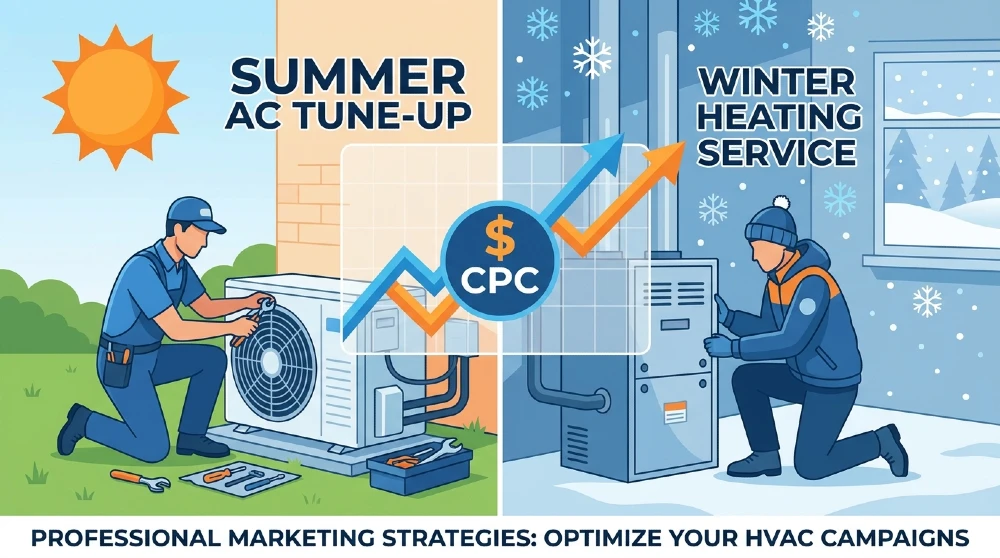
If you run an HVAC business, seasonal HVAC keywords are the reason your Google Ads bill spikes every June and every December. These are the search terms people type in right before their AC breaks in a heatwave or their furnace dies in a cold snap — and because demand is urgent, advertisers bid aggressively, pushing CPC (cost-per-click) past $30, sometimes past $70, for a single click.
The good news: you don’t have to pay for all of that traffic. If you rank organically for these same terms through SEO, you capture the same buyer intent without paying per click. This guide breaks down exactly which seasonal HVAC keywords carry the highest CPC, why they cost so much, and how to rank for them using both content and technical SEO.
What Are Seasonal Keywords in HVAC SEO?
Seasonal keywords are search terms whose volume rises and falls with the weather. In HVAC, this means cooling-related searches peak in summer and heating-related searches peak in winter, while maintenance-related searches peak in spring and fall.
This matters for SEO because Google reads seasonal search patterns as a signal of intent. A search for “AC not cooling” in July is almost always transactional — the user wants a technician today, not a blog post. Google’s ranking systems use query intent classification to match these searches with pages that show clear signs of local service availability: phone numbers, service area pages, and reviews.
If your website doesn’t have a dedicated page targeting that seasonal term before the season hits, you’re leaving high-intent traffic — and high-CPC traffic — on the table.
Why Seasonal HVAC Keywords Have High CPC
CPC in the HVAC industry is high for one simple reason: the customer lifetime value is high, and the purchase decision is fast. When someone’s AC stops working in 100-degree heat, they call the first company that answers — not the fifth.
Advertisers know this, so they bid up the price of clicks. Combine that with:
- Low search volume relative to demand spikes (short seasonal windows)
- High commercial intent (repair and replacement, not research)
- Local competition in dense metro areas
…and you get some of the highest CPC in local services SEO, right alongside legal and medical keywords.
Example CPC Ranges by Season
| Keyword Type | Example Keyword | Typical CPC Range | Peak Season |
|---|---|---|---|
| Emergency repair | “AC repair near me” | $25–$65 | June–August |
| Installation | “AC installation cost” | $20–$45 | Spring, early summer |
| Emergency heating | “furnace not working” | $20–$55 | December–February |
| Replacement | “furnace replacement near me” | $25–$50 | Fall, winter |
| Maintenance | “HVAC tune up” | $8–$20 | Spring, fall |
These numbers vary by metro area and competition level, but the pattern is consistent across the U.S.: emergency and replacement terms cost the most because they convert the fastest.
Summer Seasonal HVAC Keywords
Summer keywords focus almost entirely on cooling failures and installations. These are the highest-CPC months of the year for most HVAC companies.
High-value summer keywords include:
- AC repair near me
- Emergency AC repair
- AC not cooling
- Central air installation cost
- AC unit replacement
- Same day AC repair
These are transactional queries. Users searching them expect to see local service pages, not general blog content. Your service pages should load fast, list a phone number above the fold, and clearly state service areas — all factors tied to local search ranking signals like proximity, prominence, and relevance.
If you haven’t optimized your website structure for this kind of local intent, our professional business website guide covers the foundational layout choices that help these pages convert.
Winter Seasonal HVAC Keywords
Winter searches mirror summer, but for heating systems. No-heat emergencies are some of the most urgent searches in the entire home services category — a broken furnace in freezing weather is a same-day decision for most homeowners.
High-CPC winter keywords include:
- Furnace repair near me
- No heat emergency
- Furnace not turning on
- Heating system replacement
- Emergency heating repair
- Furnace installation cost
Because these searches spike suddenly during cold snaps, ranking organically before the season starts is far more cost-effective than trying to outbid competitors on paid ads during a demand surge.
Shoulder Season Keywords: Spring and Fall
Spring and fall keywords have lower CPC but still matter, because this is when smart HVAC companies lock in recurring revenue through maintenance contracts.
Common shoulder-season keywords:
- HVAC tune up
- AC maintenance checklist
- Furnace inspection cost
- HVAC maintenance plan
- Spring AC checkup
These terms have lower commercial urgency but higher long-term value since maintenance customers often become repeat customers. Content built around these keywords works well as evergreen content that supports your site’s overall topical authority in HVAC SEO.
How to Build a Seasonal HVAC Keyword Calendar
A seasonal keyword calendar prevents you from scrambling every time weather shifts. It also tells Google, months in advance, that your site is a consistent authority on both heating and cooling — not just whichever season is currently trending.
A simple structure:
- 60–90 days before peak season — publish or refresh service pages targeting that season’s keywords
- 30 days before peak season — build internal links from blog content to those service pages
- During peak season — monitor rankings and adjust based on real click data
- After peak season — update the page with fresh reviews, pricing, and FAQs for next year
This cycle is why content freshness signals matter so much in local service SEO — Google favors pages that show ongoing relevance, not pages published once and forgotten.
Combining SEO and PPC for Seasonal HVAC Campaigns
Given how high seasonal HVAC CPC gets, the smartest approach isn’t choosing SEO or PPC — it’s using both strategically.
- Use PPC for the first 60–90 days of a new service page while it builds organic rank
- Shift PPC budget down as organic rankings climb for the same seasonal HVAC keywords
- Reinvest saved ad spend into content and technical SEO improvements like page speed and schema markup
This hybrid model is exactly why understanding search engine results page (SERP) behavior for seasonal terms matters — you’re not choosing one channel permanently, you’re managing channel mix based on where you rank organically.
Local SEO Signals That Affect Seasonal Keyword Rankings
Seasonal HVAC keywords are almost always local intent searches, meaning your Google Business Profile and local citations directly affect how well you rank.
Key local ranking factors:
- Consistent NAP (name, address, phone) across directories
- Service area pages for each city or region you cover
- Reviews mentioning seasonal services (e.g., “fixed my AC same day”)
- Local schema markup on service pages
For a deeper breakdown of how local SEO differs from broader national SEO strategy, our local SEO vs global SEO guide explains how to structure your Google Business Profile for maximum visibility.
Turning Seasonal Keywords Into Landing Pages, Not Just Blog Posts
One mistake HVAC companies make is targeting high-CPC seasonal keywords only with blog posts. Blog content is good for education, but it rarely ranks well for transactional terms like “AC repair near me” because Google interprets that query as wanting a service page, not an article.
Instead:
- Build a dedicated landing page per service, per season (AC repair, furnace repair, installation, maintenance)
- Keep blog content focused on informational keywords (“how often should I service my AC”)
- Link blog posts to service pages using clear, descriptive anchor text
This structure improves topical clustering, which helps Google understand your site’s full range of HVAC expertise rather than treating each page in isolation.
Technical SEO Checklist for Seasonal HVAC Pages
Technical factors matter more for seasonal keywords because competition is fierce and small ranking gaps translate to real revenue loss.
- Page speed: Under 2.5 seconds load time on mobile
- Schema markup: LocalBusiness and Service schema on every service page
- Mobile-first design: Most emergency HVAC searches happen on phones
- Click-to-call buttons: Reduce friction for urgent searches
- Internal linking: Connect seasonal pages to your homepage and core service hub
If your site’s technical foundation isn’t solid, even the best content targeting high-CPC seasonal keywords won’t rank. A full 2026 SEO pricing breakdown can help you understand what technical work typically costs to fix.
AI Overviews and Seasonal HVAC Searches
Google’s AI Overviews now answer many informational HVAC queries directly in the search results, before organic listings appear. This changes how you should structure content for generative engine optimization (GEO).
To be cited in AI Overviews:
- Answer the core question in the first 1–2 sentences under each heading
- Use clear, factual statements rather than vague marketing language
- Structure content with proper headings so AI systems can extract clean answers
Our SGE and AI search strategy guide and generative engine optimization guide go deeper into formatting content specifically for AI-driven search results, which increasingly influence which HVAC companies get seen first — even before someone clicks a paid ad.
Tracking Seasonal Keyword Performance
You can’t manage what you don’t measure. Track these metrics per keyword, per season:
- Organic ranking position (weekly during peak season)
- Click-through rate (CTR) from search
- Conversion rate from organic vs. paid traffic
- Cost saved from reduced ad spend as organic rank improves
Our top SEO tools guide lists tools that track local rank fluctuations, which is critical since HVAC rankings can shift daily during peak demand periods.
Building Authority With Backlinks for HVAC Seasonal Pages
Backlinks remain one of the strongest ranking factors, especially for competitive, high-CPC local service keywords. Local directories, home improvement publications, and community sponsorships all provide relevant, topically-aligned backlink opportunities.
Our backlink building techniques guide covers ethical, sustainable link-building methods that work well for local service businesses like HVAC companies.
FAQs About Seasonal HVAC Keywords and CPC
Why is HVAC CPC so much higher in summer and winter? Demand spikes sharply during extreme weather, and customers convert fast, so advertisers bid more aggressively during these windows.
Should I pause SEO during off-peak seasons? No. Off-peak months are when you should be building and refreshing pages for the next peak season — waiting until demand spikes means you’re competing from behind.
Do seasonal keywords need separate pages for each city? Yes, if you serve multiple cities or regions. Separate, localized pages perform significantly better than one generic service page.
Seasonal HVAC keywords carry high CPC because they represent urgent, high-value customers — and that’s exactly why ranking organically for them is worth the investment. A well-structured, technically sound, locally optimized website captures this demand year-round without depending entirely on paid ads.
If you’re ready to build a seasonal SEO strategy for your HVAC business, you can book a consultation or explore our full range of SEO services and service offerings.