
Most IT founders treat MSP SEO and MSSP SEO as the exact same job. They assume that adding words like “security” to an existing IT website will bring in high-paying cybersecurity retainers. That assumption is why many campaigns fail.
Managed Service Providers (MSPs) and Managed Security Service Providers (MSSPs) sell completely different outcomes to different buyers. Because the buyers think differently, their search habits do not match. If you market a security firm using standard IT tactics, your search engine rankings will attract the wrong visitors and generate zero qualified pipeline.
This guide breaks down how both search strategies work, why their parameters differ, and how to build an organic engine that actually signs contracts.
What Is the Core Difference Between MSP SEO and MSSP SEO?
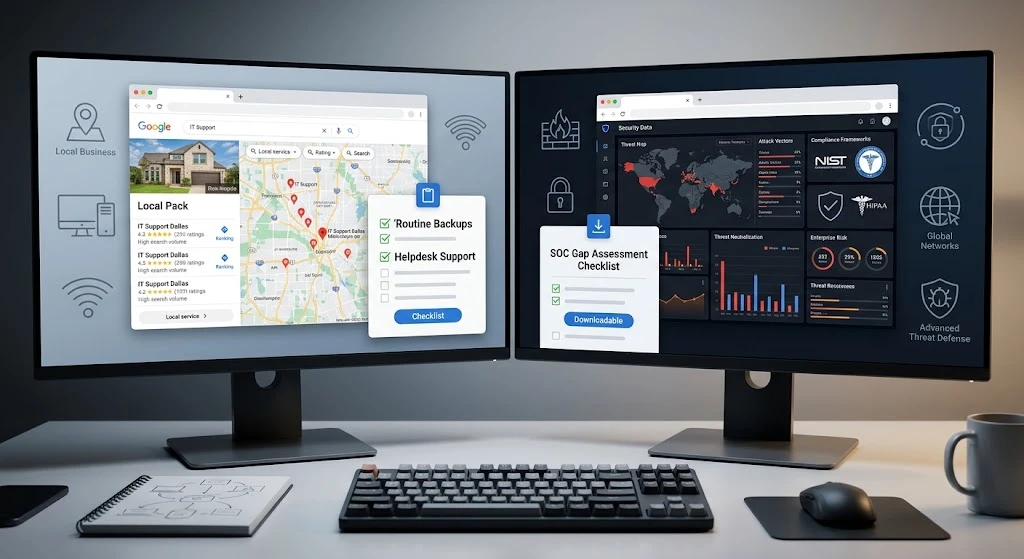
The core difference comes down to physical location versus risk level. MSP SEO targets local operational problems, while MSSP SEO targets national enterprise risk and compliance requirements.
An MSP sells operational uptime. Their prospective client is an office that needs working computers, printer connections, cloud backups, and responsive helpdesk engineers. The search queries for MSPs are almost always tied to immediate proximity. The buyer wants an IT team nearby who can send a technician to their building if the network goes down. Because of this, standard campaigns rely heavily on specialized SEO services designed around local visibility, city landing pages, and Google Business Profile optimization.
An MSSP sells risk reduction, threat containment, and regulatory compliance. An enterprise security buyer does not care whether your Security Operations Center (SOC) is five miles away or across the country. They care whether you can monitor their endpoints, stop ransomware attacks, and satisfy strict federal compliance audits.
Because of this difference:
- MSP search traffic is high-volume, highly localized, and transactional.
- MSSP search traffic is low-volume, location-independent, and research-heavy.
When you run organic search campaigns for these two models, you cannot use the same keyword lists or page layouts. The searcher’s mindset is fundamentally different from the first query they type.
Who Searches for What? Decision-Maker Intent Compared
To rank on search engines, you have to write for the specific person typing into the search box. The people hiring an MSP are rarely the same people hiring an MSSP.
The MSP Buyer: Operations-Focused Generalists
The person looking for an MSP is usually an office manager, a chief operating officer, an operations director, or a small business owner. In many cases, they have limited technical knowledge. They do not search for complex network protocols. Instead, they search for solutions to business headaches:
- “IT support company near me”
- “Outsourced helpdesk services for small law firms”
- “Office 365 migration services”
- “Network setup for new clinic”
Their search intent is practical. They want reliable support, fast response times, and predictable monthly pricing. They judge a website based on simple explanations, client reviews, and local credibility.
The MSSP Buyer: Security and Compliance Officers
The person looking for an MSSP is typically a Chief Information Security Officer (CISO), a Vice President of IT, an IT Director, or a Chief Compliance Officer. These individuals possess deep technical expertise. They do not search for “computer support.” They search for precise capabilities and compliance frameworks:
- “SOC-as-a-service pricing breakdown”
- “Managed detection and response providers for financial institutions”
- “NIST 800-171 gap assessment cost”
- “SIEM deployment and 24/7 log monitoring”
These buyers are evaluating liability and competence. If your page reads like a generic sales pitch, they will hit the back button immediately. They expect detailed technical specs, evidence of active threat monitoring, and proof that your team understands the regulatory pressures of their industry.
Which Search Parameters Actually Separate the Two Strategies?
Four major search parameters separate an MSP organic campaign from an MSSP organic campaign:
Geographic Targeting
MSP SEO relies on geographic radius. You target specific cities, metro areas, and adjacent counties. If an MSP operates out of Chicago, they build pages targeting Chicago and nearby suburbs. MSSP SEO operates nationwide or globally. A company in New York will gladly hire a security provider in Texas if that provider specializes in their specific compliance framework.
Search Volume Versus Deal Value
MSP keywords typically carry moderate to high monthly search volumes. Hundreds of people in any major metro area search for IT support each month, and individual contracts usually range from $1,500 to $6,000 per month.
MSSP keywords have much lower search volume. A term like “managed MDR for defense contractors” might only receive 20 to 50 searches per month across the entire country. However, a single closed deal can easily exceed $80,000 to $250,000 in annual recurring revenue. Ranking number one for low-volume MSSP terms drives massive business value because each visitor represents enterprise-level budget.
Sales Cycle Length
An MSP prospect often searches, books a discovery call, and signs a service agreement within 30 to 45 days. They have a broken system or an expiring contract that needs a quick replacement.
An MSSP prospect is making a significant enterprise commitment. Their buying process involves internal security reviews, legal evaluations, board approvals, and technical proof-of-concept tests. Their research journey can take 6 to 12 months. Your search content must support this long research path by providing downloadable compliance checklists, deep architectural comparisons, and buyer guides.
Search Intent Categories
MSP search queries are mostly transactional and commercial. The searcher wants to hire a company soon. MSSP search queries are heavily informational during the early and middle stages of the buying cycle. Security buyers want to know how a specific threat is handled or how two technologies compare before they ever submit their email address on a contact form.
When Should an IT Business Use MSP SEO vs MSSP SEO?
Choosing the wrong strategy wastes your budget and sends unqualified traffic to your sales team. Here is how to determine which framework fits your business model:
When to Use MSP SEO
Run an MSP search campaign if your core revenue comes from:
- Day-to-day desktop and server support
- Onsite network installations and cable routing
- Cloud backups, email administration, and VoIP setups
- Routine software licensing and patch management
- General IT consulting for local small and mid-sized businesses
If your field engineers need to drive to customer offices regularly, your organic focus must remain on local map rankings, localized service pages, and geographic relevance.
When to Use MSSP SEO
Shift your investment into an MSSP search campaign if your primary offerings include:
- A dedicated 24/7 Security Operations Center (SOC)
- Managed Detection and Response (MDR) or Extended Detection and Response (XDR)
- Continuous vulnerability scanning and penetration testing
- Specialized regulatory compliance support (such as CMMC, HIPAA, PCI-DSS, or ISO 27001)
- Incident response retainers and digital forensics
If your value proposition centers on protecting critical infrastructure and preventing data breaches, a local IT SEO strategy will not produce enterprise buyers. You need an authoritative, topic-driven framework that proves your defensive capabilities.
Which Types of Businesses Rely on Each Service?
The industries that purchase traditional IT support differ significantly from those that invest in managed security retainers. Understanding this helps you tailor your keyword targeting to the right end market.
Typical MSP Clients
Standard MSPs serve broad local business communities where operations depend on basic digital reliability:
- Professional services such as local legal practices, accounting offices, and real estate agencies
- Regional construction, contracting, and architecture firms
- Local retail groups, distribution centers, and light manufacturers
- Private practices, dental groups, and regional family clinics
These organizations need their technology to function smoothly every business day. They want someone to call when an email server fails, a computer crashes, or an employee needs onboarding.
Typical MSSP Clients
MSSPs serve organizations with valuable data, strict legal obligations, or high vulnerability to extortion:
- FinTech platforms, regional banks, and credit unions
- Large healthcare networks, hospital systems, and medical device companies
- Defense industrial base contractors, aerospace suppliers, and government vendors
- SaaS companies and software enterprises holding proprietary customer records
- Critical logistics providers and public utilities
These buyers look for specific security certifications on your site. If they are an aerospace supplier, they are searching for providers who understand CMMC Level 2 requirements. Your content must speak directly to their compliance mandates rather than offering vague assurances about general network security.
What Are the Concrete Business Benefits of Running a Dedicated Strategy?
Aligning your search strategy with your actual service model generates noticeable operational and financial improvements.
Benefits for MSPs
- Predictable Local Lead Flow: Ranking in local search results and map packs puts you in front of local businesses actively looking for immediate IT contracts.
- Shorter Closing Windows: Because the prospect has an urgent operational need, local organic leads convert into closed recurring revenue quickly.
- Lower Content Creation Costs: You can build topical authority without needing deep, proprietary cybersecurity research papers or vulnerability teardowns. Teams looking to establish this regular rhythm often pull from tested MSP marketing ideas to build clear, consistent publishing schedules.
Benefits for MSSPs
- High-Margin Enterprise Retainers: Winning organic visibility for complex security phrases puts you in front of buyers with six-figure budgets.
- Pre-Qualified Sales Conversations: When technical buyers read detailed architectural content on your site, they already know you understand their environment before the first meeting begins.
- National Reach Without In-Person Footprint: You can secure lucrative multi-year contracts anywhere in the country without opening physical regional offices.
- Sustainable Pipeline Growth: Organic visibility creates recurring inbound interest that protects you from relying solely on outbound cold calling. For security firms, building this predictable inbound structure is central to achieving MSP marketing long-term business growth.
Which Approach Do Most Service Providers Prefer and Why?
The vast majority of IT service providers start with MSP SEO. It is simpler to execute, results arrive faster, and the market for basic computer support is large in every population center. An MSP can write service pages for ten nearby cities, optimize their Google Business Profile, collect local customer reviews, and start seeing phone calls within three to four months.
However, as competition in the general IT space has intensified, margins on routine IT support have shrunk. Standard IT services are increasingly viewed as a commodity. Because of this, mature IT companies are shifting their service lines toward security.
Those making the shift prefer MSSP SEO for two main reasons:
- Pricing Power: Basic IT support is often negotiated down to a low per-user fee. Advanced security monitoring, threat hunting, and compliance management command premium retainer pricing that clients rarely challenge on price alone.
- Client Retention: Replacing an IT support vendor is relatively straightforward. Replacing a security vendor that manages your firewall rules, SIEM pipelines, and compliance documentation is a complex, high-risk process. MSSP clients stay on retainer far longer.
Because the stakes are higher, many providers choose to stop running disjointed campaigns and learn how to move from random campaigns to a real strategy so their organic traffic matches their higher-tier service margins.
What Happens When You Apply an MSP SEO Strategy to an MSSP Website?
Using traditional IT marketing tactics on an enterprise security offering creates predictable points of failure.
You Attract Low-Budget Inquiries
If you target broad phrases like “cybersecurity services near me” or “business antivirus support,” your inbox will fill with micro-businesses looking for $50 per month malware protection. Your sales team will waste hours disqualifying leads who cannot afford your SOC services.
Technical Buyers Leave Immediately
If a CISO searches for MDR solutions and lands on a page containing generic advice like “always use strong passwords” and “never click strange email links,” they will exit the page within seconds. Superficial content damages your brand’s credibility. It signals to technical executives that your team operates at an entry level.
High Bounce Rates Hurt Your Rankings
Search engines monitor how users interact with your pages. When sophisticated searchers click your link, find unhelpful or basic content, and instantly hit the back button to find a more detailed resource, search engines lower your organic position over time.
To prevent these disconnects, providers regularly review MSP growth online optimization services to align their page structures, technical terminology, and user journeys with the actual expectations of enterprise buyers.
How to Transition Your Keyword and Content Architecture from MSP to MSSP
If your business is upgrading from standard IT support into advanced cybersecurity management, your website architecture must evolve as well. You cannot simply rewrite your homepage and expect organic traffic to adjust. You need a structured, step-by-step transition:
Step 1: Separate Your Service Line Architecture
Do not mix general helpdesk tasks with managed security on the same service page. Build dedicated URLs for your security services:
- One page for Managed Detection and Response (MDR)
- One page for 24/7 SOC-as-a-Service
- One page for Vulnerability Management and Penetration Testing
- One page for Compliance Readiness (such as NIST or HIPAA)
Keeping these service offerings separated helps search engines understand the specific intent behind each page and prevents your own URLs from competing with each other in search results.
Step 2: Shift from Geo-Modifiers to Regulatory and Pain-Point Modifiers
Stop building pages like “Cybersecurity Services in Austin.” Instead, build pages targeting industry pain points and compliance requirements:
- “Managed SOC for Regional Banking”
- “CMMC Level 2 Compliance Implementation”
- “Ransomware Remediation for Industrial Manufacturers”
These queries match how enterprise executives research their business needs.
Step 3: Upgrade Content Depth and Technical Rigor
Replace light blog posts with technical documentation, threat briefings, and compliance breakdowns. Discuss actual software tools, security architectures, and log management systems. When a prospect reads your material, they should find practical explanations of how your security stack operates rather than high-level marketing buzzwords.
Step 4: Revise Your Lead Magnets and Calls to Action
An enterprise security buyer will rarely click a button that says “Contact Us for a Free Quote.” They have not decided to buy yet, and they do not want a sales pitch.
Replace transactional calls to action with valuable discovery assets:
- A downloadable compliance checklist
- A self-guided cyber posture scorecard
- A detailed whitepaper comparing internal SOC costs with outsourced SOC retainers
Step 5: Clarify Deliverables Across Your Site
Make sure your site explains your onboarding steps, monitoring cadences, and monthly reporting standards clearly. Before contracting with any marketing partner or rebuilding your site, review what should be part of MSP marketing services, what’s included, and what to expect so your team sets realistic timelines for organic results.
Frequently Asked Questions
Can an IT provider successfully rank for both MSP and MSSP keywords on a single domain?
Yes, but only if the domain clearly separates general IT services from cybersecurity offerings. You must maintain distinct service silos. Use your main navigation to present IT support and managed security as two separate solution categories. Never target both operational IT terms and advanced security terms on the same landing page, as this confuses search engines regarding the page’s core focus.
How many backlinks are needed to rank for MSSP keywords compared to MSP keywords?
MSSP keywords generally demand higher domain authority and more specialized backlinks than local MSP terms. While a local MSP can rank well with regional business directory links and local press mentions, an MSSP needs references from reputable technology publications, cybersecurity blogs, and enterprise software review platforms. Quality and topical relevance matter far more than total link volume.
Should an MSSP display service pricing on its website for SEO purposes?
Publishing clear pricing models or detailed cost breakdowns can give an MSSP a significant search ranking advantage. Security buyers search extensively for terms like “SOC-as-a-service cost” or “managed detection pricing tiers.” Even if you cannot provide an exact quote due to variable network sizes, publishing typical price ranges or explaining the variables that influence pricing will attract high-intent traffic that competitors miss by hiding all pricing information.
What is the most common technical SEO mistake made on managed security websites?
The most frequent technical mistake is burying complex service solutions inside a single, generic “Services” page or behind non-indexable interactive tools. Search engine crawlers require distinct, text-accessible URLs for each security discipline to evaluate relevance and index the content properly. When an MSSP groups all its capabilities onto one page, search engines struggle to match that page against specific, high-intent technical queries.