
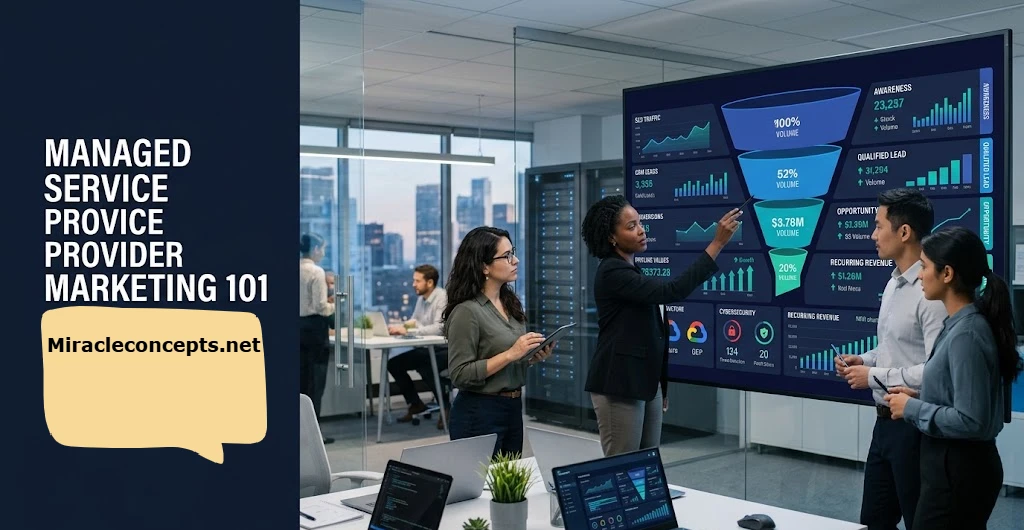
Managed Service Provider Marketing 101 is not about publishing random blog posts or buying low-quality leads. It is a revenue system that helps an MSP become visible to the right businesses, prove it can reduce operational risk, and convert qualified prospects into profitable recurring contracts. This guide explains how to define your target market, build service-led SEO, create high-intent offers, manage paid and organic channels, and measure marketing by qualified opportunities and MRR.
This guide is written for MSP owners, marketing managers, sales leaders, and technical founders who want a repeatable growth system instead of scattered tactics. By the end, you’ll have a clear positioning statement, a channel plan, a website structure that converts, a lead-qualifying offer, a full-funnel content plan, a KPI framework, and a 90-day action plan you can start executing this week.
What Is Managed Service Provider Marketing?
Managed service provider marketing is the process of attracting, qualifying, and converting business accounts into long-term managed services contracts, then retaining and expanding those accounts over time.
It’s fundamentally different from marketing a one-time IT repair shop. A break-fix business sells a single transaction. An MSP sells a relationship: monthly recurring revenue, contract renewals, account expansion, and retention over years, not days.
That difference changes everything about how you should market.
Buyers aren’t just comparing prices. They’re weighing real business risk, downtime, cybersecurity incidents, compliance exposure, poor support response, weak backup practices, and getting locked into a vendor who doesn’t understand their industry. Your marketing has to speak to that risk directly.
A complete managed service provider marketing system includes:
- Positioning, who you serve and why you’re different
- Demand generation, creating awareness among buyers who don’t know they need you yet
- Demand capture, winning buyers who are already searching for a solution
- Lead qualification, filtering for fit before sales spends time on a call
- Sales conversion, turning qualified leads into signed contracts
- Nurture, staying relevant to leads who aren’t ready yet
- Referral and retention marketing, growing revenue from existing relationships
Here’s a simple example of the difference clear positioning makes. “We offer complete IT solutions” tells a buyer nothing. “We provide managed cybersecurity and Microsoft 365 support for 25–150 employee accounting firms in [location]” tells them exactly who you serve, what you do, and why they should care.
If you’re still refining your broader strategy before diving into execution, this piece on marketing for MSPs and the strategies that actually work is a useful companion to this guide.
How Do You Define the Right MSP Target Market?
You define the right MSP target market by building a detailed Ideal Customer Profile (ICP) instead of trying to serve “all small businesses.” A narrow, well-researched ICP produces higher close rates, better retention, and stronger referrals than a broad one ever will.
An ICP for an MSP typically includes:
- Industry
- Employee or device count
- Geographic area
- Existing internal IT team size (if any)
- Technology stack
- Compliance requirements
- Cyber-insurance pressure
- Problems with their current provider
- Estimated monthly recurring revenue potential
- Who actually holds buying authority
A simple ICP scoring model
You can score prospects against four factors to prioritize outreach and content:
ICP Score = Fit + Pain + Urgency + Commercial Value
- Fit, do they match your industry, size, and technical profile?
- Pain, do they have a problem you solve well?
- Urgency, is there a trigger event (incident, compliance deadline, growth)?
- Commercial Value, does the account meet your minimum contract threshold?
To find your strongest niche, look at your current client base: who’s most profitable, who stays longest, who refers you the most, who you can serve well operationally, and where search demand already exists for that specialty.
It’s just as important to define who not to target. That usually includes one-off break-fix buyers, accounts below your minimum contract value, and businesses whose technology environment doesn’t match your delivery capability. Saying no to poor-fit leads early protects your sales team’s time and your service quality.
Which MSP Positioning Strategy Attracts Better-Fit Clients?
The MSP positioning strategy that attracts better-fit clients is specialization, by industry, by company size, or by the specific problem you solve, rather than trying to appeal to everyone.
There are three common routes:
- Industry specialization (e.g., MSPs for law firms, healthcare, accounting)
- Company-size specialization (e.g., MSPs for 20–100 employee businesses)
- Problem or outcome specialization (e.g., cybersecurity-first MSPs)
A useful format for building your positioning statement is:
“We help [specific business type] achieve [business outcome] by solving [high-cost problem] through [specific delivery model].”
Buyers don’t buy technical features, they buy outcomes. Here’s how to translate common MSP capabilities into language that resonates with a business decision-maker:
| Technical feature | Buyer-facing outcome |
| 24/7 monitoring | Problems are detected before they disrupt operations |
| Managed detection and response | Security incidents receive continuous monitoring and escalation |
| Microsoft 365 administration | Employees work securely without internal IT bottlenecks |
| Quarterly business reviews | Leadership receives evidence that IT supports business goals |
| Tested backups | The business has a documented recovery path after an incident |
Avoid vague superlatives like “best,” “complete,” or “full-service” unless you can back them up with proof, case studies, certifications, or specific numbers. Unsupported claims quietly erode trust.
A strong homepage should follow a simple formula: state who you serve, what problem they have, the outcome you deliver, proof it works, and a clear next step.
What Should an MSP Marketing Funnel Look Like?
An effective MSP marketing funnel maps each stage of the buyer’s journey, from first noticing a problem to becoming a customer, to a specific question, content asset, and call to action. A single generic “Contact Us” button can’t do that job across every stage.
| Funnel stage | Buyer question | Suitable asset | CTA | KPI |
| Awareness | Why is our IT becoming difficult to manage? | Diagnostic article or video | Read the assessment guide | Engaged visits |
| Problem awareness | How serious is our risk? | Risk checklist or maturity assessment | Complete assessment | Leads |
| Solution research | Should we use an MSP or hire internally? | Comparison guide | View service model | Returning visitors |
| Provider comparison | Which MSP fits our industry and size? | Case study and service page | Request consultation | Qualified leads |
| Decision | What will onboarding involve? | Transition plan and FAQ | Book assessment | Opportunities |
| Post-sale | How will success be measured? | QBR and onboarding guide | Contact account team | Retention and expansion |
Low-friction offers work well as mid-funnel conversion points because they give the buyer something concrete without asking for a big commitment. Strong examples include:
- Managed IT maturity assessment
- Cybersecurity risk review
- Microsoft 365 security review
- Backup and disaster recovery validation
- Co-managed IT gap assessment
For each of these, be explicit about what’s included and what isn’t. That’s what separates a qualified-lead magnet from a “free consultation seeker” trap that clogs your sales pipeline with poor-fit prospects.
Which Website Pages Does an MSP Need to Generate Leads?
An MSP website needs a service-led page structure, with a dedicated page for each core service, rather than cramming every offer onto one generic “IT services” page. Search engines and buyers both respond better to specificity.
What Should the Managed IT Services Page Cover?
This page should explain who the service is for, what’s included, support hours and response model, device and user coverage, the onboarding process, service boundaries and exclusions, SLA terms, and client outcomes. The primary call to action here should be to request a managed IT assessment.
What Should the Cybersecurity Services Page Cover?
This page should cover your security monitoring and response model, endpoint/identity/email/network/backup protection, the incident escalation process, cyber-insurance support, security awareness training, and any frameworks or standards you genuinely support, backed by real proof such as certifications or documented process. The CTA should invite a cybersecurity readiness review.
What Should the Co-Managed IT Page Cover?
This page should clarify when co-managed IT makes sense, how responsibilities split between the internal team and your MSP, escalation and ticket ownership, after-hours coverage, project support, and reporting. The CTA should help the reader identify their internal IT capacity gaps.
What Other MSP Service Pages Should Be Created?
Build separate pages wherever a service is commercially meaningful on its own, such as:
- Microsoft 365 support
- Cloud migration
- Backup and disaster recovery
- Help desk support
- Network management
- Compliance IT support
- vCIO or strategic IT consulting
- Business continuity planning
Every page should have a unique buyer problem, defined service scope, supporting proof, qualification criteria, internal links, and a conversion action. A page shouldn’t exist just because a keyword research tool flagged the term, it needs a real reason to exist.
If you’re rebuilding your site structure from scratch, this guide on how to rank a new website on Google covers the foundational steps worth getting right early.
How Do You Build an MSP SEO Keyword Strategy?
You build an MSP SEO keyword strategy by organizing keywords around buyer intent, not just search volume, and mapping each intent type to the right page format.
| Keyword type | Example pattern | Page type |
| Service | managed IT services | Core service page |
| Service + location | managed IT services in [city] | Location landing page |
| Service + industry | managed IT for law firms | Vertical service page |
| Problem | why businesses need managed IT | Educational article |
| Comparison | MSP vs internal IT team | Comparison article |
| Evaluation | questions to ask an MSP | Buyer guide |
| Pricing | managed IT services pricing | Pricing or planning guide |
| Transactional | cybersecurity assessment for businesses | Offer landing page |
| Compliance | MSP support for [framework] | Compliance service page |
| Alternative | co-managed IT vs fully managed IT | Comparison page |
A common mistake is keyword cannibalization, multiple pages competing for the same terms, such as “managed IT services,” “IT support,” “IT consulting,” “help desk support,” local pages, and industry pages all overlapping. Each page needs a distinct, well-defined purpose.
Before publishing any new page, run it through this qualification checklist:
- Does the query indicate a business buyer, not a consumer?
- Does the searcher have a problem your MSP genuinely solves?
- Can the page support a clear commercial next step?
- Does the query match your actual service geography?
- Does the account likely meet your minimum contract value?
- Can you provide original expertise on this topic?
Link educational content back to the relevant service pages and assessments naturally within the body copy, this helps both search engines and readers understand how your content connects. For a deeper look at technical execution, MSP SEO to rank on Google covers on-page and technical factors in more detail.
Which Content Topics Attract MSP Buyers at Each Funnel Stage?
The right content topics for MSP buyers depend on where they are in the buying journey, early awareness content differs completely from decision-stage proof content.
What Should MSP Awareness Content Explain?
Awareness content should address problems business leaders already recognize, even if they don’t have the technical vocabulary for them:
- Signs that internal IT can’t scale with the business
- The hidden cost of reactive IT support
- Why unresolved tickets create operational risk
- How employee growth strains IT processes
- Why a “backup success” report doesn’t prove recoverability
What Should MSP Consideration Content Compare?
Consideration-stage content should help a buyer evaluate their options directly:
- MSP vs internal IT
- Co-managed IT vs fully managed IT
- Break-fix vs managed services
- Local MSP vs national provider
- Outsourced help desk vs internal help desk
- Managed cybersecurity vs separate point security tools
Each comparison should cover when each option makes sense, the main cost drivers, implementation risks, ongoing operational responsibilities, and a short decision checklist.
What Should MSP Decision-Stage Content Prove?
By this stage, the buyer needs proof, not persuasion. Useful assets include:
- Industry-specific case studies
- Onboarding and migration plans
- Sample quarterly business review (QBR) reports
- SLA and escalation explanations
- Security and access-control process documentation
- Client references, where permitted
- Team expertise and certifications
- A service coverage map
- Transparent qualification criteria and next steps
Skip generic “10 cybersecurity tips” articles that don’t connect to a real buyer problem, service page, or assessment, they add page count without adding topical relevance or conversion value.
How Can Local SEO Generate Better MSP Leads?
Local SEO generates better MSP leads by making your Google Business Profile accurate and complete, and by building genuine location pages only where you can actually deliver service.
Start with your Google Business Profile: accurate category selection, defined service area, correct business information, real photos, and clear service descriptions.
For location pages, only build them for areas where you actually serve clients or can realistically deliver service. Each location page should include local proof points:
- Clients you’ve served in that region
- Local industries you understand well
- Realistic service response expectations
- Local partnerships
- Regional compliance or business concerns
Publishing dozens of near-identical city pages is risky, it dilutes topical authority and rarely helps rankings or conversions. Quality beats quantity here.
Keep citations and directory profiles consistent across the web, and encourage reviews that describe the actual service and outcome naturally, never script or misrepresent what a client said.
Track calls, direction requests, form submissions, and qualified opportunities from local search, not just keyword rankings. Link your location pages back to relevant service and industry pages to reinforce topical relevance across the site.
How Should an MSP Use Google Ads Without Wasting Budget?
An MSP should use Google Ads by separating campaigns by commercial intent and sending each one to a matching landing page, never the homepage.
Structure campaigns around distinct service lines:
- Managed IT services
- Cybersecurity services
- Microsoft 365 support
- Backup and disaster recovery
- Co-managed IT
- Emergency or urgent support, if you offer it
Use negative keywords aggressively to filter out irrelevant traffic, including terms related to:
- Jobs
- Courses
- Certification
- Free software
- Personal computer repair
- Consumer support
- DIY tutorials
Match your ad copy tightly to your ICP and the outcome you deliver, and set up call tracking, form tracking, CRM source attribution, and qualified-lead status tracking from day one.
Build in regular quality controls: search-term review, lead-quality review, missed-call review, conversion-rate analysis, cost per qualified opportunity, and closed-won MRR. Lead volume alone is a misleading KPI if sales ends up fielding mostly poor-fit inquiries.
How Do LinkedIn and Email Marketing Work for MSPs?
LinkedIn and email work together for MSPs by building familiarity and trust over time, with LinkedIn handling top-of-mind visibility and email handling deeper, segmented nurture.
What Should an MSP Publish on LinkedIn?
A healthy content mix includes:
- Executive explanations of business risk
- Industry-specific security insights
- Client lessons, shared with permission
- Behind-the-scenes service processes
- Short analysis of technology or compliance changes
- Practical checklists for business leaders
- Posts that demonstrate employee expertise and technical credibility
LinkedIn should build familiarity and trust; the website should handle deeper education and conversion.
How Should MSP Email Nurture Be Segmented?
Segment email nurture by:
- Industry
- Company size
- Service interest
- Buying stage
- Assessment completed
- Sales status
- Existing customer status
A practical example, a nurture sequence for a cybersecurity assessment lead might:
- Deliver the assessment result
- Explain the highest-risk issue found
- Show how that issue affects operations or insurance
- Provide a relevant case example
- Explain the remediation process
- Invite the prospect to a scoped review
Define clear exit conditions for the sequence: booked meeting, disqualified, unsubscribed, converted, or transferred to sales. A generic monthly newsletter is not a substitute for behavior-based nurture, it doesn’t respond to where the prospect actually is in their decision.
How Do Reviews, Referrals, and Partnerships Create MSP Demand?
Reviews, referrals, and partnerships create MSP demand by building third-party trust that’s far more persuasive than anything you say about yourself.
Ask for reviews after a measurable success event, such as:
- A successful onboarding
- A resolved major incident
- A completed security improvement
- A positive quarterly business review
- A successful migration
Keep the request neutral, and never require or script positive wording.
For case studies, follow a consistent workflow: get permission, document the original business problem, record the intervention, quantify the outcome, and validate the final story with the client before publishing. Add industry, company size, services used, and technology context where the client allows it.
Build referral relationships with complementary professionals:
- Accountants
- Legal firms
- Cyber-insurance brokers
- Compliance consultants
- Office technology providers
- Commercial real estate advisors
- Business continuity specialists
Give each referral partner a clear description of your ideal client, the referral trigger to watch for, the handoff process, and what feedback you expect from them. Then actually measure partner-sourced opportunities and closed MRR, a referral program without measurement tends to quietly stall.
How Should an MSP Create Offers That Convert?
An MSP should create offers matched to buyer readiness, a low-commitment assessment for someone early in their research, and a detailed transition plan for someone actively comparing providers.
| Offer | Best-fit intent | Required scope |
| IT maturity assessment | Early problem awareness | Questionnaire, maturity score, priority gaps |
| Cybersecurity risk review | Risk-aware buyer | Defined control areas and findings summary |
| Microsoft 365 security review | Technology-specific intent | Identity, MFA, email, admin, device, and sharing review |
| Backup validation | Continuity concern | Backup coverage, restore testing, RPO, and RTO review |
| Co-managed IT assessment | Internal IT pressure | Role mapping, ticket analysis, escalation gaps |
| IT transition plan | Active provider comparison | Discovery, migration phases, risks, responsibilities, timeline |
For every offer, be explicit: what the prospect actually receives, who qualifies for it, and whether it’s free, paid, limited, or conditional. Avoid vague language like “Get a free consultation” unless that consultation has a clearly defined business outcome attached to it.
How Do You Measure MSP Marketing ROI?
You measure MSP marketing ROI by tracking a full chain from initial channel through to closed monthly recurring revenue, not by stopping at surface-level traffic metrics.
Channel → Lead → Qualified Lead → Opportunity → Closed MRR
Metrics worth tracking include:
- Organic qualified leads
- Paid qualified leads
- Referral opportunities
- Marketing-qualified leads
- Sales-qualified opportunities
- Opportunity conversion rate
- Win rate
- Customer acquisition cost (CAC)
- Average contract value
- Monthly recurring revenue (MRR)
- Customer lifetime value (LTV)
- CAC payback period
- Sales-cycle length
- Pipeline influenced by marketing
Rankings, impressions, sessions, and raw form submissions are diagnostic metrics. They tell you something is working, but they don’t tell you whether it’s working commercially.
| Metric | Why it matters |
| Organic traffic | Shows visibility, but not fit |
| Qualified organic leads | Shows whether SEO attracts the right audience |
| Opportunity rate | Shows lead quality and sales alignment |
| Closed MRR | Shows direct commercial value |
| CAC payback | Shows whether growth is financially sustainable |
What Should an MSP Marketing Technology Stack Include?
An MSP marketing technology stack should cover a defined set of functions, not a random collection of trending tools. Focus on what each layer needs to do:
- Analytics and search performance tracking
- Call tracking
- CRM
- Marketing automation
- Email platform
- Form and chatbot qualification
- Review management
- Rank and competitor monitoring
- Consent and privacy management
- Dashboard and revenue attribution
The integrations that actually matter most:
- Form submissions flowing into the CRM
- Call source data flowing into the CRM
- CRM stage syncing to your reporting dashboard
- Closed deals linked back to original and influencing campaigns
- Lead score triggering sales notification
- Booked meetings suppressing further nurture emails
Which specific tools you choose depends on budget, data maturity, team capacity, and what systems you already have in place. There’s no single “right” stack, there’s a right stack for your operation.
How Can MSPs Use AI Without Publishing Low-Quality Content?
MSPs can use AI effectively by applying it to research and structure work, while keeping human review firmly in place for anything technical, compliance-related, or client-specific.
AI is genuinely useful for:
- Query clustering
- Content briefs
- Competitor categorization
- Internal-link suggestions
- Sales-call theme extraction
- Content repurposing
- FAQ discovery
- Drafting structured outlines
Human review should always cover:
- Technical accuracy
- Security recommendations
- Compliance claims
- Client examples
- Pricing
- SLA descriptions
- Incident-response claims
- Product capabilities
Strengthen AI-assisted content with original evidence that a language model can’t fabricate on its own: first-hand process detail, screenshots where relevant, anonymized ticket themes, real client outcomes, expert commentary, implementation constraints, and clear author credentials.
Google has been explicit that automation used primarily to manipulate search rankings goes against its guidelines, and that it rewards content that’s original, accurate, and genuinely written for people rather than search engines. AI should make your content more useful and more accurate, not a shortcut for mass-producing near-identical location pages or generic articles. If you’re formatting content for both traditional search and AI-driven results, technical SEO for SGE is worth reading alongside this section.
What Trust and Compliance Signals Should an MSP Website Show?
An MSP website should clearly show the difference between holding a certification, supporting a client’s compliance program, implementing technical controls, providing documentation, and accepting responsibility for compliance outcomes, these are not the same thing, and conflating them creates real legal and trust risk.
Cover relevant trust areas directly on your site:
- Access control
- Privileged-account management
- Multi-factor authentication (MFA)
- Backup and recovery testing
- Security monitoring
- Incident escalation
- Vendor management
- Data handling
- Employee training
- Business continuity
If you reference standards like PCI DSS, SOC 2, or HIPAA, be precise about your exact role. Never imply that hiring your MSP automatically makes a client compliant, compliance is the client’s responsibility, and your role is to support specific technical controls within it.
Add a dedicated security page that explains how prospects can request information securely, and only list certifications, partner status, insurance, documented processes, and named responsible personnel when they’re accurate and current.
What Is a Practical 90-Day MSP Marketing Plan?
A practical 90-day MSP marketing plan moves from foundation work, to building core assets, to launching and measuring, in that order, so you’re not running paid campaigns before your website can actually convert the traffic.
What Should an MSP Complete in Days 1–30?
- Define your ICP and exclusion criteria
- Review which current clients are profitable and which aren’t
- Analyze three competitor groups: direct local, similar-size benchmark, and larger aspirational competitors
- Audit your homepage, service pages, forms, call tracking, and CRM
- Select one primary offer
- Rewrite your core positioning
- Fix conversion and measurement gaps
What Should an MSP Build in Days 31–60?
- Publish or improve your primary managed IT service page
- Publish two high-value service pages
- Publish one industry-specific page
- Create one location page based on genuine service coverage
- Create one case study
- Launch your primary assessment landing page
- Configure conversion tracking and CRM routing
- Build your first nurture sequence
What Should an MSP Launch in Days 61–90?
- Launch tightly controlled paid search campaigns
- Publish comparison and decision-stage content
- Start a review-request workflow
- Activate referral partners
- Publish consistent LinkedIn content
- Review lead quality weekly with sales
- Report qualified opportunities, win rate, and MRR, not just traffic
- Remove or revise campaigns generating poor-fit leads
For a broader roadmap beyond the first 90 days, MSP growth strategies covers what to focus on as the pipeline matures.
Which MSP Marketing Mistakes Reduce Lead Quality?
The most common MSP marketing mistakes that reduce lead quality include:
- Targeting every business instead of a defined ICP
- Using “IT services” as the only major page on the site
- Ranking for consumer repair searches instead of business buyer terms
- Sending every campaign to the homepage
- Publishing generic AI-generated articles with no original insight
- Creating duplicate city pages
- Claiming compliance without explaining the actual scope
- Hiding the onboarding process from prospects
- Using fear-based cybersecurity messaging without practical guidance
- Asking for contact details before providing meaningful value
- Failing to route leads to sales quickly
- Measuring form submissions instead of qualified opportunities
- Publishing case studies without quantified outcomes
- Using technical language without translating it into operational impact
What Questions Should Businesses Ask Before Hiring an MSP?
Businesses should ask specific, scope-defining questions before hiring an MSP, and a transparent MSP should be able to answer all of them clearly on their own site or in the first conversation:
- What businesses similar to ours do you currently support?
- Which services are included in the monthly agreement?
- What is excluded?
- How are critical incidents escalated?
- What are your response and resolution expectations?
- How do you test backups and recovery?
- How do you manage privileged access?
- How do you support compliance requirements?
- What happens during onboarding?
- How do you measure service quality?
- Which reports will leadership receive?
- What happens if we want to leave?
- Which services require third-party licensing or additional fees?
Publishing honest answers to these questions on your own site does double duty, it builds trust with prospects and gives you decision-stage content that ranks for exactly what serious buyers are searching.
How Much Does MSP Marketing Cost?
MSP marketing cost varies too much by market, competition, and current website condition to state a single reliable number, but you can plan around the variables that actually drive the cost.
Key cost drivers include:
- Target market size
- Level of competition
- Current website condition
- Number of service and location pages needed
- Content depth required
- Paid-media budget
- CRM and attribution requirements
- Internal marketing resources available
- Design or development work needed
- Sales follow-up capability
Most MSPs plan around three broad tiers:
- Foundation, positioning, tracking, core pages, local presence
- Demand capture, SEO, content, paid search, landing pages, and nurture
- Pipeline growth, full-funnel content, authority building, paid media, CRM attribution, and sales enablement
Whatever budget you land on, evaluate ROI using qualified opportunities, closed MRR, CAC payback, and sales-cycle impact, not cost per click or cost per lead alone.
Managed Service Provider Marketing 101 FAQs
What is Managed Service Provider Marketing 101?
It’s a complete framework for MSPs to attract, qualify, and convert the right business accounts, covering positioning, website structure, SEO, paid ads, content, nurture, referrals, and ROI measurement.
How do MSPs get more qualified business leads?
By defining a clear ICP, building service-specific pages, using low-friction assessment offers, and routing leads through CRM tracking so sales only spends time on well-matched prospects.
What is the best marketing channel for an MSP?
There isn’t one universal answer, it depends on your ICP, budget, and sales cycle. Most successful MSPs combine SEO, paid search, referrals, and LinkedIn rather than relying on a single channel.
Should an MSP focus on SEO or Google Ads first?
SEO builds long-term compounding visibility, while Google Ads delivers faster but ongoing results. Many MSPs start with a small, tightly targeted ad campaign while SEO builds in the background.
How does local SEO help managed service providers?
It improves visibility for businesses actively searching for IT support in your service area, particularly through Google Business Profile optimization and genuine, well-supported location pages.
What pages should an MSP website have?
At minimum: managed IT services, cybersecurity, co-managed IT, and any other commercially meaningful service, plus relevant industry and location pages, case studies, and a clear offers page.
How long does MSP marketing take to produce results?
Paid campaigns can generate leads within weeks. SEO and content typically take three to six months to build meaningful, compounding traction.
How much should an MSP spend on marketing?
It depends on market size, competition, and growth goals, there’s no fixed universal figure. Budget should scale with the tier of work: foundation, demand capture, or pipeline growth.
How can an MSP measure marketing ROI?
By tracking the full chain from channel to lead to qualified lead to opportunity to closed MRR, rather than stopping at traffic or form-submission counts.
Should an MSP specialize in one industry?
Specialization, by industry, size, or problem, generally produces stronger positioning, easier content creation, and higher-quality leads than a broad, generalist approach.
What makes an MSP marketing campaign successful?
Clear ICP targeting, matching landing pages to campaign intent, honest offers, fast lead routing to sales, and consistent measurement of qualified opportunities rather than raw lead volume.
How can an MSP use AI for marketing safely?
Use it for research, structure, and drafting support, but keep human review in place for anything technical, compliance-related, or client-specific, and always add original, verified evidence to the final content.