
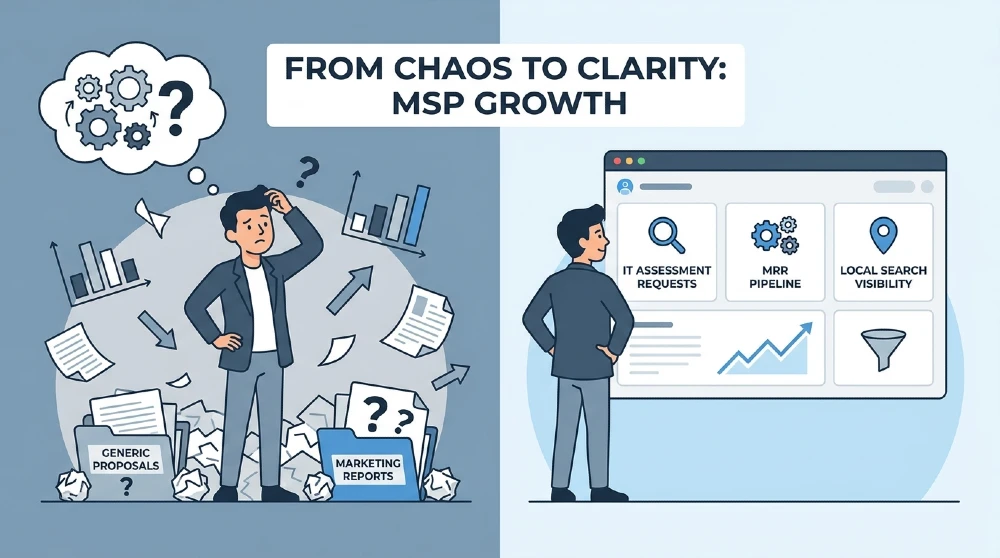
MSP marketing services typically include positioning strategy, local SEO, content built for IT service buyers, paid acquisition (Google Ads and LinkedIn), email nurture sequences, and AI search optimization. Most agencies deliver foundational work in months 1–3, then shift into a recurring lead-generation engine from month 4 onward. Most MSPs should expect 4–6 months before pipeline growth becomes predictable.
If you run a managed services provider and you’re evaluating a marketing partner, you’re probably wondering exactly what you’re paying for and how long it takes to see results. This guide breaks down the real deliverables, a realistic timeline, and the red flags that separate agencies who understand MSPs from generic B2B shops that don’t.
The Exact Deliverables You Receive Each Month
A good MSP marketing services engagement is front-loaded with setup work, then transitions into ongoing execution. Here’s how that typically breaks down.
Month 1–3: Foundation, Positioning & Technical Setup
The first quarter is about building the infrastructure everything else depends on. Expect:
- Ideal client profile (ICP) definition based on your best existing accounts
- Competitor gap analysis to find keyword and messaging opportunities
- Website conversion audit (is your site actually built to book IT assessments?)
- Local SEO baseline and Google Business Profile optimization
- Analytics and call-tracking setup so you can attribute leads correctly
- CRM or PSA integration for lead handoff
Month 4+: The Ongoing Content, SEO & Lead Generation Engine
Once the foundation is in place, the work becomes recurring:
- Monthly blog content targeting problem-aware searches
- Service page and location page optimization
- Backlink acquisition to build domain authority
- Paid campaign management (Google Ads, LinkedIn)
- Email nurture sequences for leads not yet ready to buy
- Monthly reporting tied to pipeline, not just traffic
The Hidden Deliverables Most Agencies Don’t List
Some of the most useful work never makes it onto a proposal:
- Reviewing recorded sales calls to sharpen messaging
- Building QBR (quarterly business review) slide templates you can reuse internally
- Coordinating co-marketing funds with vendors like Microsoft, Cisco, or Datto
- Designing a referral program structure
- Monitoring how often your brand gets cited in AI search tools like ChatGPT and Google AI Overviews
Why MSP Marketing Fails When Agencies Treat You Like a SaaS Company
MSP marketing services only work when the agency understands how MSPs actually sell — not when they apply a generic B2B SaaS playbook.
The “Digital Transformation” Trap That Kills Local Search Rankings
Generic B2B agencies love writing broad thought-leadership content about “digital transformation.” The problem is that MSP buyers rarely search that way. They search with urgency: “IT support near me,” “server down help,” “email not working.” Content built around buzzwords instead of real search behavior simply doesn’t rank for the terms that bring in leads.
Why MRR Metrics Beat Vanity Traffic Every Time
Ten thousand blog visitors mean nothing if none of them book an IT assessment. MSP marketing should be measured against marketing-sourced pipeline and cost per qualified conversation — not pageviews or impressions. If your reporting only shows traffic charts, you’re not seeing the metric that actually matters to your bottom line.
How Vendor Co-Marketing Changes Your Lead Quality Overnight
Agencies experienced with the managed services industry know how to tap into vendor co-marketing programs from Microsoft, Cisco, or Datto. These programs can fund co-branded campaigns and add a credible acquisition channel most generic agencies never even mention.
The Realistic Timeline (No Fluff)
MSP marketing services don’t produce overnight results. Here’s a realistic breakdown of what typically happens and when.
| Phase | Timeframe | What Happens |
|---|---|---|
| Discovery & audit | Weeks 1–4 | Stakeholder interviews, sales cycle mapping, technical SEO fixes, call-tracking setup |
| Content & local SEO build | Months 2–3 | Service-area page launches, compliance-driven content (HIPAA, SOC 2), lead magnets, Google Ads build |
| Indexing & nurture | Months 4–6 | Organic rankings stabilize, email nurture activates, first marketing-qualified leads arrive |
| Predictable pipeline | Month 6+ | Repeatable lead flow, mature retargeting audiences, active referral loops, QBR-ready reporting |
How to Spot an Agency That Actually Understands MSPs
They Ask About Your Sales Cycle Before Your “Brand Voice”
A red flag is an agency that opens the conversation talking about logo colors or brand tone. An agency that understands your business asks how long it takes to go from first call to a signed managed services agreement.
They Build Conversion Paths for IT Assessments, Not Just Contact Forms
A generic “Contact Us” page typically converts at around 0.5%. A dedicated “Get Your Free Network Health Check” page, built around a specific offer, can convert at 3–5%. The difference comes down to whether the agency understands what actually gets an MSP buyer to act.
They Report Pipeline Contribution, Not Just Blog Traffic
Good reporting should say something like “marketing sourced $X in MRR opportunities this quarter,” alongside keyword rankings — not just a screenshot of a traffic graph.
The Core Service Stack Explained
Positioning & Messaging: Outcome-Based, Not Feature-Based
“We do IT support” is a weak pitch. “We prevent downtime” sells the outcome instead of the task. Strong positioning leans on risk framing and compliance posture — the things that actually keep an IT decision-maker up at night.
Website Architecture: Service Pages, Location Pages & Booking Flows
Your site structure should support local SEO with clear service and location pages, alongside a straightforward path to book an assessment — whether that’s a calendar link or a simple form, kept fast and mobile-friendly.
Content Engine: Blogging That Ranks for Real Problems
The best-performing MSP content answers problem-aware searches like “my email is down,” not abstract industry trends. This means targeting “People Also Ask” questions, using FAQ schema, and building comparison content buyers actually search for.
Paid Acquisition: Google Ads & LinkedIn ABM
Paid campaigns for MSPs work best when built around high-intent local keywords (like “IT support near me”), geo-fencing, and account-based outreach to named prospects on LinkedIn.
AI Search Optimization: Getting Cited in ChatGPT & AI Overviews
As more buyers research through AI tools, structured data, entity authority, and answer-first formatting help your content get cited directly in AI-generated responses, not just ranked on a search results page.
Nurture Marketing: From First Visit to QBR
Email sequences, retargeting ads, case study distribution, and referral asks keep leads warm long after their first website visit, right through to becoming a client you review quarterly.
What Success Looks Like: KPIs That Matter
- Marketing-sourced pipeline vs. total revenue — how much new MRR can be traced back to marketing touchpoints
- Cost per IT assessment request — the metric that predicts profitability; if an assessment costs $300 to generate and 30% close, you know your real acquisition cost
- Organic visibility for high-intent local keywords — terms like “managed IT services [city]” or “cybersecurity for [industry]”
- Client lifetime value — stronger positioning tends to attract larger accounts with higher ACV and lower churn
Red Flags That Predict a Bad Agency Partnership
- They can’t explain the difference between break-fix and managed services. If they don’t understand your business model, they can’t market it accurately.
- They promise page-1 rankings in 30 days. MSP SEO is competitive. Anyone promising instant rankings is either buying low-quality traffic or not being straight with you.
- They build a “beautiful” website with no conversion strategy. Good design without assessment booking flows, trust signals, and local schema is just decoration.
FAQ: What MSP Owners Ask Before Hiring a Marketing Partner
A freelancer can work for a single deliverable, like blog writing. But full MSP marketing services — SEO, paid ads, positioning, and reporting working together — usually need a small team with different specialties, which is what an agency provides.
Most MSPs investing seriously in marketing budget somewhere in the low-to-mid four figures per month at minimum, scaling up with company size and growth goals. The right number depends on your target market size and sales cycle length.
MSP marketing focuses specifically on recurring revenue relationships, compliance-driven buying triggers (like HIPAA or SOC 2), and long sales cycles tied to managed services agreements — not one-off IT project sales.
Yes, agencies familiar with the MSP space can help you access co-marketing funds from vendors like Microsoft, Cisco, or Datto to offset campaign costs.
Look past traffic and rankings. Check whether marketing is producing tracked, marketing-sourced pipeline and a reasonable cost per qualified conversation.
SEO builds a long-term, compounding asset but takes months to show results. Paid ads generate faster leads but stop the moment you stop spending. Most MSPs benefit from running both together rather than picking one.