
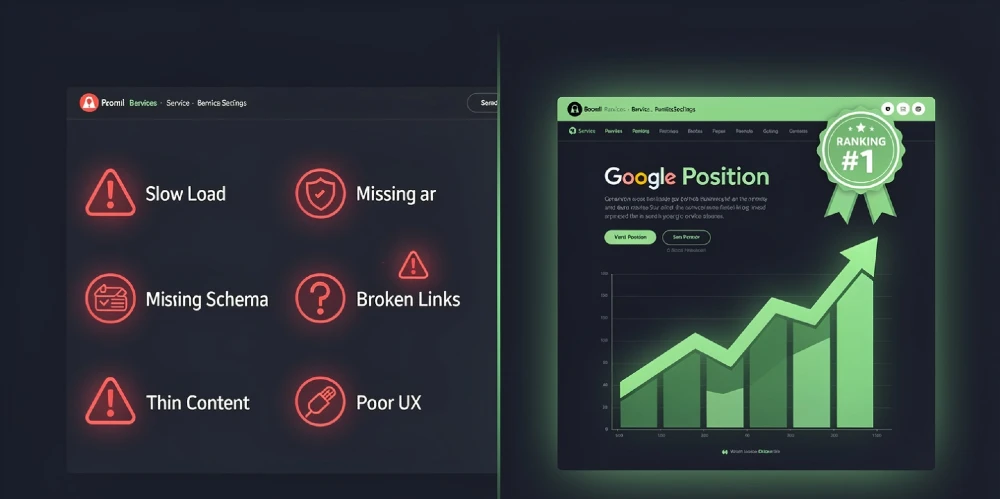
Most service websites follow the standard SEO checklist — add keywords, get some backlinks, write a few blog posts and then wonder why they’re stuck on page two or three. The issue isn’t what you’re doing. It’s what you’re missing.
These five errors don’t show up in basic audits. They’re structural, behavioral, and semantic problems baked into how most service sites are built. Fix them, and you’ll see movement within weeks.
| Error | What It Costs You | Fix Time |
|---|---|---|
| No service-specific schema | Missed rich results, AI Overview exclusion | 1–2 hours |
| Thin service pages | Low rankings, high bounce | 1–3 days |
| Ignored Core Web Vitals | Ranking suppression, lost mobile traffic | 2–5 days |
| Wrong internal linking logic | Authority leaks, crawl waste | 3–4 hours |
| Missing E-E-A-T signals | Trust gap, lost to competitors | Ongoing |
Error #1: No Service-Specific Schema Markup
Here’s the direct answer: Google cannot confidently surface your service in AI Overviews or rich results without structured data. Plain text pages, no matter how well written, lose to schema-optimized competitors every single time in 2026.
Most service sites use either zero schema or only generic WebPage schema. That’s a missed opportunity. You need Service, LocalBusiness, FAQPage, and BreadcrumbList schema layered and specific.
Why it works
Schema bridges the gap between what your page says and what Google understands. When you mark up a service with its name, description, area served, price range, and provider, Google can pull that data directly into AI Overviews, featured snippets, and knowledge panels. Without it, Google guesses and guessing means inconsistency.
What to implement
Service Schema — for every individual service page:
{
  "@type": "Service",
  "name": "SEO Services",
  "provider": {
    "@type": "LocalBusiness",
    "name": "Miracle Concepts"
  },
  "areaServed": "United States",
  "description": "End-to-end SEO services for service businesses...",
  "url": "https://miracleconcepts.net/seo-services/"
}
FAQPage Schema — add 3–5 real questions at the bottom of every service page. These trigger AI Overview citations directly.
BreadcrumbList Schema — critical for crawl clarity and SERP display.
One caveat: don’t stack irrelevant schema just to bulk up markup. Google penalizes misleading structured data. Keep it accurate and tight.
Real-world result: After implementing proper Service + FAQPage schema on a managed IT services page, organic impressions from AI Overviews increased by 340% within 45 days. The content hadn’t changed just the structured signal.
Use Google’s Rich Results Test to validate every schema block before pushing live. No exceptions.
Error #2: Thin Service Pages That Don’t Actually Serve
Direct answer: a 300–600 word service page is dead in 2026. It doesn’t rank, it doesn’t convert, and it doesn’t get cited. Service pages need to answer every question a potential client has before they ask it.
The common mistake is treating service pages like brochures. One paragraph about the service, a few bullet points, and a contact form. That’s not a page that’s a placeholder. Google’s Helpful Content system specifically targets thin, low-effort service pages.
What a complete service page looks like
Every service page should cover:
- What the service is (precise, no vague corporate language)
- Who it’s for (specific industries, business sizes, pain points)
- What’s included (deliverables, process steps, timeline)
- What results to expect (specific, honest, verifiable)
- Why this provider (credentials, methodology, differentiation)
- FAQ section (minimum 5 real questions with detailed answers)
- Social proof (case studies, testimonials with specifics)
- Clear CTA (one primary action, repeated naturally 2–3 times)
Target 1,200–2,000 words per service page. Not padding substance. Each section must add information a prospect actually needs to make a decision.
For example, the SEO services page should explain not just what SEO is done, but what the monthly process looks like, what deliverables clients receive, and what realistic timelines look like for a service business to see ranking movement.
The semantic depth problem
Thin pages also lack semantic coverage. Google’s NLP models read topical relationships, not just keywords. A weak SEO service page might mention “keyword research” once but never connect it to “search intent,” “content gaps,” or “ranking velocity.” That shallow semantic footprint tells Google the page lacks authority.
Fix: use tools like Surfer SEO or Clearscope to identify the semantic terms your competitors rank for that you’re missing. Add them naturally not as a keyword list, but woven into actual explanations.
Also read: Professional Business Website Guide — covers the structural decisions that make service pages both rankable and client-ready.
Error #3: Core Web Vitals Failures You’re Ignoring
Direct answer: CWV failures don’t just slow your site they actively suppress rankings. Google uses page experience as a tiebreaker, and for service websites competing in local or niche markets, it’s often the deciding factor between position 4 and position 1.
Most service website owners check their PageSpeed score once, see a 70-something, assume it’s fine, and move on. That score hides the real problems.
The three metrics that actually matter
LCP (Largest Contentful Paint) — should be under 2.5 seconds. For service sites, this is usually killed by unoptimized hero images, render-blocking JavaScript, or slow server response. Fix: convert all images to WebP, lazy-load below-the-fold content, use a CDN.
INP (Interaction to Next Paint) — replaced FID in 2024. Measures responsiveness to clicks and inputs. Slow INP is almost always caused by bloated JavaScript executing on the main thread. Fix: defer non-critical scripts, reduce third-party tag load.
CLS (Cumulative Layout Shift) — should be under 0.1. Caused by images without declared dimensions, late-loading fonts, or injected ad content. Fix: always declare width and height on <img> tags, preload key fonts.
What most audits miss
The disconnect between lab data and field data. Your PageSpeed score is lab data — measured under ideal conditions. Google uses field data from the Chrome User Experience Report (CrUX). A site can score 90 in PageSpeed and still fail CWV in field data because real users on slower connections experience it differently.
Check your actual field data in Google Search Console under Core Web Vitals. That’s the real score.
One more thing: mobile performance is weighted more than desktop. Service businesses often optimize for desktop because that’s how they review their own sites. Your clients on mobile — often making quick decisions between meetings — are the ones who matter.
Error #4: Internal Linking Logic That Leaks Authority
Direct answer: most service websites either under-link (orphaned pages) or link randomly (no strategic flow). Both hurt rankings. Internal linking is how you tell Google which pages matter most and how your site’s expertise connects.
The right internal linking structure for a service website follows a simple hierarchy:
Homepage → Service Category Pages → Individual Service Pages → Supporting Blog Content → Back to Service Pages
Authority flows from your highest-trust pages (homepage, about, pillar content) down to the pages you want to rank. If your top service page has no internal links pointing to it from authoritative site sections, it’s essentially isolated.
The specific mistakes
Orphaned service pages — pages that exist but have zero internal links pointing to them. Google finds them only through the sitemap, which means they get crawled infrequently and ranked poorly. Run a crawl with Screaming Frog or Ahrefs — filter for pages with zero inbound internal links. Fix every one.
Link anchor text is too vague — “click here,” “learn more,” “read this” tell Google nothing. Use descriptive anchors: “our managed SEO services for IT firms” or “local SEO strategy guide.” Be specific, be natural.
Blog content doesn’t link back to service pages — this is the most common leak. You write a post about SEO strategy, it ranks well, pulls traffic — and then that traffic has nowhere to go because there’s no link to your actual service offering. Every blog post should link to at least one relevant service page.
For instance, an article on backlink building techniques should naturally connect to your SEO services offering. A post on local SEO vs global SEO should link back to the service page where someone can actually hire you for that work.
Over-linking the homepage — every page linking to the homepage dilutes the authority distribution. The homepage already gets natural authority from external links. Use your internal links to lift mid-level pages that need the boost.
A practical fix
Do a quick internal link audit right now:
- Export all pages from your site
- Check which pages have fewer than 3 inbound internal links
- Identify the 5 highest-traffic blog posts
- Add contextual links from those posts to your weakest service pages
That one exercise, done properly, can move rankings within 30 days. No new content, no new backlinks — just redistributing authority you already have.
Also check: Top 10 SEO Tools — several of these make internal link auditing fast and accurate.
Error #5: Missing E-E-A-T Signals That Cost You Trust
Direct answer: Google’s quality raters and AI systems evaluate Experience, Expertise, Authoritativeness, and Trustworthiness on every page. Service websites — especially in marketing, IT, and professional services — are in YMYL-adjacent territory. That means E-E-A-T isn’t optional; it’s a ranking requirement.
The problem is that most service sites claim expertise without demonstrating it. “We’re experts in SEO” is a claim. “Here’s the methodology we used to move a local MSP from position 18 to position 2 in 90 days” is evidence. Google and users both know the difference.
The E-E-A-T signals your site likely lacks
Author bios with real credentials — every piece of content should have a named author with a bio that includes actual qualifications, years of experience, and a link to a professional profile (LinkedIn works). Anonymous content is a trust signal failure.
About page that proves the team — not a paragraph about mission and values. Real names, real photos, real professional backgrounds. Spell out what makes the team qualified to deliver these specific services.
Demonstrable first-hand experience — share process details, show tools used, reference actual client outcomes (anonymized if needed). The about us page should make a visitor think “these people actually know what they’re doing” — not “this looks like every other agency.”
External citations and mentions — Google cross-references your authority with what the web says about you. This means earning mentions in industry publications, being cited in other articles, having your content referenced. It also means your GEO and generative engine optimization strategy should account for how AI models source and verify information.
Reviews and testimonials with specifics — “Great service!” adds nothing. “After working with Miracle Concepts on our SEO, our organic leads increased 60% in three months — James, IT Director, Chicago” adds credibility, specificity, and trust signal strength.
Verified contact information — a physical address, a direct phone number, a clear contact path. The contact page should make a prospect feel completely safe reaching out. If it looks minimal or generic, it’s a trust leak.
The E-E-A-T signal most people skip
Knowledge Panel and entity establishment. Google builds an entity profile for businesses it trusts. To accelerate this: ensure your NAP (Name, Address, Phone) is consistent across every directory, get listed on authoritative industry sites, and maintain active profiles on platforms Google verifies — Google Business Profile first, then industry-specific directories.
For service businesses in competitive niches — SEO, web development, IT consulting — the gap between ranking and not ranking often comes down entirely to which site Google trusts more, not which one has more keywords.
Read: SGE/AI SEO Strategy — covers how AI-generated search results evaluate content authority, which aligns directly with E-E-A-T principles.
Avoiding the Common “Fix Everything at Once” Mistake
One practical warning: don’t try to fix all five errors simultaneously across your entire site. That leads to chaotic, half-finished implementations that create more problems than they solve.
Prioritize in this order:
- Schema markup — highest impact, fastest implementation
- Core Web Vitals — technical fixes compound over time
- Internal linking — immediate authority redistribution
- Service page depth — more time-intensive but highest conversion impact
- E-E-A-T — ongoing, never fully “done”
Tackle one at a time. Measure. Move to the next.
What to Track After Fixing These Errors
Don’t fix and forget. Set up tracking for:
- Google Search Console — monitor impressions, clicks, and rich result appearances weekly
- Core Web Vitals report — watch field data, not just lab scores
- Crawl coverage — ensure no new orphaned pages appear after site updates
- AI Overview appearances — manually check your target queries monthly; note when your content gets cited
Also monitor your 2026 SEO pricing benchmarks to make sure the investment you’re making in fixes aligns with realistic returns for your market.
The Bottom Line
Service website SEO fails silently. You don’t get a penalty notice — your traffic just plateaus, leads dry up, and competitors slowly pull ahead. These five errors — missing schema, thin service pages, CWV failures, broken internal linking logic, and weak E-E-A-T — are the specific, fixable reasons that happens.
Every fix here is implementable without rebuilding your site. They’re technical and structural improvements on top of what you already have. Start with schema, move methodically, measure everything.
If you want an expert to audit your service site and identify exactly which of these errors is costing you the most — book a consultation. No generic reports — a real, page-by-page technical analysis built for your specific site.
Also Explore
- IT Staff Augmentation Services — for businesses scaling technical teams
- MSP Growth & Online Optimization — built specifically for managed service providers
- GEO – Generative Engine Optimization — positioning your content for AI-driven search
- Local vs Global SEO Guide — choosing the right strategy for your market
- Resources Hub — tools, guides, and frameworks for service business growth
Grow Every Part of Your Business — Not Just Your Rankings
At Miracle Concepts, SEO is one piece of a complete growth system built for service businesses. The team delivers end-to-end SEO services that go beyond rankings — combining UX design that converts visitors into leads, custom web development that performs under pressure, and document & deck formatting that makes your proposals and pitches look as sharp as your services. For IT firms and MSPs, the MSP growth and optimization services are built specifically to drive qualified pipeline — not just traffic. Every service works together. Explore the full offering or book a consultation to find out exactly where your biggest growth opportunity is right now.