
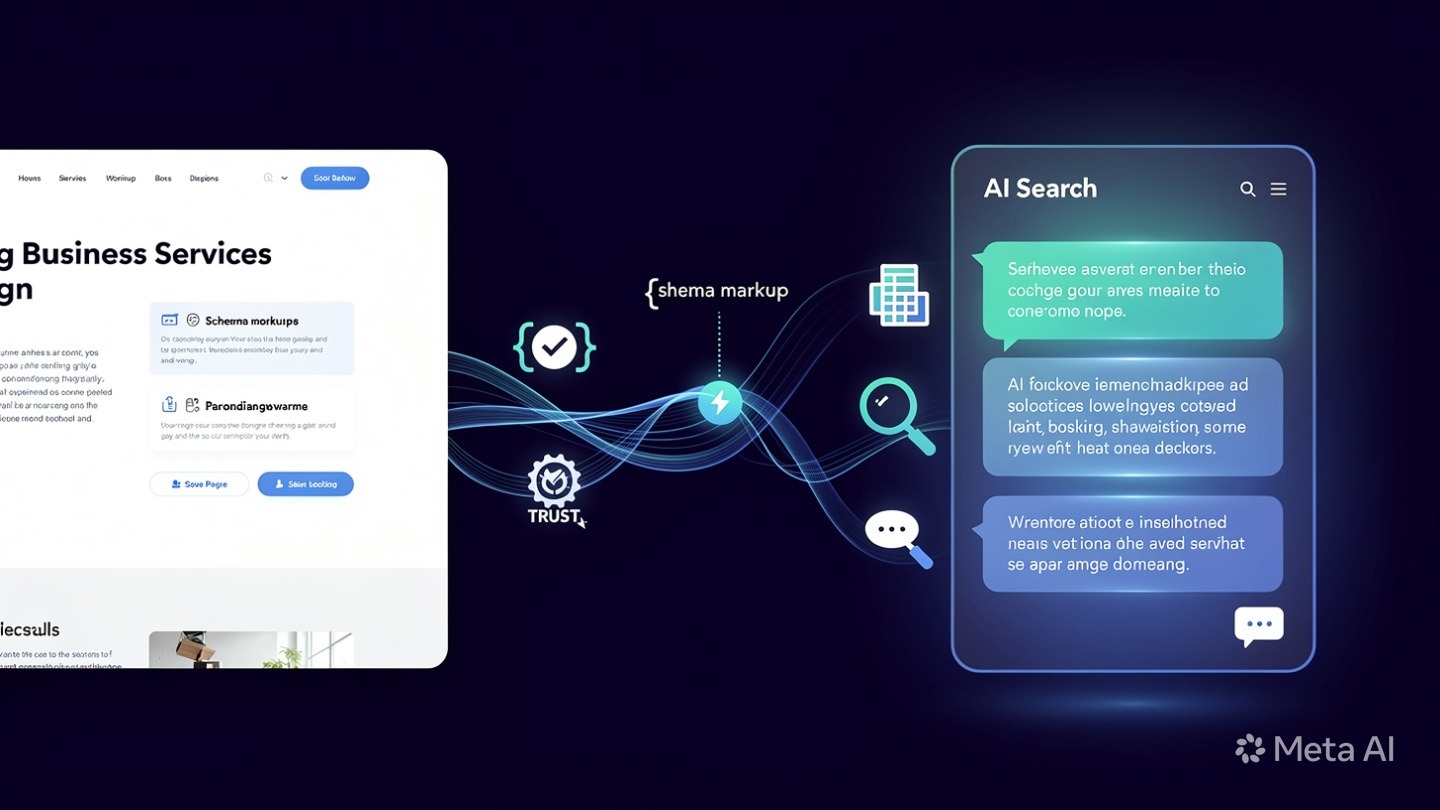
If you run a service business — agency, MSP, law firm, contractor, consultancy, anything where someone has to “hire” you instead of “buy” you — the search landscape underneath you has shifted in a way that traditional SEO playbooks don’t explain well. Google’s AI Overviews now answer a huge share of queries directly on the results page, and tools like ChatGPT, Perplexity, and Gemini are becoming research assistants people use before they ever type into Google. None of that kills SEO. It changes what gets rewarded.
This isn’t a “background and history” piece. It’s the exact mechanics of what’s different, what to do about it, and what most agencies writing about this topic in 2026 are still getting wrong.
- Does AI Overviews kill organic traffic for service companies? No, but it reroutes it — fewer clicks on broad informational queries, more clicks on high-intent “who should I hire” queries if your content is structured to be cited.
- Biggest 2026 shift: Ranking is no longer about pleasing one algorithm — it’s about being retrievable and citable across multiple AI systems simultaneously. Search engines evaluate whether content is well-structured enough for AI to extract and cite.
- What actually moves the needle: Structured data (Schema), entity clarity (who you are, what you do, where), answer-first content blocks, and verifiable proof of experience — in that order of effort-to-payoff.
- What to stop doing: Chasing broad keywords, writing generic “what is X” content, and treating backlinks as a numbers game.
- Fastest win this month: Add Service + FAQ schema to your top 5 service pages and rewrite the first paragraph of each to directly answer the query in plain language.
Old SEO vs. AI SEO: The Actual Difference (Not the Marketing Version)
Old SEO answered “how do I rank this page.” AI SEO answers “why would a machine trust this page enough to quote it.” That’s the entire shift in one sentence, and almost every other article on this topic buries it under fluff.
Here’s why it works this way: Google’s AI Overviews and competing AI engines don’t crawl your page and rank it in a list anymore — they extract specific claims from your content, cross-reference them against other sources, and synthesize an answer. If your page makes a vague claim (“We provide top-notch SEO services”), there’s nothing for the AI to extract. If your page makes a specific, checkable claim (“We rebuild Core Web Vitals scores for service-based sites, typically moving LCP under 2.5 seconds within 30 days”), that’s a sentence an AI system can lift, attribute, and use to answer someone’s question.
This is the practical reason “answer-first” writing beats “story-first” writing now. The old SEO habit of opening with three paragraphs of context before the actual answer is exactly what gets skipped by both AI summarizers and impatient readers.
Why Service Companies Specifically Get Hit Different
Most AI SEO content treats every business type the same. That’s a mistake, and it’s the first place I’d push back on the generic advice floating around.
E-commerce sites have product schema and a fairly mechanical buying decision. Media sites have scale and domain authority built over years. Service companies sit in the hardest spot: the buying decision is trust-based, the proof points are harder to structure into data (you can’t schema-mark “this contractor showed up on time”), and most service sites still write like brochures instead of like answer banks.
That’s exactly why a professional, well-structured business website matters more in 2026 than it did in 2022. The site itself is now part of the trust signal AI systems weigh — page structure, load speed, and clarity all feed into whether a model treats you as a reliable source to cite.
The Ranking Factors That Actually Matter Now (And the Ones That Don’t)
Backlinks still matter, but the bar moved. Volume of links used to correlate loosely with authority. Now what matters has shifted from quantity to contextual relevance and trust — a single mention from a recognized industry publication outweighs twenty low-quality directory links. If you’re still running a link-building campaign built on volume, you’re optimizing for 2019. Our backlink building techniques guide breaks down what’s actually worth pursuing now.
Technical SEO didn’t go away — it got a new layer. AI crawlers (Google-Extended, OAI-SearchBot, ClaudeBot, PerplexityBot) need explicit access in your robots.txt, and increasingly, sites are adding an llms.txt file to guide what these bots should prioritize. Auditing robots.txt to allow these AI crawlers and implementing llms.txt with server-side rendering for AI-accessible content is now a real technical SEO task, not an optional extra. If your service pages are rendered client-side with heavy JavaScript and no server-side fallback, some AI crawlers simply won’t see your content at all — they’ll cite a competitor instead.
Core Web Vitals tightened too. Interaction to Next Paint (INP) has become a harder gate than it used to be, and poor mobile experience now directly suppresses ranking regardless of content quality. Run your top service pages through PageSpeed Insights this week — not as a checkbox, but because a slow page genuinely gets passed over for citation in favor of a faster competitor with the same information.
Schema markup is the single most underused lever for service companies specifically. Three types matter most: LocalBusiness schema covering your name, address, hours, service area, and categories; FAQ schema for questions that mirror how people query AI systems directly; and Service schema detailing the specific services you offer along with pricing ranges and coverage area. None of these require a developer — most CMS platforms have plugins, and free tools like Google’s Structured Data Markup Helper walk you through it step by step.
What Top 10 Results Get Wrong (And What to Do Instead)
I went through the current top-ranking pages on this exact topic before writing this, and the pattern is consistent: long historical preambles about “what is AI search,” generic bullet lists copied from the same three sources, and almost zero service-business-specific guidance. Here’s what’s missing and how to fix it on your own site.
Gap 1: No connection between AI visibility and lead generation. Most articles treat AI Overview citation as a vanity metric. For a service company, the real question is whether that citation drives a consultation booking. The fix: structure your service pages so the AI-citable answer sits directly above your call-to-action, not buried in a separate FAQ page three clicks away. Someone reading an AI summary about your service should be one click from your consultation booking page.
Gap 2: Treating GEO and AEO as separate from SEO. They’re not separate disciplines you bolt on — they’re outcomes of doing the fundamentals well. Answer Engine Optimization is really a subset of Generative Engine Optimization, and doing GEO effectively also improves your AEO performance. If your site already does local SEO right — accurate citations, strong Google Business Profile, consistent NAP data — you’re already most of the way to AI search visibility. We cover the foundational layer in our local SEO vs global SEO guide and go deeper on the AI-specific layer in our GEO strategy breakdown.
Gap 3: No mention of entity consistency. AI systems build an internal “entity” profile of your business across every place it appears — your website, your Google Business Profile, directories, social profiles, press mentions. If your business name, service descriptions, or even tone of voice are inconsistent across these, the AI has a harder time confidently citing you as a single trustworthy source. Entity clarity, structured data, authority, and freshness are now the core signals AI search systems weigh, replacing the older signal set of backlinks and keyword density alone.
Gap 4: Zero honest discussion of what AI Overviews cost you. Yes, AI Overviews reduce click-through on broad informational searches — that’s real, and pretending otherwise is dishonest. But the click-through rate on high-intent commercial queries (“best [service] near me,” “who should I hire for [task]”) hasn’t collapsed the same way, because people still want to compare and choose a vendor, not just read a summary. The strategy shift is to deprioritize chasing broad informational keywords and double down on the comparison and decision-stage queries where AI summaries actually drive action.
Step-by-Step: Getting Your Service Pages Cited in AI Overviews
This is the part most guides skip because it requires actual specificity instead of generic advice.
Step 1 — Audit what you’re currently being cited for (or not). Search your core service queries in Google and check if an AI Overview appears, then check if any competitor is cited. Run the same queries through ChatGPT and Perplexity with web browsing enabled. This baseline tells you where the gap actually is instead of guessing.
Step 2 — Rewrite your top 5 service pages with answer-first structure. Each page should open with a 2-3 sentence direct answer to the implied question (“What does [service] cost,” “How long does [service] take,” “What’s included in [service]”) before any context or persuasion. This single change does more for AI citation than any technical tweak.
Step 3 — Add the three schema types covered above. LocalBusiness, Service, and FAQ. Prioritize FAQ schema on pages targeting comparison or “best” queries, since those map almost directly to how people phrase questions to AI assistants.
Step 4 — Fix your internal linking architecture. AI crawlers and traditional crawlers both use internal links to understand which pages you consider most important. A site with the right SEO tools supporting this process can audit orphaned pages — pages with no internal links pointing to them rarely get indexed properly, let alone cited. Service pages should link to relevant case studies or proof pages, and blog content should link back to the service page it supports, not the other way around as an afterthought.
Step 5 — Get cited on third-party sources you don’t control. This is the step everyone underweights. AI systems weigh corroboration — if only your own website claims you’re an expert in something, that’s weaker than if an industry directory, a review platform, or a press mention says the same thing independently. Prioritize getting listed accurately on industry-specific directories over generic ones.
Step 6 — Monitor and iterate monthly, not quarterly. AI search visibility shifts faster than traditional rankings because the underlying models get updated more frequently than Google’s core algorithm historically did. Set a recurring monthly check rather than treating this as a one-time project.
Content Structure That AI Engines Can Actually Extract
There’s a specific writing pattern that performs better for citation, and it’s not complicated — it’s just different from how most service businesses write their marketing copy.
Write each section so the heading poses an implicit question and the first sentence under it answers that question in plain, complete language — not a teaser sentence that makes someone read further to get the point. Follow with the explanation, examples, and nuance after the answer, not before. This is the inverse of how most copywriters are trained to write, where you build anticipation before the payoff. AI summarization doesn’t reward anticipation. It rewards extractable clarity.
Keep paragraphs short — three to four sentences max for service pages. Long, dense paragraphs are harder for both AI extraction and human skimming, and skimmability is something Google’s helpfulness systems also weigh directly now.
Use specific numbers wherever you honestly can. “Fast turnaround” is not citable. “Typical turnaround of 5-7 business days for standard projects” is citable, and it also reads as more trustworthy to a human reader, which matters since the AI Overview is often just the doorway — the person still clicks through to verify before they hire anyone.
Common Mistakes to Avoid
A few patterns I’d actively flag as wasted effort or counterproductive in 2026:
Don’t keyword-stuff service descriptions hoping to rank for every variation. AI systems classify intent semantically now, so unnatural repetition reads as low quality rather than helping relevance. Don’t publish thin “AI search guide” blog content just to chase the topic trend without connecting it back to your actual service offering — it dilutes topical authority instead of building it. Don’t ignore your existing high-performing content; updating and re-optimizing a page that already ranks decently is usually faster ROI than publishing something new from zero. And don’t treat schema markup as a one-time task — service areas, pricing, and offerings change, and stale schema can actively mislead AI systems into citing outdated information about your business.
One more: don’t outsource AI SEO to an agency that can’t explain the mechanics above in plain language. If a proposal still leads with “we’ll build 50 backlinks a month,” that’s a 2019 strategy being resold under a new label.
Tools Worth Using to Track This
Beyond standard rank trackers, a few tools specifically address AI search visibility: Google Search Console now has filtering for AI Overview appearances under its performance reports, which is the most direct first-party data you’ll get. Third-party tools focused on LLM citation tracking exist too, though this category is young and changing fast, so test before committing to a paid tool. Our SEO tools roundup covers the broader stack worth having regardless of the AI search layer.
Where AI Search Strategy Connects Back to Site Fundamentals
None of this works in isolation. A site with weak technical foundations — slow load times, poor mobile UX, inconsistent NAP data, no internal linking strategy — won’t benefit much from schema markup alone. We’ve seen this directly with service-business clients: adding FAQ schema to a slow, poorly structured page moved nothing, but the same schema added to a page that already had solid Core Web Vitals and a clear internal link structure started showing up in AI Overview citations within weeks. The schema isn’t magic. It’s a signal layered on top of fundamentals that already need to be solid.
This is also where industry-specific nuance matters — what works for SEO targeting interior designers as a niche service differs from what an MSP or IT consulting firm needs, because the buying questions and trust signals differ by industry. Generic “AI SEO checklists” miss this entirely.
For citation specifically, getting the basics of source attribution right matters more than people assume — both for your own content’s credibility and for understanding how AI systems decide what to trust enough to quote. Our guide on how to cite a website covers the practical side of this if you’re publishing original research or data your industry might reference back to you.
What This Costs and What It’s Worth
Budget conversations around this shift are murky right now because a lot of agencies are repackaging existing SEO retainers with “AI” added to the name without changing the actual deliverables. A transparent breakdown of where 2026 SEO spend should actually go — technical work, content restructuring, schema implementation, and ongoing monitoring — is laid out in our 2026 SEO pricing guide, which is worth reviewing before signing anything that doesn’t itemize these specific tasks.
FAQs
Does AI Overviews reduce organic traffic for service businesses? For broad informational queries, yes — click-through drops because the answer is satisfied on the results page. For high-intent commercial queries where someone needs to choose and contact a provider, click-through holds up better because comparison and trust-building still require visiting the actual site.
Is GEO a replacement for SEO? No. Strong SEO is the foundation for strong AEO and GEO — they’re not competing disciplines, GEO is built on top of solid SEO fundamentals, not instead of them.
How long does it take to see results from AI search optimization? Faster than traditional SEO in some cases because AI systems re-crawl and re-synthesize more frequently than Google’s core algorithm historically updated — some service pages see citation changes within 3-6 weeks of structural changes, though competitive industries take longer.
Do I need a developer to add schema markup? Not necessarily. Most CMS platforms offer plugins, and free generators exist for LocalBusiness, Service, and FAQ schema. A developer helps for custom implementations, but it’s not a hard requirement to get started.
If your site’s SEO foundation needs work before any of this AI-search layer can do its job, that’s usually the real starting point. Beyond SEO services, a fully optimized service business also needs a website built for both humans and AI crawlers through proper web design and development, a UX design approach that keeps visitors engaged once an AI summary brings them to your site, clean document and deck formatting for client-facing proposals, and reliable MSP support services to keep the technical infrastructure behind all of it running without gaps. These pieces work together — ranking well means nothing if the site that earns the click doesn’t convert the visitor into a client. Book a consultation if you want a direct audit of where your site currently stands against these 2026 AI search factors.