
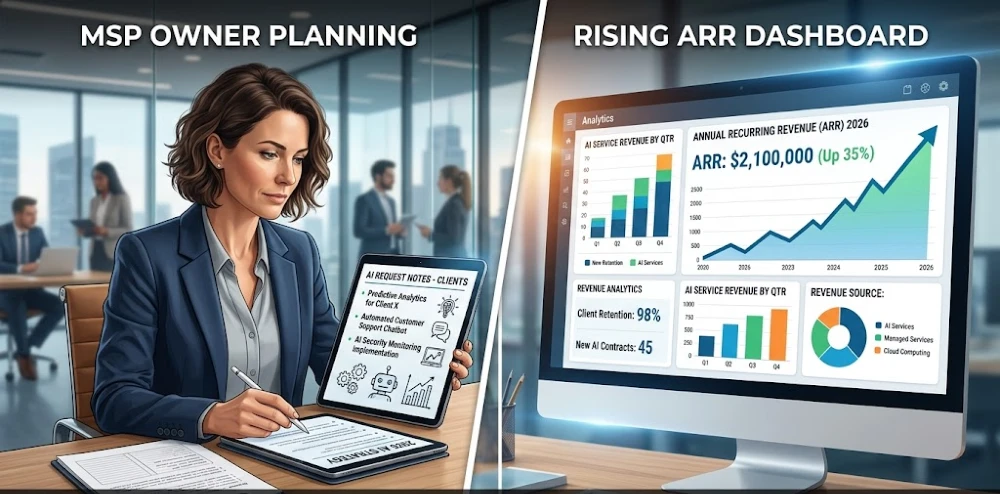
AI monetization for MSPs is the most talked-about — and most frustrating — challenge in the managed services industry right now. Clients want AI. They ask for it in every meeting. And yet, the money is not flowing. According to the Kaseya 2026 State of the MSP Report, 48% of MSPs rank AI and automation as their clients’ number one demand. Only 13% are generating meaningful revenue from it.
That is a 35-point gap. And it is not closing fast enough.
| 48%MSPs rank AI as clients’ #1 demand in 2026 | 13%MSPs generating meaningful AI revenue | 35ptsThe gap — and the opportunity | $500k+ARR some MSPs are adding with right packaging |
Why AI Monetization for MSPs Keeps Failing
Let us be direct. Most MSPs are not failing at AI because they lack tools or knowledge. They are failing because they are treating AI like a feature instead of a service line.
Here is what is actually happening on the ground:
• Clients want AI strategy, governance, and integrations — but push back hard on premium pricing.
• Deal sizes are shrinking as traditional managed services get commoditized. AI is not automatically filling that gap.
• Internal AI use — automating tickets, patch management, monitoring — is working. External monetization, selling AI value to clients, is still broken for most MSPs.
• Success stories exist. Some providers are adding $500k+ ARR. But the packaging model is rarely shared or documented.
| The real problem is not AI. It is that MSPs are trying to sell a capability when clients want to buy an outcome. |
What the Gap Actually Costs You
If you are delivering AI work but not billing for it correctly, you are subsidizing your clients’ AI transformation with your own margins. Think about that for a second. Your engineers are spending time on AI integrations, prompt engineering, workflow automations — and it is buried in a flat monthly retainer that has not changed in two years.
Meanwhile, pure-play AI consultancies and Big Tech partners are walking into your accounts and charging $15,000 to $50,000 for projects you could have owned. The gap is not just a revenue problem. It is a positioning problem.
Winning Strategies MSPs Are Using Right Now
1. Outcome-Based Pricing
Charge for measurable results — tickets resolved by AI, hours saved per month, workflows automated. Not per license. Not per hour. Per outcome. Clients pay for value, not time. This single pricing shift changes the entire client conversation from cost to ROI.
2. Managed AI Service Bundles
Package AI as a recurring service tier: “Managed AI” or “AI Governance as a Service.” Include tool selection, configuration, monitoring, and quarterly reviews. Recurring. Predictable. Defensible. This is the same evolution that happened when break-fix became managed services — and it is happening again right now.
3. Client-Facing Dashboards
Build portals or reporting views that show clients their AI ROI in plain numbers. When clients can see the value, renewals and upsells become much easier conversations. If your client cannot see it, they cannot defend the budget for it.
4. AI + Cybersecurity Bundles
Combine AI services with AIOps, compliance automation, and security posture management. This cross-sell creates stickier, higher-value engagements that are hard to unbundle. It also puts you in every board-level conversation about risk — where the real budgets are.
The Packaging Problem — and How to Fix It
MSPs are great at delivering AI work. They are terrible at packaging it into something a client can understand and budget for.
The fix is not complicated, but it requires discipline. Build a one-page service sheet that states exactly what is included, what the outcome looks like, and what it costs per month. If you cannot describe your AI offering in three sentences, your client cannot justify signing off on it. Start there.
Proving ROI to Clients Who Do Not Trust the Numbers
Client skepticism about AI ROI is real. Most of your clients have seen vendors promise AI savings that never materialized. That history is working against you.
The solution is specificity. Do not say “AI will save you time.” Say “In month one, we automated your ticket triage and your average resolution time dropped from 4.2 hours to 1.7 hours. Here is the dashboard.” Show the before. Show the after. Let the numbers do the selling.
Where AI Monetization for MSPs Is Headed in Late 2026
The MSPs building structured AI service lines now will have a significant advantage by Q4 2026. Here is what the trajectory looks like:
• AI governance and compliance services will become mandatory as regulations tighten around AI use in SMB sectors.
• AIOps integration will move from optional add-on to core MSP expectation — especially in healthcare, finance, and legal verticals.
• The “AI-ready” MSP designation will become a real market differentiator, similar to how ISO certifications shaped enterprise procurement a decade ago.
• Pricing models will shift from project-based to subscription — the same arc that turned break-fix into managed services.
The window to build this practice now — before it becomes table stakes — is roughly 12 to 18 months. After that, you are catching up.
One Thing to Do This Week
Pull your last 90 days of client work. Highlight every hour your team spent on anything AI-related — integrations, prompt work, automation builds, governance conversations. Add it up. Now ask yourself: did you bill for any of that as a distinct AI service line?
If the answer is no, that is your starting point. Not a new tool. Not a new certification. Just clarity on what you are already delivering and what it should cost.
| WHY THIS MATTERSThe 35-point gap between AI client demand and MSP revenue is not a technology problem — it is a business model problem. MSPs that solve the packaging and pricing challenge in 2026 will control the AI services market in their regions for the next five years. The ones that wait will find themselves commoditized by consultancies that got there first. The shift from “we use AI internally” to “we sell AI as a service” is the defining move of this MSP generation. |