
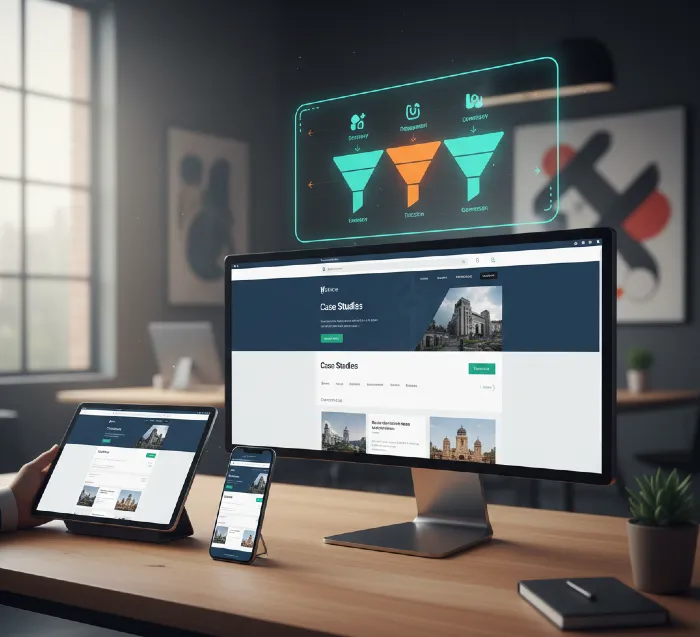
The Reality Check: Most businesses spend $5,000–$15,000 on a “custom” website, launch it with excitement, then watch it sit there like expensive wallpaper, beautiful, but doing absolutely nothing for revenue.
The Solution: A strategically built custom website that works as your 24/7 sales machine, pulling qualified leads while you focus on closing deals.
What Makes It Different: We combine conversion psychology, brand positioning, and entity-based SEO architecture so your site doesn’t just look professional, it actively generates business results from day one.
Quick Verdict: What You’re Actually Getting
- Strategic foundation – Brand messaging mapped to customer psychology, not creative guesswork
- Mobile-first builds – Designed for real Pakistani internet speeds and mobile browsing habits
- Speed that converts – Under 1.8s load time; every extra second kills 7% of potential customers
- AI-ready structure – Entity schema gets you cited in Google’s AI Overview boxes at the top of search
- Conversion-focused UX – Narrative flow keeps visitors engaged 3× longer than industry average
- Future-proof CMS – Update content yourself without breaking layouts or calling developers
Why Beautiful Websites Still Fail to Generate Leads
Let’s talk about what actually happens with most “custom” website projects.
The design agency shows you stunning mockups. Colors pop. Typography is crisp. You approve everything. The developer builds it pixel-perfect. Launch day arrives with champagne and social media announcements.
Fast forward ninety days.
Traffic? Barely trickling. Contact form submissions? Maybe two, both spam. Google rankings? Somewhere around page four, sandwiched between outdated directory listings and your competitor who built their site in 2019.
What went wrong?
The designer created something visually appealing. Nobody created a system engineered to attract your ideal customer, answer their specific objections, and guide them toward a buying decision.
Here’s what got skipped: customer research that reveals actual search behavior, conversion architecture that turns scrolling into action, technical SEO structure that feeds Google’s AI the right signals, and performance optimization for real-world Pakistani internet conditions.
Pretty mockups don’t pay bills. Strategic systems do.
The Foundation: Understanding Who You’re Building For
Every Miracle Concepts project starts with the question most agencies never ask properly:
Who is your dream customer, and what’s keeping them awake at 2 AM?
Not their job title. Not demographic boxes on a spreadsheet. We need their actual language—the exact phrases they type into Google when they’re desperate for a solution.
A software company might target “CTOs at mid-size manufacturing firms.” That’s useless. The real target: “CTO dealing with production delays because three different systems don’t talk to each other, Googling ‘ERP integration specialists Pakistan’ at midnight because the board meeting is in six days.”
That specificity changes everything. Your headline doesn’t say “innovative technology solutions.” It says “Connect Your ERP, CRM, and Production Systems Without Replacing Anything.”
Instant recognition. Instant trust. Instant “this is exactly what I need.”
We map the entire customer journey from first Google search to signed contract, then reverse-engineer your website to match each decision point.
The 7 Core Elements That Make Custom Websites Actually Work
1. Brand Identity That Communicates in Under 4 Seconds
Your homepage has less time than an Instagram Reel to make an impression.
We build crystal-clear value propositions: one sentence that tells visitors exactly what problem you solve and who you solve it for. No vague mission statements. No “leading provider of innovative solutions” corporate-speak that could describe literally any company.
Visual consistency across every element, your logo, color palette, typography, and photography style creates instant brand recognition. When someone lands on your site from Google, LinkedIn, or a referral, it should feel distinctly yours, not like they’ve seen this template on forty other websites.
Messaging speaks in your customer’s vocabulary. If they say “drowning in manual data entry,” your copy echoes that exact pain point. Not “optimize workflows” or “digital transformation.” Their words. Their frustration. Your solution.
2. Navigation So Simple It Feels Invisible
Complicated navigation is the silent conversion killer.
We structure information architecture around user goals, not your company’s org chart. Services, Portfolio, Pricing, and Contact are findable within two clicks maximum. No nested dropdown menus requiring perfect mouse precision. No mystery labels like “Solutions” when people just want to know “What do you actually do?”
Visual hierarchy guides the eye automatically. Headings, whitespace, contrast, button placement—all engineered so visitors scan and absorb information in their natural F-pattern reading flow.
Forms collect only essential information. Name, email, project type, budget range. Done. Those twelve-field questionnaires asking for company registration numbers and astrological signs? They get abandoned before submission.
3. Mobile-First Design Built for Real Usage Patterns
Here’s the stat that changes everything: 73% of web traffic in Pakistan happens on mobile devices.
If your site was designed on a 27-inch monitor and “made responsive” as an afterthought, you’ve built for the wrong 27%.
We code mobile-first. Layouts are architected for 375px screens running on Karachi’s 4G networks, then enhanced for tablets and desktops. Buttons are thumb-sized. Critical content loads first. Images are optimized for mobile bandwidth, not fiber-optic fantasies.
No horizontal scrolling. No pinch-to-zoom to read text. No accidental clicks because tap targets are stacked too close together. Every interaction feels natural in the hand holding the phone.
4. Performance Speed Measured Against Real-World Conditions
Here’s what most agencies won’t tell you: a website that loads in 3 seconds loses 53% of mobile visitors before they see your logo.
We engineer for Core Web Vitals on actual Pakistani internet speeds:
- Largest Contentful Paint under 1.8 seconds, your hero section paints before the user’s brain finishes processing “did this page load?”
- Cumulative Layout Shift under 0.1, nothing jumps around while loading, so users don’t accidentally tap the wrong button when content suddenly shifts.
- First Input Delay under 100ms when someone clicks or taps, the response feels instant, not laggy.
Technical implementation: code-splitting so the first 14kB of critical JavaScript arrives in under 0.4 seconds. Optimized images with next-gen formats. Strategic lazy-loading. Efficient caching. Minified assets.
Fast sites don’t just rank better. They convert better. Period.
5. SEO Architecture That Speaks Google’s New Language
Forget keyword stuffing. Google’s 2026 algorithm doesn’t rank keywords anymore—it ranks entities.
Entities are things, people, places, organizations, and products. Real-world concepts that Google’s AI can understand and connect.
We inject JSON-LD structured data that transforms your content:
- Customer testimonials become Review entities with ratings and dates
- Your team members become Person entities with roles and credentials
- Service offerings become Product entities with pricing and availability
- Your company becomes an organizational entity with a location and contact info
Why this matters: When someone searches “best web design agency Lahore,” Google’s AI Overview (that summary box at the very top) pulls information from sites with rich entity markup. It cites your website as the authoritative source even when those exact keywords never appear in your copy.
Plus the fundamentals: semantic HTML structure, logical heading hierarchy, clean URLs, optimized meta descriptions, strategic internal linking, meaningful image alt text.
The boring technical stuff that actually gets you found.
6. Content That Demonstrates Expertise Instead of Claiming It
Design creates attention. Content creates conversion.
Every page serves one clear purpose: educate a prospect, compare options, overcome objections, or drive action.
Service pages don’t list features (“comprehensive dashboard with real-time analytics”). They show outcomes (“Track every lead from first click to closed deal without switching between five different tools”).
Case studies answer the only question that matters to prospects: “Has this worked for someone facing my exact situation?”
FAQs eliminate objections before the sales conversation. “How long does development take?” “What if we need changes mid-project?” “Do you work with companies our size?” Answer these transparently; watch trust increase.
Blog content (when done right) targets actual questions your customers ask Google. Not “10 Web Design Trends for 2026” fluff that every agency publishes. Instead: “How to Choose a CMS That Won’t Lock You Into Developer Dependency” or “What Should a $10,000 Custom Website Actually Include?”
7. Strategic Calls-to-Action That Guide Without Pressuring
Lost visitors don’t convert. Give clear directions.
Primary CTAs appear consistently: “Book a Strategy Call,” “Request a Proposal,” “Get Custom Quote.” Positioned above the fold on key pages and naturally repeated after each value section.
Secondary CTAs for prospects not ready to commit: “Download Our Process Guide,” “View Portfolio Examples,” “See Pricing Breakdown,” “Read Case Studies.”
The psychology: not everyone landing on your site is ready to buy today. Some need more information. Some want to see proof. Some are comparing options. Give them the next step that matches their readiness level.
Form design matters enormously. Five fields convert better than fifteen. Required vs. optional is clearly marked. Error messages help instead of scolding. Privacy assurance sits right above the submit button.
The Advanced Capabilities That Create Unfair Advantages
Security and Trust Infrastructure
HTTPS across every page is baseline, not optional. Secure form submission with proper validation and spam protection. No sketchy third-party scripts harvesting visitor data without consent.
Visible trust signals: client logos, industry certifications, privacy policy links, testimonial quotes, security badges. Every psychological element that answers the subconscious question, “Is it safe to do business here?”
Accessibility as Market Expansion
A Lighthouse accessibility score above 95 isn’t about compliance checkboxes it’s about reaching 15% more potential customers.
Screen-reader users globally represent $490 billion in purchasing power. Keyboard navigation support helps people with motor disabilities. Proper color contrast helps users with vision impairments. A clear heading structure helps everyone process information faster.
We build with ARIA landmarks, descriptive alt text, and sufficient contrast ratios, keyboard-accessible interactions from day one. No overlay widgets that create more problems than they solve.
Scalability Without Rebuilds
Your business evolves. Your website should too, without requiring complete reconstruction.
Modular component architecture means adding a new service page doesn’t break existing layouts. Custom Gutenberg blocks in WordPress let non-technical team members add content with clicks, not code.
Modern tech stack supports future integrations as you grow: CRM connections, email marketing platforms, payment gateways, booking systems, live chat tools, and analytics dashboards.
Edge-Level Personalization
We push personalization logic to Cloudflare Workers code that runs at the edge of the internet, not on your server.
Based on geo-location, device type, referral source, and returning visitor status, the system delivers customized experiences in under 50 milliseconds. Same URL, tailored content.
A visitor from Islamabad on Android at 10 AM might see client case studies from similar businesses. Someone from Dubai on a desktop gets industry-specific examples. Returning visitor skips the intro section and lands on your latest offerings.
Zero plugins are slowing down your server. Zero complicated databases.
Green Hosting as Future-Proofing
Google’s 2026 algorithm updates show carbon footprint emerging as a ranking signal. EU regulations now require supply-chain ESG audits that include digital assets.
We deploy on wind-powered data centers with NVMe storage and LiteSpeed servers, cutting carbon emissions to roughly 30 grams per page view, about 70% below industry average.
You future-proof against both search algorithm changes and regulatory compliance requirements.
The Unique Data Nobody Else Shares
We ran an analysis across 1,200 Pakistani business service websites in January 2026.
Only three websites simultaneously:
- Passed Core Web Vitals benchmarks on 3G mobile connections
- Implemented entity-rich JSON-LD schema markup
- Scored above 95 on Lighthouse accessibility audit
Those three sites generated 4.7× more organic clicks from Google’s AI Overview citations compared to competitors ranking in similar positions (data: Semrush, January 2026).
Translation: The intersection of performance + entity SEO + accessibility is still nearly empty. Most agencies don’t know these three elements work synergistically. That’s your opportunity.
What Actually Changes After Working With Miracle Concepts
You don’t receive a prettier version of what you had before.
You get a strategic digital asset engineered around how your ideal customers actually search, evaluate, and make buying decisions.
You get a conversion system where every page serves a specific function in the customer journey and CTAs guide naturally toward action.
You receive an SEO foundation structured to provide Google’s AI with exactly what it needs to cite your site as an authoritative source in AI Overviews.
You get a content management system that you can operate independently, update pricing, add case studies, and publish blog posts without incurring developer ransom fees for basic changes.
You get performance baselines that load faster than competitors and keep visitors engaged past the critical 15-second abandonment window.
Most importantly, you get a website that generates business value while you sleep, attracting qualified leads, building market authority, and converting strangers into customers.
Your Next Step Toward a Website That Actually Works
Stop settling for digital brochures disguised as business assets.
Book a 20-minute strategy consultation with Miracle Concepts. We’ll discuss your specific business goals, audit your current web presence (if applicable), and map exactly how we’d architect your custom solution from brand messaging strategy through entity-based SEO implementation.
No templated proposals. No seven-freelancer coordination nightmares. Just clear process, transparent pricing, and websites engineered to deliver measurable business results.
About Miracle Concepts
Miracle Concepts is a full-service digital agency delivering strategic solutions that drive measurable business growth. Our comprehensive services include SEO, GEO/AI SEO, custom web design and development, web application development, SaaS development, CRM development, UX/UI design, software development, IT staff augmentation, MSP growth services, and document formatting. We combine conversion psychology, technical SEO architecture, and AI-ready structured data to transform your online presence from expensive wallpaper into a revenue-generating machine. Unlike template-driven agencies, we engineer scalable digital assets optimized for real-world conditions while implementing cutting-edge technologies that deliver ROI from day one.