

Ask yourself this: What is the true value of ranking #1 when the answer is already on the screen? Search Generative Experience (SGE)
The brutal truth is that after decades of optimizing for the coveted top organic spot, Google has, in effect, moved the goalposts to a field you don’t own. The Search Generative Experience (SGE), now rolling out to a billion users worldwide as AI Overviews, isn’t just another rich snippet. It’s a hostile takeover of the SERP’s informational real estate, and it’s time to stop treating it like a temporary beta feature.
If your SEO strategy still revolves solely around hitting the first position, you’re hemorrhaging traffic you just don’t know it yet.
The $1,600 Pixel Drop: Why SGE Changes Everything
For years, we traded in short or long tail keywords and links. We measured success in $100 organic positions and $10,000 traffic gains. Today, the conversation is about pixels and diminishing returns.
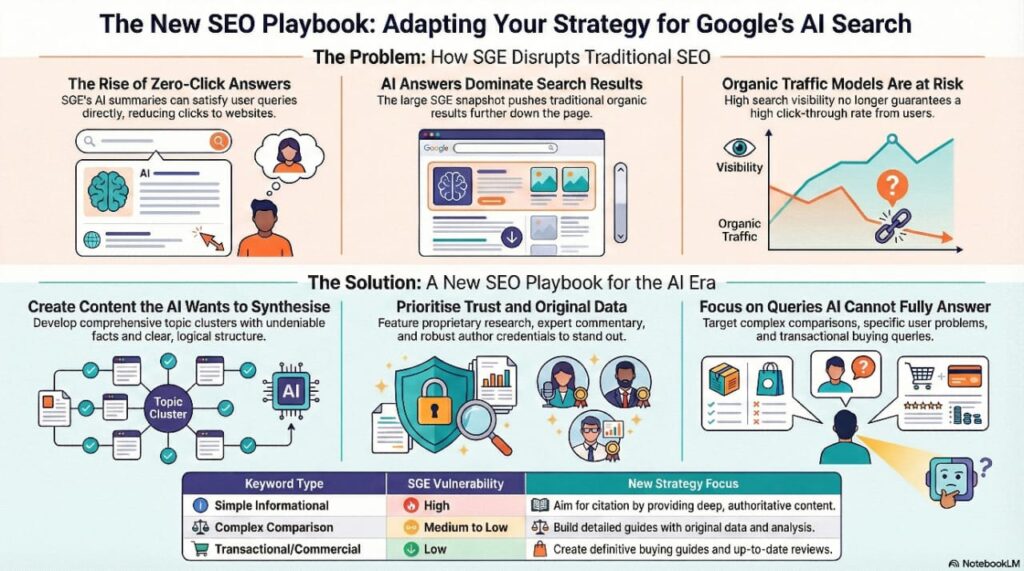
The average expanded AI Overview pushes the traditional organic #1 link down by roughly 1,600 pixels. That’s 1.5 screen heights on a desktop. On mobile, it’s even worse. If your link is below the fold on a conversational query, it simply doesn’t exist for the average user.
This isn’t theory. The data we’ve tracked across high-intent, informational queries is stark and benefit for voice search:
- CTR Collapse: Studies show a traffic reduction in traditional organic results ranging from 30% to over 50% when an AI Overview is present. Users are getting their answers instantly.
- The 93% Problem: This is the metric that should terrify every old-school SEO: Research indicates that roughly 93% of the source links cited within an AI Overview are not from the existing top 10 organic results.
Let that sink in. Google’s AI is deliberately pulling from sources outside the traditional ranking hierarchy. The algorithm is prioritizing content that is clear, well-structured, and genuinely expert—often ignoring the established “authority” signals we spent decades building. It’s a validation of utility over link equity, and that shift requires a complete re-engineering of your content machine.
The Generative Engine Optimization (GEO) Mandate
Forget “SEO.” We are operating under the rules of Generative Engine Optimization (GEO). This new mandate acknowledges that Google’s primary product is no longer a list of links; it’s a synthetic answer. Your job is now to become the single, most undeniable source that the AI must include in its answer.
In my experience testing these tools, the systems reward clarity and completeness. They punish fluff and ambiguity. If your content is vague, hidden behind massive introductory paragraphs, or lacks genuine depth, the AI will simply source its answer from a cleaner, better-structured competitor.
Here’s the three-pillar strategy for winning in the age of Search Generative Experience:
1. E-E-A-T is Now the Survival Kit
For too long, E-A-T (Expertise, Authoritativeness, Trustworthiness) was a nebulous concept, mostly applied to YMYL (Your Money or Your Life) queries like health and finance. With SGE, E-E-A-T—now including Experience—is the baseline for all high-value content.
Why? Because the AI has been burned. It has a history of generating garbage (remember the glue-on-pizza saga?). Google’s response has been to double down on verifying who wrote the content and why they are qualified.
What SGE Rewards:
- First-Hand Experience: Use phrases that demonstrate you’ve actually done the thing you’re writing about. Instead of “A person should consider,” write: “I noticed that when implementing this feature, step three always broke on the latest Python build.”
- Clear Author Schema: Ensure every piece of content clearly attributes a qualified author. Use Article schema, and link the author profile to professional profiles (LinkedIn, etc.).
- Cited Credentials: If you are citing data, link directly to the study, not just another blog post. The AI traces sources, and shallow linking is a massive red flag for a lack of genuine research.
2. The Intent-First Content Strategy (Target the Mid-Funnel)
Top-of-funnel (TOFU) content—the “What is X” keywords—are now nearly 100% owned by the AI Overview. If the user only needs a definition, they won’t click. This traffic is gone.
The new battleground is the middle and bottom of the funnel, where human judgment, comparison, and transactional intent take over.
| Funnel Stage | Old Strategy (Dead) | New Strategy (Alive) |
| Top (Informational) | “What is Bitcoin Mining?” | Targeted Failure: Create content so deep and complex that the AI cannot summarize it in a single paragraph. Focus on analogy and opinion. |
| Middle (Commercial/Comparison) | “Best CRM Software” | Transactional Clarity: Create comparison tables, pricing matrices, and detailed Pros/Cons. AI struggles with opinionated, up-to-the-minute feature data. |
| Bottom (Transactional) | “Buy Acme Widget 5.0” | Hyper-Specific Q&A: Optimize for long-tail questions that involve troubleshooting, integration, or unique use cases that lead directly to a product or service. |
I noticed that queries demanding nuance—like “How does a B2B SaaS sales funnel differ in 2025 vs. 2020?”—still reliably drive clicks, because the AI cannot synthesize a definitive, subjective answer. It is forced to recommend sources. That’s your window.
3. Engineering for the AI Scraper (Structure is King)
The AI doesn’t read your flowery introductions. It scrapes for patterns, headings, and data elements. Your content needs to be engineered like a well-commented piece of code—clean, labeled, and easy to parse.
Tactical Implementation:
- Direct Answers First: The first paragraph below an H2 or H3 must answer the question posed in the heading, concisely. Follow the format: “The key to X is Y.” Use bold immediately for the core takeaway.
- Bullet Point Mania: Break down complex information. AI loves lists. Use them liberally. This increases mobile retention and ad viewability.
- Use FAQ/How-To Schema: Implement specific schema markup on every piece of eligible content. This helps the AI immediately identify question/answer pairs, making your content the perfect component for an Overview.
- Create Contextual Data Boxes: Incorporate custom CSS boxes or tables that visually set aside key statistics or takeaways. This segregation helps the AI extract discrete chunks of information.
If you don’t structure your content to be consumed by a machine, you won’t be seen by the human. It’s that simple.
Editor’s Analysis: The Long Tail of Trust
The initial panic over SGE was understandable. We saw the traffic bombs land. But panic is for amateurs. The seasoned operator sees this as a necessary, if painful, market correction.
SGE is not the death of SEO; it is the end of cheap content.
For years, we tolerated mass-produced, 1,200-word articles that were essentially five different Google search results regurgitated. That thin, uninspired content is what SGE is designed to eliminate. The AI scrapes it, synthesizes the one useful sentence, and discards the source.
The true currency in the Search Generative Experience era is trust.
- We must stop writing for the generalist keyword and start writing for the person who needs a surgical, technical answer.
- We need to focus on building vertical authority so deep that the AI has no choice but to cite you, even if your site is smaller than a major publication. The niche is the new #1 ranking factor.
- I suspect the biggest challenge ahead won’t be recovering lost traffic, but convincing clients and internal stakeholders to shift their content budget away from high-volume, low-intent queries toward low-volume, high-value, high-E-E-A-T production. That is a difficult conversation, but the alternative is watching your organic channel wither on the vine.
The future belongs to the site that answers the obscure question better than anyone else and proves, unequivocally, that they know what they’re talking about.
FAQs
Q: Will AI Overviews completely eliminate the need for websites?
A: No. AI Overviews satisfy informational needs, but they cannot satisfy transactional needs. They can tell you the steps for wiring a server, but they cannot wire the server or sell you the specific cables. Websites remain essential for commerce, community building, proprietary tools, and high-value conversion points.
Q: How quickly should I expect to lose organic traffic after SGE rolls out in my region?
A: The impact varies dramatically by niche and content type. Content heavily focused on dictionary definitions, basic history, or simple “how-to” steps (e.g., “how to boil an egg”) will see the fastest and most severe traffic drops, often 30% or more within weeks. Middle and bottom-funnel content (product reviews, complex technical troubleshooting) is more resilient.
Q: Is it possible to rank in both the traditional organic results and the SGE AI Overview?
A: Yes, but it’s rare. Early studies show that only about 4.5% of URLs cited in the AI Overview are also the #1 organic result. The system often favors links from authoritative but lesser-known pages deeper in a large site, or niche sites with high topical authority, even if they historically ranked lower. Focusing on generating a citation in the SGE snapshot is often a more viable strategy than fighting for the old #1 spot.
Q: Does structured data (Schema Markup) guarantee inclusion in SGE?
A: Absolutely not. Structured data is an interpreter for the AI; it helps Google understand what your content is (a recipe, an FAQ, a product). It does not validate your content’s quality or trustworthiness. If your content is thin, schema won’t save you. However, high-quality, E-E-A-T-compliant content with proper schema has the highest probability of citation in a generative summary.